Top 10 Indian open source projects that are giving US big tech a tough time
Ten open source AI projects from Indian developers, each lined up against the big tech product it takes on. Laya vs Jev, Munder Difflin vs Muse and Grok Bot.
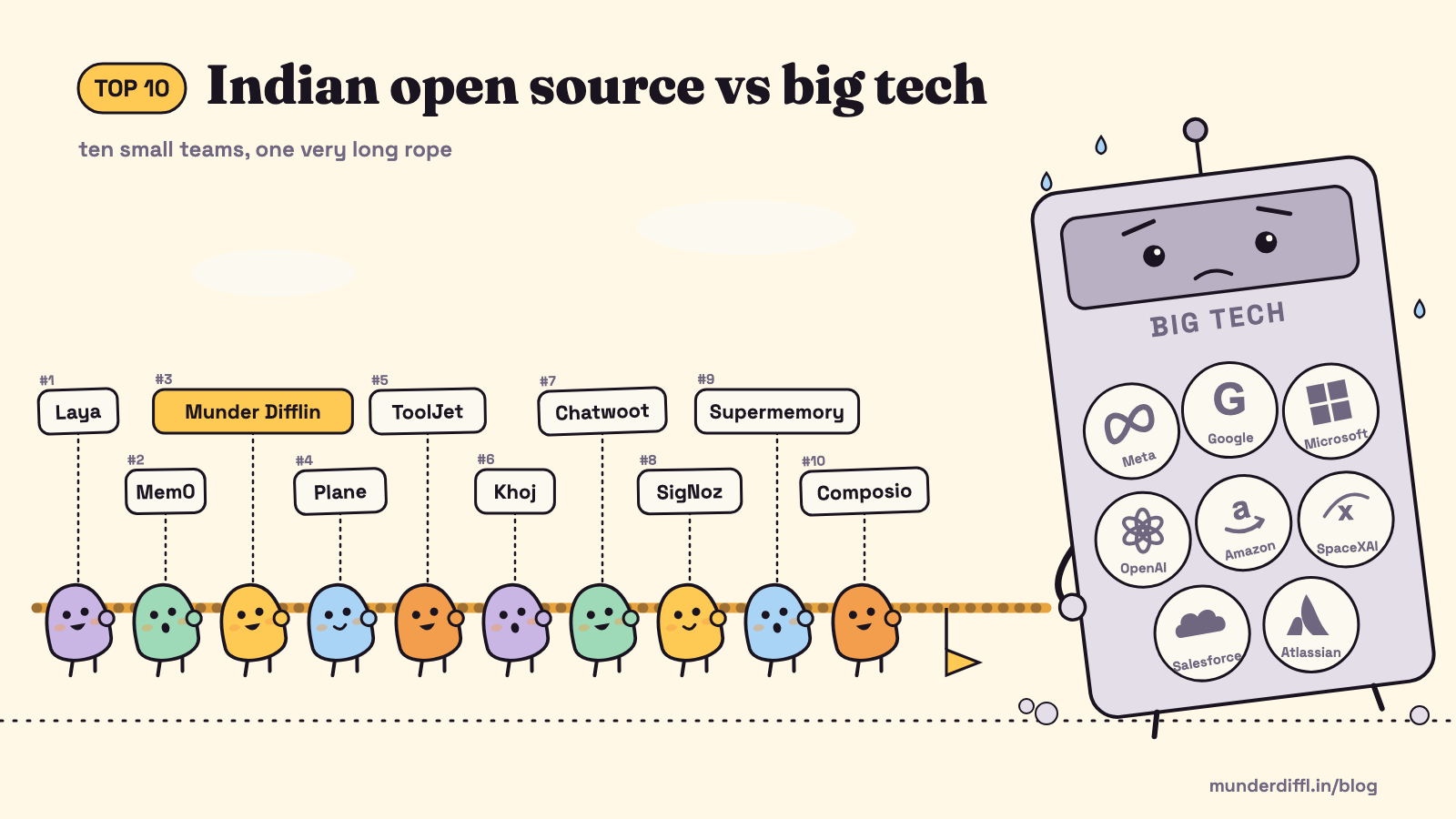
Big tech ships an AI product, charges $20 to $120 a month for it, and a few weeks later someone in Kerala or Bengaluru puts a free version on GitHub. Here are ten Indian open source AI projects doing exactly that, each one next to the big tech product it is up against.
Full disclosure: number three is ours. We made the list, so we put ourselves on it. We did put ourselves third and not first, which we think shows admirable restraint.
How we picked: the project is open source on GitHub, AI sits at the core of it, it was started by Indian founders or developers, and there is a clear big tech product on the other side of the ring. Star counts come from the GitHub API on 25 September 2026. Stars measure attention, not quality, so treat them as a rough signal.
1. Laya vs TypeSafe’s Jev
Open decision model vs hosted decision model
- 22.7k stars
 Nandakishor M
- Kasaragod, Kerala
- Apache 2.0
Jev went viral this month. It comes from TypeSafe AI, a startup brought out of stealth by a former OpenAI researcher, and its pitch is “decisions, not strings”: you ask a typed question, it answers with a choice, a score or a yes or no probability, and it never writes a paragraph you did not ask for. You reach it through TypeSafe’s hosted API.
Convai Innovations, a small team in Kasaragod, Kerala, answered with Laya. It is a 421 million parameter model under the Apache 2.0 license, with weights on Hugging Face, and it ships a self hosted server that speaks the same wire protocol as Jev’s API. There is a multilingual version for 100+ languages, and the project site quotes 33 millisecond answers. The community has already ported it to Apple’s MLX, to Node.js and into a plain browser tab.
2. Mem0 vs OpenAI’s ChatGPT memory and Amazon’s AgentCore Memory
Memory for any agent vs memory for one company's agent
- 65.9k stars
 Taranjeet Singh
 Deshraj Yadav
- Y Combinator
ChatGPT remembers you, but only inside ChatGPT. Amazon sells agent memory, but inside AWS. Mem0 is a drop in memory layer that works with whatever model and agent you already use.
Taranjeet Singh started out as an engineer at Paytm, and Deshraj Yadav led the AI platform for Tesla Autopilot. They built an open source ML platform, EvalAI, together before this. Mem0 has raised $24 million from Y Combinator, Peak XV and Basis Set, and it is the most starred project on this list.
3. Munder Difflin vs Meta’s Muse and SpaceXAI’s Grok Bot
An office of agents on your laptop vs a subscription in someone else's cloud
- 7.9k stars
 Chaitanya Giri
- Free and open source
- macOS, Windows, Linux
Meta launched Muse on 8 September with a free tier plus $20 and $100 monthly plans, and it launched for US users first. SpaceXAI’s Grok Bot gives you always on agent teammates for $120 a month and passed 400,000 weekly users in its first month. People clearly want AI coworkers.
Munder Difflin gives you a whole office of them, running on your own computer. You bring the AI engine you already have, like a Claude Code or Codex subscription, and the agents get desks, an inbox, a shared task board and a memory that survives the weekend. It is free and open source.
4. Plane vs Atlassian’s Jira
Open project planning with AI built in vs the incumbent
- 59.8k stars
 Vamsi Kurama
 Vihar Kurama
- Hyderabad
Plane calls itself the open source alternative to Jira, Linear, Monday and ClickUp, and nearly 60,000 GitHub stars suggest a lot of people were waiting for one. Brothers Vamsi and Vihar Kurama started it in Hyderabad in late 2022. Plane AI now sits inside the product, alongside projects and a wiki, and you can self host the lot.
5. ToolJet vs Microsoft Power Apps
Build internal apps with AI vs build them inside Microsoft's walls
- 41.0k stars
 Navaneeth Padanna Kalathil
- Self hostable
ToolJet builds internal tools, dashboards, business apps and AI agents, and describes itself as an enterprise app generation platform. Founder Navaneeth Padanna Kalathil had already sold an earlier startup to Freshworks. The best detail: ToolJet has raised money from M12, Microsoft’s own venture fund. So Microsoft is, in a small way, paying for its competition. We love that for everyone.
6. Khoj vs Google’s Gemini Deep Research
Your own research assistant vs Google's
- 37.5k stars
 Debanjum Singh Solanky
 Saba Imran
- Self hostable
Khoj is Hindi for “search”, which is a pretty good summary. Khoj is an AI second brain that does deep research across the web and your own notes and PDFs, schedules automations, and works with any online or local model. Its founders, Debanjum Singh Solanky and Saba Imran, both worked on Cortana at Microsoft before leaving to build the open version.
7. Chatwoot vs Salesforce’s Agentforce
Open support desk with an AI agent vs the enterprise suite
- 37.2k stars
 Pranav Raj S
 Sojan Jose
 Nithin David Thomas
- Kerala roots
Chatwoot is an open source support desk for live chat, email, WhatsApp and more, and it lists Intercom, Zendesk and Salesforce Service Cloud as the things it replaces. Its AI agent, Captain, answers common questions and suggests replies to human agents. It was founded in 2017 by Pranav Raj S, Sojan Jose and Nithin David Thomas. Pranav studied at the College of Engineering, Trivandrum, and Sojan built product at Freshworks before this.
8. SigNoz vs Datadog
Open observability vs the famous bill
- 32.2k stars
 Pranay Prateek
 Ankit Nayan
- Bengaluru
TechCrunch literally called SigNoz the “open source Datadog rival”. It gives your team, and now your AI agents, logs, metrics and traces in one tool, built on OpenTelemetry, which you can run yourself. Pranay Prateek (IIT Madras, IIM Ahmedabad) and Ankit Nayan (IIT Delhi) started it in Bengaluru in 2020. If you have ever opened an observability invoice and sat very still for a minute, you already get the appeal.
9. Supermemory vs Google’s NotebookLM
A memory engine you can run locally vs Google's notebook
- 30.9k stars
 Dhravya Shah
- From Mumbai
Supermemory is a memory and context engine with an app on top for your links, notes and files, plus a memory API developers can build on. It can run fully on your own machine. Dhravya Shah grew up in Mumbai, skipped the IIT entrance exam, and built the first version during a challenge to ship something new every week for 40 weeks. He raised his seed round at 19. One of his angel investors is Jeff Dean, Google’s AI chief. Google, again, funding the other side.
10. Composio vs OpenAI’s connectors
1000+ tools for any agent vs tools for one assistant
- 30.3k stars
 Soham Ganatra
 Karan Vaidya
- IIT Bombay grads
An agent that cannot touch your apps is just a chatbot with ambition. Composio gives agents 1000+ toolkits with login and permissions handled, so they can act inside GitHub, HubSpot and the rest, with any model and any framework. Soham Ganatra and Karan Vaidya were physics Olympiad teammates in 2013, went through IIT Bombay together, and started Composio in 2023.
What this list is not
It is not a ranking of quality. It is not a claim that any of these projects has beaten the company it is lined up against. Some of those companies are worth a trillion dollars and will be fine. The point is simpler: in almost every corner of AI, there is now an open source option started by an Indian team, and plenty of developers are choosing it.
A few of these companies now have a US office or headquarters. We counted a project if Indian founders or developers started it.
Missed one? We almost certainly did. Tell us on GitHub and we will look at it for the next list.
FAQ
Which Indian open source AI project has the most GitHub stars?
Of the ten on this list, Mem0 had the most on 25 September 2026, at about 65.9k stars. Plane was next at about 59.8k.
What is Laya?
Laya is an open weight decision model from Convai Innovations in Kasaragod, Kerala. It answers typed questions with a choice, a score or a yes or no probability instead of generating text, and it can serve the same API as TypeSafe's hosted Jev model. It is released under Apache 2.0.
Is Munder Difflin free?
Yes. Munder Difflin is free and open source. It runs an office of AI agents on your own computer using an AI engine you already have, such as a Claude Code or Codex subscription.
How were these projects picked?
Open source on GitHub, AI at the core of the product, started by Indian founders or developers, and a clear big tech product on the other side. Star counts come from the GitHub API on 25 September 2026.