Agent Tools Today, 2 Nov 2026: ChatGPT and Codex Shared Limits, Memdoor, T3 Code
The top launches, skills, multi agent moves, rising repos and arguments in AI agents from 1 to 2 Nov 2026, each with its source and date.
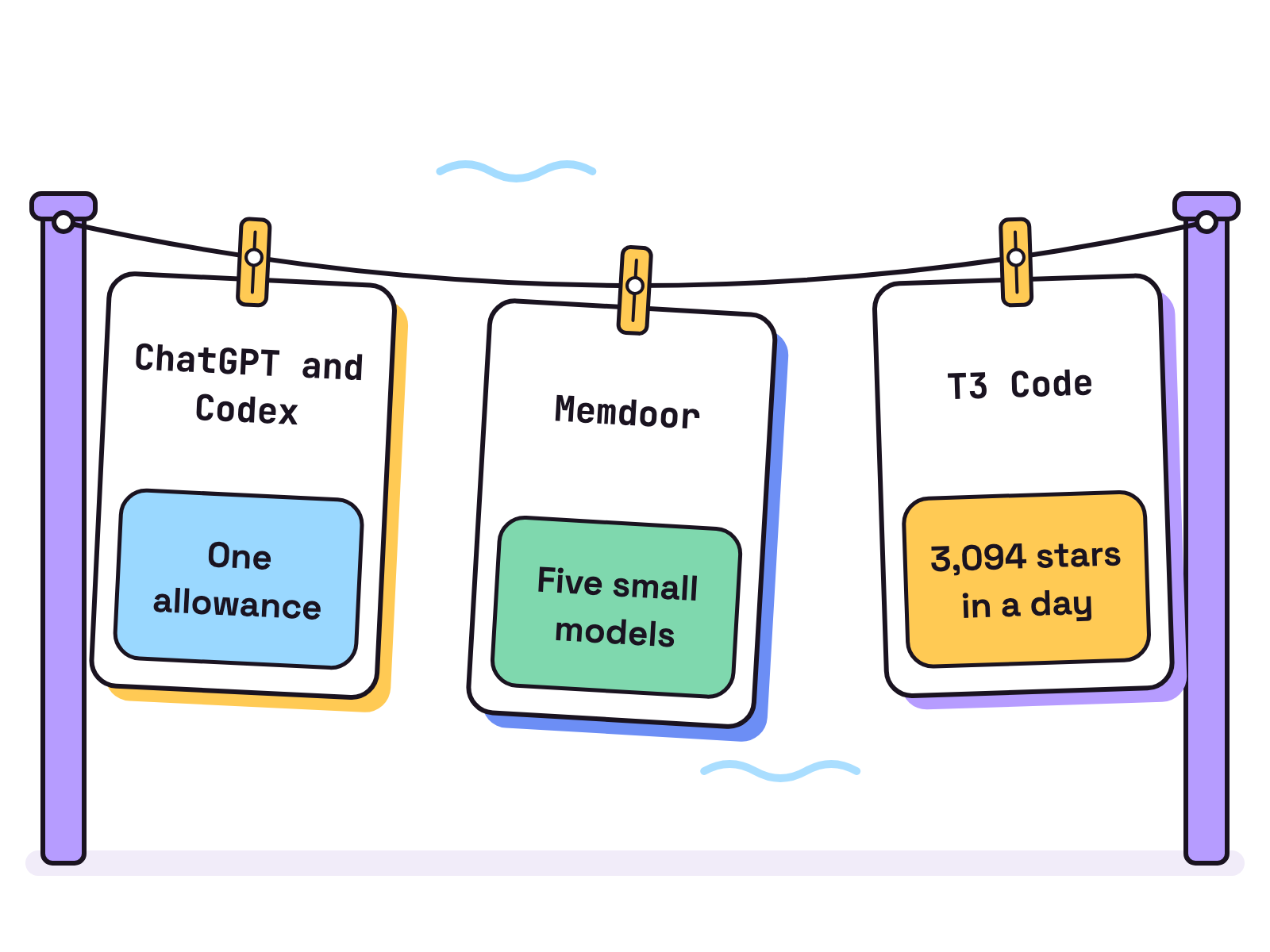
Agent tools today, 2 Nov 2026, in one line: OpenAI told subscribers, by BleepingComputer’s account, that ChatGPT and Codex will draw from one allowance, Memdoor showed five small models matching a published harness, and T3 Code took 3,094 GitHub stars in a day. It covers 1 to 2 Nov, checked 2 Nov. An earlier edition is 31 Oct.
Munder Difflin is free and open source: a desktop app that runs a team of AI agents for all kinds of knowledge work, coding included, on your own computer. It is not ranked in the lists below.
Check this first
Trigger.dev security incident. Trigger.dev’s CTO wrote on 1 Nov that it found exposure “across a subset of organizations”: “The attacker gained unauthorized access to environment variables for these organizations.” The company says it has blocked the exploit and “emailed all impacted account owners with steps to mitigate”. The post does not say how many organizations were affected or what the exploit was, and it promises updates on the status page. See security for AI coding agents. Source
Top 3 launches
- Memdoor team-solve. Its README describes “Five small models on one programming problem”, talking only through files on disk; the run used Qwen3.8-27B. On the first ten problems of a LiveCodeBench Hard list, over five passes, its README gives a mean of 9.8 of 10, against 9.6 for the original authors’ harness and 8.0 for Fable 5. The Hacker News title says “beats”. The README says “9.8 and 9.6 are within noise. The claim is parity with their harness.” It adds that the Fable 5 column is “one call per problem, from the authors’ files”, and that the contests “date from spring 2025; the model may have seen them”. Apache 2.0, more than 430 points on Hacker News on 2 Nov. Source
- dsh-superagent. DeepSeek published a “proactive coding agent for one GitHub repository”, packaged as a bundle for DeepSeek Harness. Its aim: “take as little human attention as possible, and give as much value as possible.” The README also says “Research prototype for reference only, not an official DeepSeek product.” MIT, created 31 Oct, more than 9,000 stars on 2 Nov. Source
- Uncut. A small coding harness: “One 7 MB static binary, four tools, plain stdin/stdout.” It promises “No silent context cuts”: the README says the entire conversation is sent on every model call. MIT, created 1 Nov, version 0.1.1 published that day, more than 300 stars on 2 Nov. Source
Top 3 skills, MCP servers and plugins
- stack-diagram. A skill: “Describe your stack in a sentence. Get an architecture diagram with official logos.” MIT, created 1 Nov, version 0.2.0 published that day, more than 530 stars on 2 Nov. Source
- AI Manju Skills. Templates for AI comic dramas in 21 genres. Its Chinese README says each template is one
SKILL.mdfile with no dependencies (our translation). MIT, created 31 Oct, more than 240 stars on 2 Nov. Source - Claude Animated Shorts. It says “It makes 55-70 s vertical animated story shorts”, drawn with
three.jsinside Remotion. MIT, created 1 Nov, more than 210 stars on 2 Nov. Source
Top 3 moves from multi agent tools
- Orca 1.4.246. Published 2 Nov. Its notes lead with Orchestrator V3, then list pull requests, including “Warn before trusting non-official plugins; review access-growing updates one by one”, merge conflicts resolved “from the phone”, and “Show a card in the coordinator’s chat when it starts a worker”. Source
- Qwen Code 0.26.5. Published 1 Nov. It “Enables Generated UI by default” and adds “an experimental one-command Helm deployment for Managed Agent”. Source
- GitHub Copilot CLI 1.0.106-2. A pre release, published 1 Nov.
/resume <session-id>now brings a running background session to the foreground, and an HTTP MCP server that never answers holds startup for its timeout once, not three times. Source
Top 3 rising repos
- T3 Code. It calls itself an “agent harness control surface”. MIT, more than 38,000 stars, and 3,094 stars in a day on GitHub trending on 2 Nov, up from 930 on 31 Oct. Its 1 Nov nightly adds organization wide policies; the latest stable is 0.1.6. Source
- Claude Code Game Studios. “Turn a single Claude Code session into a full game development studio.” MIT, more than 32,000 stars, and 967 stars in a day on GitHub trending on 2 Nov. Its last push was 19 Oct. Source
- AiSOC. “Open-source AI Security Operations Center”, with alert fusion and agent triage, says its GitHub description. MIT, more than 6,300 stars, and 446 stars in a day on GitHub trending on 2 Nov. Source
Stars can rise for reasons other than use: names to watch, not picks.
Top 3 things people are arguing about
- Will ChatGPT and Codex draw from one allowance? BleepingComputer reported on 1 Nov that an OpenAI email says “Your use of ChatGPT and Codex will draw from the same allowance”, with Unlimited Instant left out, and that OpenAI doubled Work and Codex allowances on its Pro plans from 29 Oct. SmartScope, reading OpenAI’s help article, says this starts in December for Plus, Pro and Business. We could not open that article. OpenAI’s Codex pricing page, read 2 Nov, says “ChatGPT Work and Codex share usage” and gives no date. More than 220 points on Hacker News on 2 Nov. See Codex vs Claude Code usage limits. Source
- Does touching model training get a Claude account blocked? One user claims so, in a post relayed by FourWeekMBA, saying “anything touching RFT, SFT, or training larger models” now gets the account blocked. FourWeekMBA found no public Anthropic statement on the account as of 1 Nov. Anthropic’s Commercial Terms bar using the services “to build a competing product or service, including to train competing AI models”; nothing public ties that clause to this account. Another Hacker News user reports no refusals. More than 450 points on Hacker News on 2 Nov. Source
- Which JavaScript framework costs agents the least? Nolan Lawson built the same app five times per framework and took the median; Angular failed twice, so some of its metrics use three runs. “Most clearly, SvelteKit, Gracile+Lit, and Angular are more expensive to build than the other frameworks.” He warns that “everything I’m measuring is very stochastic”, and that “For Nuxt, the MCP was never used by the agents.” Published 28 Oct, more than 320 points on Hacker News on 2 Nov. Source
How this list is built
For this edition, covering 1 to 2 Nov, we read the GitHub releases of tracked tools, vendor blogs and changelogs, GitHub trending, and the Hacker News front page. We did not read X or Reddit for it; one argument above starts from a post on X, read only as FourWeekMBA relays it. A name only makes a list with a link that was opened and a signal that can be shown: points, stars or a dated release. Repos are checked against the GitHub API before they appear. New here? Start with the install guide.