Agent Tools Today, 30 Oct 2026: Mistral Large 4 Weights, Claude Code 2.1.314, Herdr App
The top launches, skills, multi agent moves, rising repos and arguments in AI agents from 29 to 30 Oct 2026, each with its source and date.

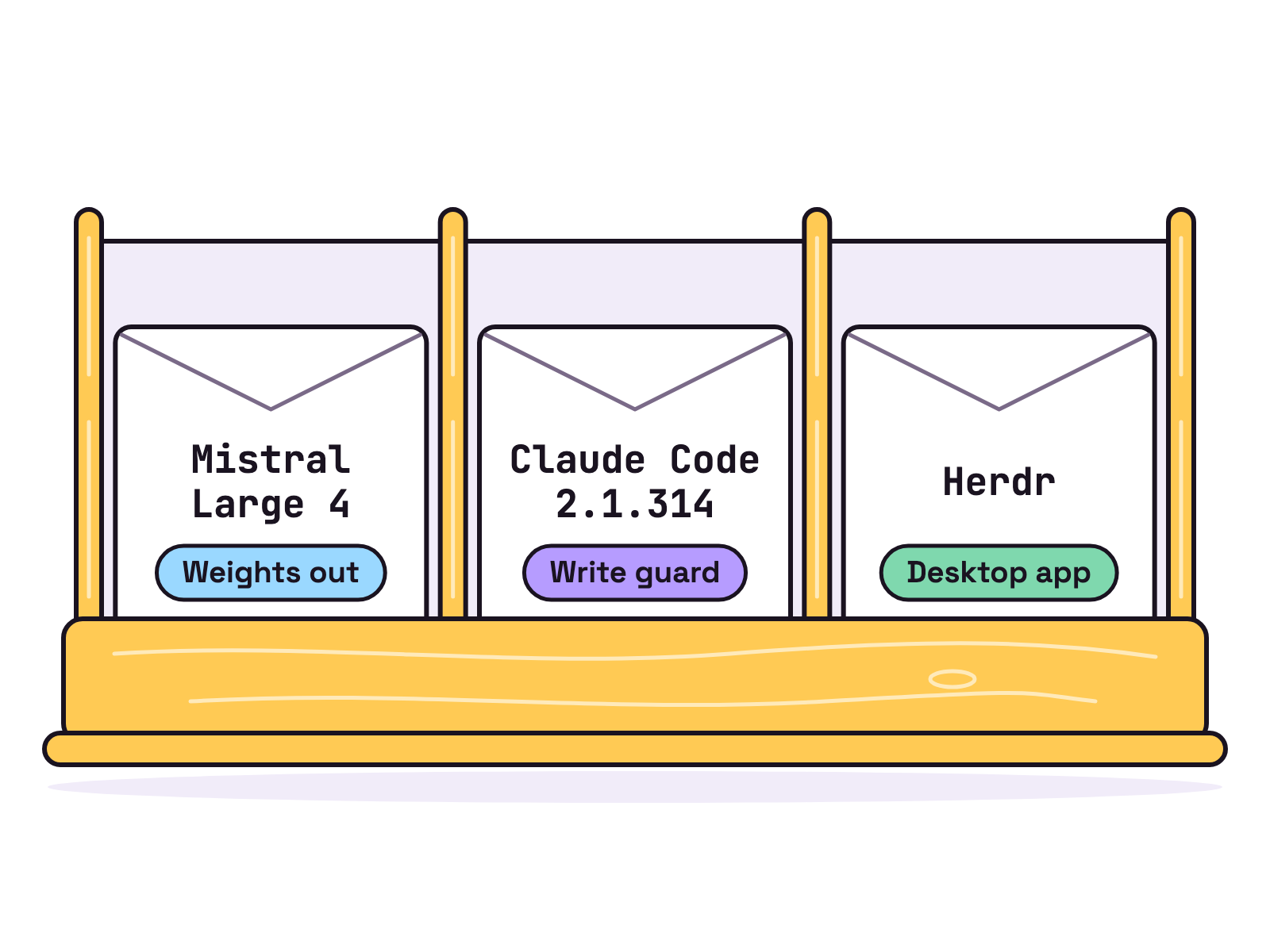
Agent tools today, 30 Oct 2026, in one line: Mistral released the weights of Mistral Large 4, Claude Code 2.1.314 can refuse every write outside your working folders, and Herdr shipped a desktop app for terminals and coding agents. It covers 29 to 30 Oct, checked 30 Oct. An earlier edition is 26 Oct.
Munder Difflin is free and open source: a desktop app that runs a team of AI agents for all kinds of knowledge work, coding included, on your own computer. It is not ranked in the lists below.
Top 3 launches
- Mistral Large 4 weights. On 29 Oct Mistral put the weights on Hugging Face under the Mistral Ecosystem Open-Weight license, which its post calls “a modified MIT license”. The post prices the API at $0.70 per million input tokens and $2.10 per million output tokens on 29 Oct 2026. More than 1,250 points on Hacker News on 30 Oct. Details in Mistral Large 4. Source
- Qwenputer. A stock Qwen 3.5 4B model with a RISC-V CPU compiled into its weights, using the model’s Gated DeltaNet layers as memory. Its write up says it runs arithmetic, C and MicroPython inside the forward pass “without any external runtime or tool usage”, and calls it “a pretty fun experimental model”. More than 680 points on Hacker News on 30 Oct. Source
- Herdr desktop app. Herdr now has “a desktop app for terminals and coding agents”: spaces for work, a status for each agent (working, blocked, done or idle), and terminals that keep running when you close the window. Builds for Linux, Apple Silicon Macs and Windows, Apache 2.0, more than 210 stars on 30 Oct. See Herdr alternatives. Source
Top 3 skills, MCP servers and plugins
- AI Design Skills. A collection of design skills for Claude Code, Cursor, Codex, Windsurf “and anything else that reads a markdown rules file”. The first,
landing-page-design, builds a landing page from intake questions to a full visual system. MIT, more than 12,000 stars, and 1,187 stars in a day on GitHub trending on 30 Oct. Source - MiniMax mcode-stack. “The workflows and skills the MiniMax Code team uses to build MiniMax Code”, each a
SKILL.mdskill or checklist, among them a check for whether work should go to a subagent and an audit of what tools cost in context. MIT, created 28 Oct, more than 420 stars on 30 Oct. Source - Grim Prompter. A threat modeling skill: point Claude Code, Codex or another coding agent at a repo and get a threat model traced to the code, from 36 architecture workflows and 29 method and analysis prompts. MIT, created 28 Oct, more than 160 stars on 30 Oct. Source
Top 3 moves from multi agent tools
- Claude Code 2.1.314. Published 30 Oct. A new
permissions.blockWritesOutsideWorkingDirectoriessetting makes Write, Edit and NotebookEdit refuse paths outside the working folders in every permission mode. VS Code and the Claude Desktop Code tab now summarize a 200K+ token conversation left idle, and sessions no longer fail turn after turn when an admin caps a model’s effort. See Claude Code alternatives. Source - Codex 0.166.0. Published 29 Oct. It adds keyboard driven transcript selection with search, GPT-6.1 Terra in the bundled, Vertex AI and Amazon Bedrock model catalogs,
codex queue --resume, andcodex doctor --network-onlyfor connection checks. Source - OpenCode 2.2.2. Published 29 Oct. Agents can now generate images by default when a connected provider has an image model, and clicking the current Git branch on the new session screen opens the worktree picker. See OpenCode alternatives. Source
Top 3 rising repos
- OpenMausBot. It calls itself “The open-source Grok Bot alternative: your own team of AI bots, in a chat app”, where each bot is Claude or Codex running locally with its own model and connected apps. Apache 2.0, more than 7,500 stars, and 1,199 stars in a day on GitHub trending on 30 Oct. See Grok Bot alternatives. Source
- ThinkRail. A JetBrains incubator IDE built around the
picoding agent, with work isolated in git worktrees, specs kept beside the code, and Agent Skills from other coding agents read in. Apache 2.0, more than 6,000 stars, and 1,117 stars in a day on GitHub trending on 30 Oct. Source - BLA. “Blind LLM Agents”, a defensive tool that hardens software you ship so an AI reverse engineering agent hits resource budgets and follows decoys, while users see the same behavior. MIT, created 25 Oct, more than 890 stars on 30 Oct. Source
Stars can rise for reasons other than use: names to watch, not picks.
Top 3 things people are arguing about
- Can readers tell when an LLM wrote a post? In “LLM Voice” on 29 Oct, Martin Fowler writes that he urges authors “to be extra-wary of LLM-Voice” and not to have a model write a draft, since even after a human edits it, LLM Voice is very hard to remove. His site asks anyone who uses AI to help write to say how. More than 370 points on Hacker News on 30 Oct. Source
- Where do the numbers AI assistants quote come from? Trakkr traced 1,285 statistics cited by five AI assistants, published 28 Oct. 40% reached a study that says the same thing, 8% reached the study with the number changed, 40% stopped at a source it could not check, and 11% led nowhere. More than 150 points on Hacker News on 30 Oct. Source
- What are agents doing to GitHub? The New Stack reported on 28 Oct that GitHub now sees 7.4 billion commits a month, up from 2.9 billion in August, and has added 4 million CPU cores this year. GitHub puts the growth down mostly to “agentic demand”. More than 45 points on Hacker News on 30 Oct. Source
How this list is built
For this edition, covering 29 to 30 Oct, we read the GitHub releases of 16 tracked tools, vendor blogs and changelogs, GitHub trending, and the Hacker News front page. We did not read X or Reddit for it. A name only makes a list with a link that was opened and a signal that can be shown: points, stars or a dated release. Repos are checked against the GitHub API before they appear. New here? Start with the install guide.