Codex vs Cursor: Which Should You Pick in 2026?
Codex vs Cursor, checked 7 Oct 2026: what each is, licence, paid plans from $8 a month, models, where each runs, and whether Codex works inside Cursor.
Our view: pick Codex if you want OpenAI’s coding agent in your terminal with open source code, and pick Cursor if you want an editor with an agent and models from several labs. Both vendors listed a $20 a month plan. Checked 7 Oct 2026.
This is one of our head to head posts in the Comparisons hub. If Claude is on your list too, read Claude Code vs Cursor and Codex vs Claude Code.
What are Codex and Cursor?
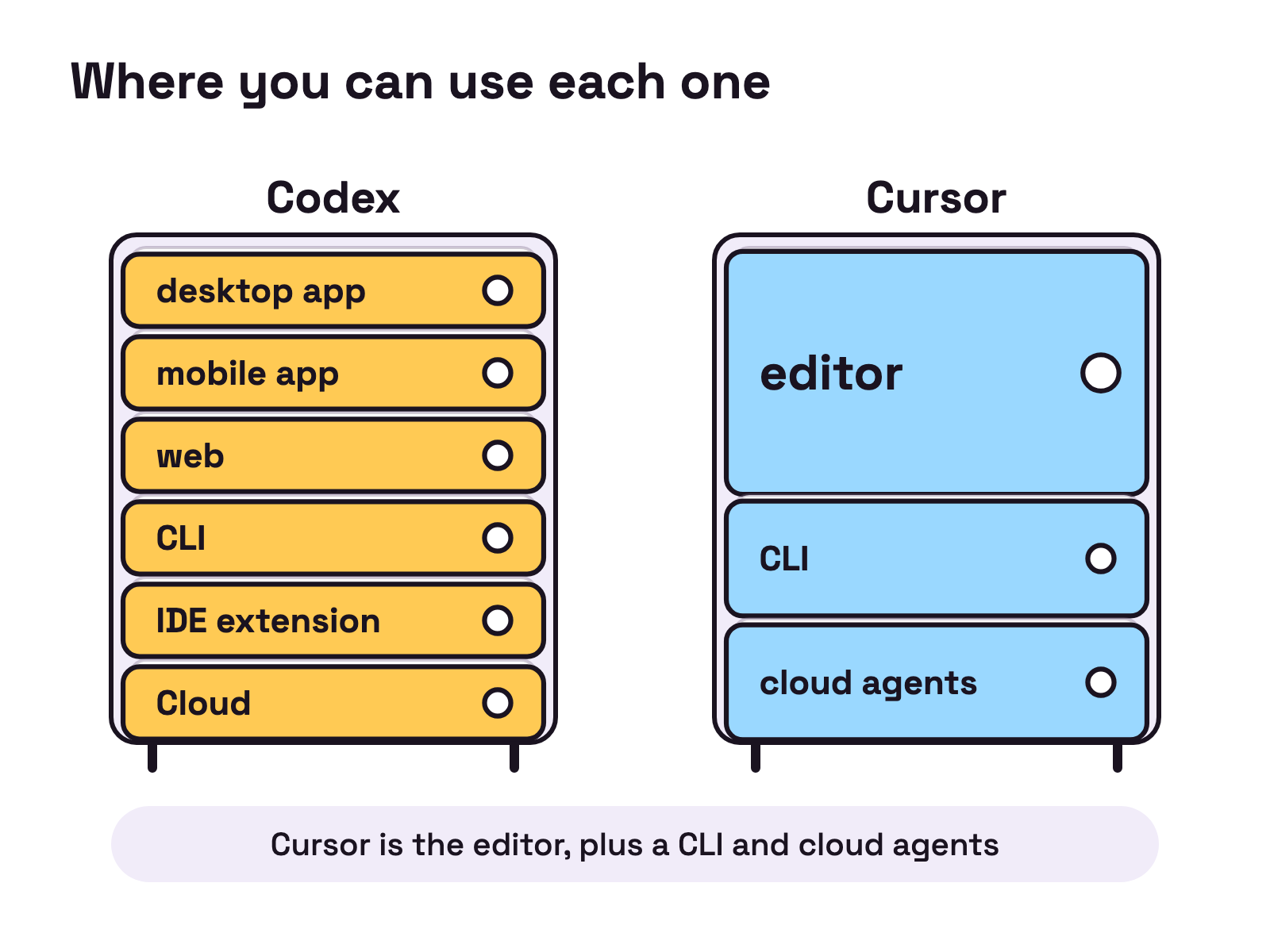
Codex is OpenAI’s coding agent, and Cursor is a code editor with an agent built in. OpenAI’s Codex docs list six places to use Codex: the ChatGPT desktop app, the mobile app, the web, the Codex CLI, the Codex IDE extension and Codex Cloud. Our what is Codex page explains each.
Cursor is the editor, plus a CLI and cloud agents. Its CLI docs say the CLI “lets you interact with AI agents directly from your terminal to write, review, and modify code”, with Agent, Plan and Ask modes.
The names do not help. Cursor’s model list has entries such as GPT-5.3 Codex (hidden by default), which is a model in Cursor’s list, not the Codex agent.
Codex vs Cursor compared, checked 7 Oct 2026
Every row was checked on 7 Oct 2026 against the vendor’s own pages or GitHub. The rows are our selection, and the plan rows cover individual plans only.
| Codex | Cursor | |
|---|---|---|
| What it is | Coding agent: CLI, desktop app, IDE extension, cloud. | Editor with an agent, a CLI and cloud agents. |
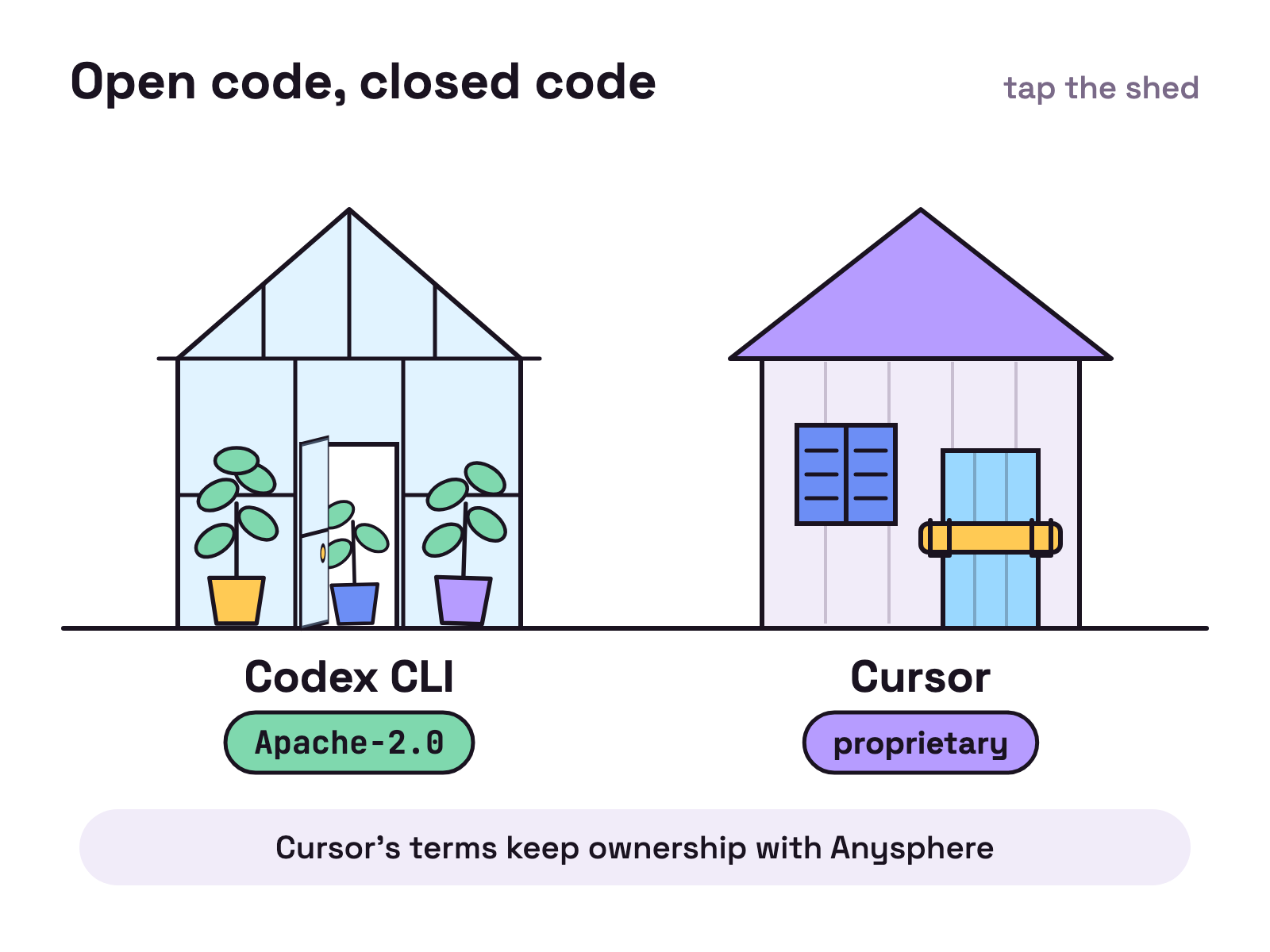
| Licence | CLI is Apache-2.0. | Proprietary. |
| Free plan | Free: GPT-6 Luna at Standard speed in the desktop app, subject to rollout. | Hobby: limited Agent requests. |
| Plan under $20 | Go, $8 a month: GPT-6 Luna at Standard speed in the desktop app, subject to rollout. | Start, ₹649 a month, tax inclusive, India only. |
| First $20 plan | Plus, $20 a month: web, CLI, IDE extension, iOS. | Individual, $20 a month. |
| Higher plans | Pro, from $100 a month. | Pro Plus, $60; Ultra, $200 a month. |
| Models | GPT-6.1 Sol and GPT-6 Luna on Plus. | Cursor’s own, plus OpenAI, Anthropic, Google and others. |
| Pay by token | API key, at API pricing. | On-demand usage at API rates. |
| Latest CLI release | rust-v0.161.0, 7 Oct 2026. | Not checked. |
Sources: OpenAI’s Codex pricing page, the openai/codex repo, Cursor’s pricing page and Cursor’s models and pricing docs.
Is Codex or Cursor open source?
The Codex CLI is open source and Cursor is not. GitHub listed openai/codex under Apache-2.0 on 7 Oct 2026, and its latest release was rust-v0.161.0, published on 7 Oct 2026. The open part is the CLI. Codex Cloud runs on OpenAI’s side.
Cursor’s terms of service say Anysphere and its licensors “own and retain all right, title and interest in and to the Service”, and that you may not reverse engineer it.
How much do Codex and Cursor cost?
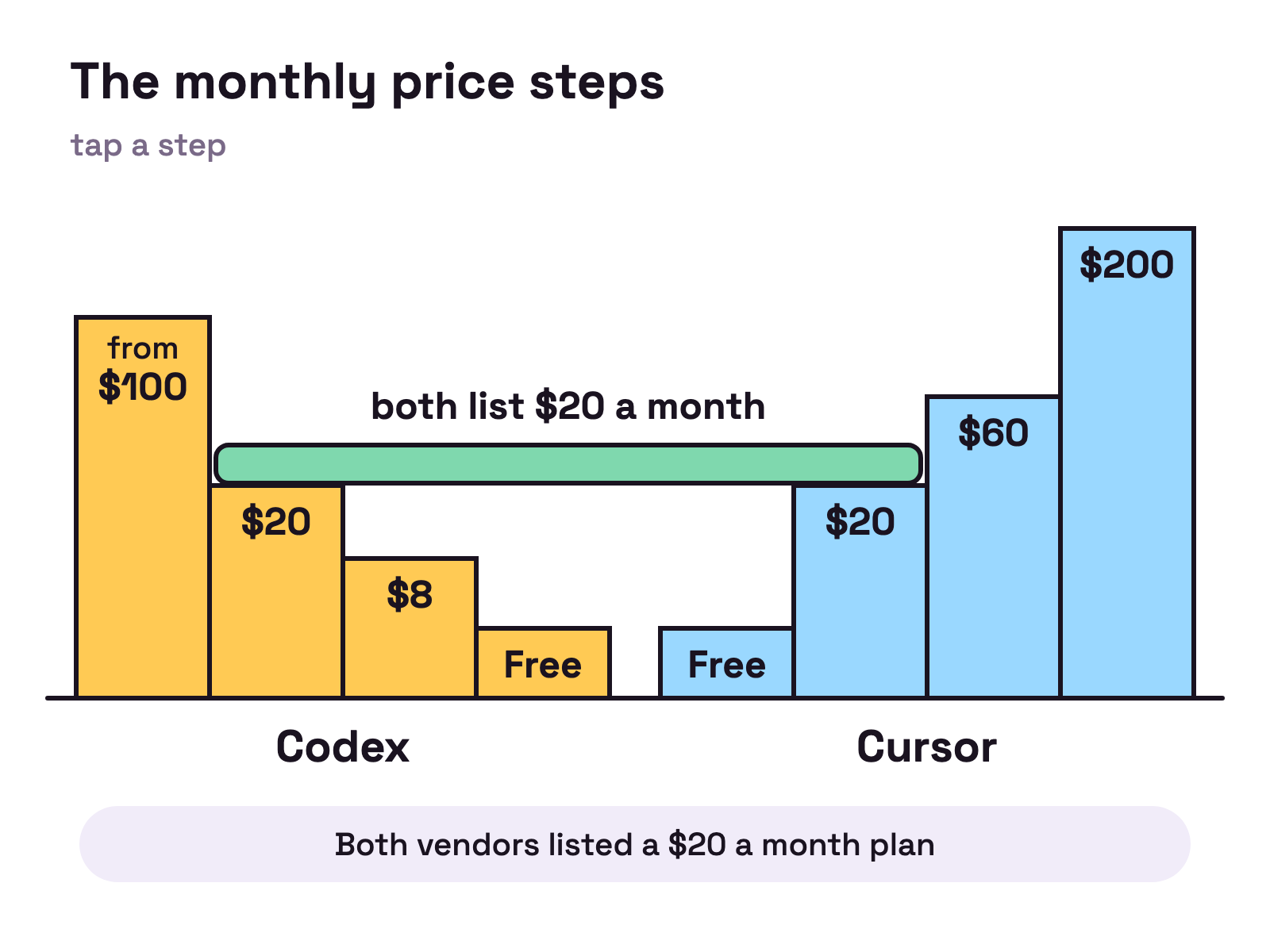
Both start free, and both listed a $20 a month plan on 7 Oct 2026. OpenAI’s Codex pricing page listed Free and Go, at $8 a month, each with “GPT-6 Luna at Standard speed in the desktop app, subject to rollout”, then Plus at $20 a month and Pro from $100 a month on 7 Oct 2026. Plus is the first plan that lists the CLI and the IDE extension. An API key also works in the CLI, SDK or IDE extension, billed at API pricing, with no cloud features.
Cursor’s pricing page listed Hobby as free with “Limited Agent requests” and Individual at $20 a month on 7 Oct 2026. On the same day its models and pricing docs named the paid tiers Pro at $20, Pro Plus at $60 and Ultra at $200 a month.
The limits work differently. OpenAI’s page estimates local messages per five hour period for Plus, and says weekly limits may also apply. Cursor’s docs describe two usage pools that reset with your monthly billing cycle, then on-demand usage at API rates. Our Codex pricing page has the full plan list.
Which models do Codex and Cursor run?
Codex runs OpenAI models, and Cursor offers models from several labs. OpenAI’s Codex models page recommends GPT-6.1 Sol and GPT-6 Luna, and also lists Astra. The pricing page lists GPT-6.1 Sol and GPT-6 Luna on Plus, and Astra Ultrafast access on Pro $500. The same models page says a custom provider needs “a compatible Responses API endpoint”.
Cursor’s models page lists its own pool (Grok and Composer) plus models from Anthropic, Google, OpenAI, Z.ai, Moonshot and Meta. Claude Opus 5.5, Gemini 3.1 Pro and GPT-5.6 Sol were on it on 7 Oct 2026. Models outside Cursor’s own pool are charged at the model’s API price, per its pricing docs.
Where does each one run?
Both run on your machine and in the cloud. The Codex CLI “runs locally on your computer”, in the README’s words. OpenAI’s Codex Cloud page says you can start and follow cloud tasks from the web, mobile or desktop app, or from your terminal.
Cursor’s cloud agents docs say they “run in isolated VMs in the cloud”, that you can run as many as you want in parallel, and that you need a paid Cursor plan.
Can you use Codex in Cursor?
Yes, through OpenAI’s IDE extension. The openai/codex README says: “If you want Codex in your code editor (VS Code, Cursor, Windsurf), install in your IDE.” OpenAI’s IDE extension page lists Cursor too, and tells you to choose the Codex icon, or run Codex: Open Codex Sidebar from the Command Palette.
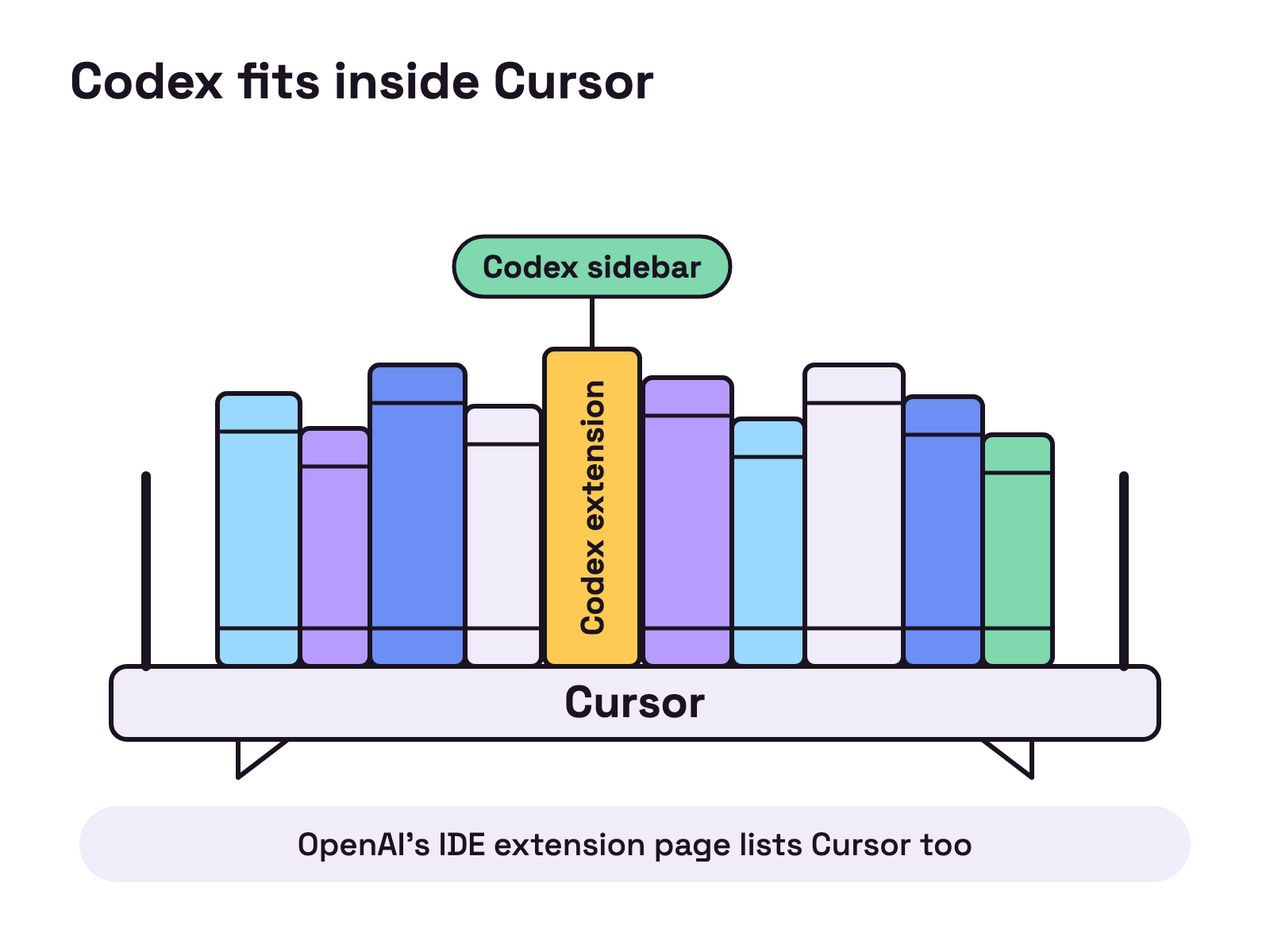
So the choice is not strict. You can keep Cursor’s editor and run Codex beside it on a ChatGPT plan that lists the IDE extension. Our Codex CLI install guide covers the terminal side.
Who should pick Codex, and who should pick Cursor?
Pick by where you like to work. Our view:
- You live in a terminal, or want open source code: Codex.
- You already pay for ChatGPT Plus or Pro: Codex, since the plan lists it.
- You want to read each change in an editor: Cursor.
- You want Claude, Gemini and GPT models in one picker: Cursor.
- You want both: Cursor with the Codex extension.
There is also a different kind of tool. Munder Difflin is free and open source: a desktop app that runs a team of coding agents such as Claude Code, Codex and Gemini CLI on your own computer. It fits if you want several agents on one job, and the install guide covers setup.
FAQ
Is Codex better than Cursor?
Neither is better for everyone. We think Codex fits you if you want a terminal agent with open source code on a ChatGPT plan, and Cursor fits you if you want an editor with models from several labs. Both vendors listed a $20 a month plan on 7 Oct 2026.
Can you use Codex in Cursor?
Yes. The openai/codex README says: if you want Codex in your code editor (VS Code, Cursor, Windsurf), install in your IDE. OpenAI's IDE extension page lists Cursor too. Both were checked on 7 Oct 2026.
Which is cheaper, Codex or Cursor?
Outside India, Codex lists the lowest priced paid plan, but its listing does not name the CLI. On 7 Oct 2026 OpenAI's Codex pricing page listed Go at $8 a month, with GPT-6 Luna at Standard speed in the desktop app, subject to rollout. Plus at $20 a month is the first plan that lists the CLI and the IDE extension. Cursor's pricing page listed Individual at $20 a month. Cursor's docs list Start at ₹649 a month, tax inclusive, India only. Both also list a free plan: ChatGPT Free with GPT-6 Luna at Standard speed in the desktop app, subject to rollout, and Cursor Hobby with limited Agent requests.
Is Codex or Cursor open source?
The Codex CLI is. GitHub listed openai/codex under Apache-2.0 on 7 Oct 2026. Cursor is not: its terms of service say Anysphere and its licensors own the Service and forbid reverse engineering it.
Does Cursor have a CLI like Codex?
Yes. Cursor's CLI docs describe a terminal agent with Agent, Plan and Ask modes, installed with a curl command on macOS, Linux and WSL, and a PowerShell command on Windows. Checked 7 Oct 2026.