Deploy a PR Reviewer That Never Sleeps — In About One Prompt
A how-to for standing up a fully automated PR-reviewing agent in Munder Difflin — one that reads your real source (not just the PR description), de-dupes noise, and only escalates what matters. With a real triage run that turned 22 duplicate firings into a clean v0.2.5 patch queue.
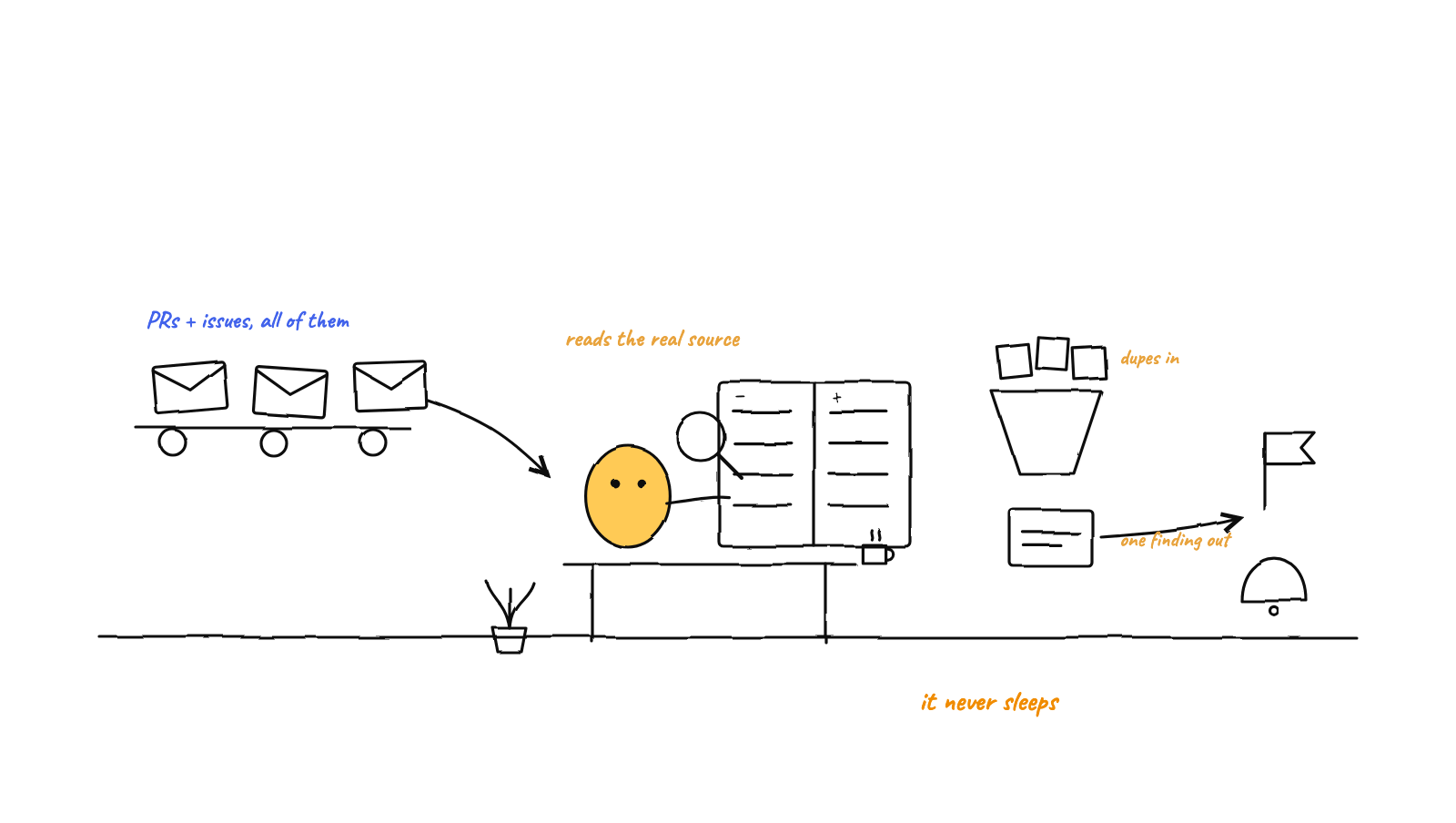
You can stand up a fully automated PR-reviewing agent in Munder Difflin in about one prompt: give it an objective, point it at your repo and open PRs, and let it review against the real source, post comments, and escalate only what matters. Ours recently triaged 5 new bug reports against the v0.2.4 release, consolidated 22 duplicate breaker firings into clean signal, and surfaced a HIGH-severity Windows-terminal regression plus a 3-issue lifecycle bug cluster sharing one root cause — all verified against source, with fixes specified and a human pinged. That triage became the v0.2.5 patch queue. Here's how to deploy your own.
Every team that ships open source hits the same wall: the issues and PRs arrive faster than anyone can read them, and most of the noise is duplicates of the same two real bugs. The SaaS review bots help — but they read the PR description, charge per seat, and don’t understand the rest of your backlog.
We built ours differently, and we run it on ourselves. This is a how-to for deploying the same thing: a PR Reviewer agent that lives in your hive, reads your actual diff and source, de-dupes the noise, and only taps a human when something is genuinely worth a human. Then a case study of what that looks like on a real, messy day.
What “PR Reviewer agent” actually means here
In Munder Difflin, an agent isn’t a chat window — it’s a real CLI (any of the ten supported engines, from Claude Code to Codex to OpenCode) running on your machine with filesystem and git access, plugged into the hive’s shared inbox and memory. So a “PR Reviewer” is just a worker you’ve given one job: watch the repo, review what comes in, and report back. Since v0.4.4 you can also hand it an installed skill — a review checklist it re-reads on every pass, so your severity bar and house rules survive across sessions.
That framing matters because of what it unlocks:
- It reads the real source, not the summary. When a PR claims “fixes the Windows usage meter,” the agent can open the reconciler, trace the path-encoding logic, and confirm the fix — instead of trusting the PR title.
- It sees the whole backlog at once. Reading the full set of open issues plus shared hive memory, it can notice that issues #41, #43, and #47 are three faces of the same bug — rather than reviewing each in a vacuum.
- It escalates through the same inbox you use. A serious finding becomes a message to you, routed like any other hive mail. No separate alerting system.

Deploying it: the one-prompt version
You don’t configure this. You brief it. Open Munder Difflin, select Michael, and describe the outcome the way you’d brief a coworker:
Stand up a PR Reviewer for our GitHub repo. Review the open PRs and any new bug-report issues against the released source — verify each claim in the actual code, post a review comment on each, consolidate duplicates into one finding, and ping me directly for anything HIGH severity. Then check for new ones every hour and do the same.
That single instruction is doing three jobs, and the orchestrator decomposes them:
- Spin up a dedicated agent. The orchestrator creates a
pr-reviewerworker scoped to this objective — a specialist that does one thing well, instead of a general agent context-switching between code review and everything else. - Run the first pass now. It reviews the current open PRs and issues immediately, against the checked-out source, and posts comments.
- Make it recurring. It registers a scheduled mission — a small persisted record with an interval and a target agent — that re-fires the reviewer every hour. New PRs get reviewed on the next tick without you touching a keyboard.
The whole job description was the prompt. There’s no workflow file, no webhook to register, no CI secret to wire. (If you’ve seen our one-prompt dogfooding story, this is the same mechanism, pointed at a tougher problem.)
The three knobs worth setting explicitly
The default behavior is good, but three things are worth naming in your brief so the agent’s judgment matches yours:
- The objective. “Review for correctness and regressions against the released source” produces sharper reviews than “review the PRs.” Tell it what good means for your repo.
- The escalation bar. Say what earns a human ping — “HIGH severity or anything touching data loss.” Everything below the bar gets a posted comment and nothing more. This is what keeps it from becoming a notification firehose.
- The de-dupe instruction. “Consolidate duplicate reports into one finding” turns a pile of redundant issues into signal. Without it, you get one review per issue; with it, you get one review per bug.
Case study: a messy day, triaged
Here’s what that deployment looked like on a real run against our own repo, right after the v0.2.4 release.
Five new user bug reports had come in. On the surface that’s five reviews. Underneath, the issue tracker was a mess: 22 separate breaker and duplicate firings — the same crashes and complaints reported multiple times, in slightly different words, by different users hitting the same code paths. A human triaging that by hand burns an afternoon just figuring out what’s actually distinct.
The PR Reviewer agent did the figuring. It read all five reports plus the surrounding issues against the v0.2.4 source, and consolidated the 22 firings down to two real findings:
- A HIGH-severity Windows-terminal regression. Verified directly against the released source — not inferred from the report. The agent traced the failing path, confirmed the regression was real and recent, specified the fix, and escalated it to the human because it crossed the severity bar.
- A 3-issue agent-lifecycle bug cluster sharing one root cause. Three separately-filed issues that all bottomed out in the same lifecycle bug. The agent named the shared root cause, specified the fix once, and grouped the three issues under it — so what looked like three problems was correctly understood as one.
For each, it posted a review comment on the relevant issues/PRs, and pinged me only for the parts that mattered. The rest — the seventeen-odd duplicates — got folded into the two findings instead of generating seventeen more notifications.
That triage became the v0.2.5 patch queue. I didn’t assemble it. I read two clear findings with fixes already specified, against source I trusted because the agent had read it too.
Why the consolidation is the real win
It’s tempting to frame this as “it reviewed PRs fast.” But the load-bearing part is the de-noising: 22 → 2. A reviewer that comments on everything just moves the triage burden into your inbox. A reviewer that reads the whole backlog, verifies against source, and collapses duplicates into root causes does the part of code review that’s actually hard — deciding what’s true and what’s distinct — and hands you the short list.
That’s the difference between an automated commenter and an automated reviewer.

What to be honest about
Two limits worth stating plainly, because overselling this helps no one:
- It runs while the app is open. The scheduler lives in the desktop app’s process — this is local-first, not a cloud cron. It catches up on overdue ticks at next launch (each mission remembers when it last fired), so the cadence resumes after a restart. But if you need reviews while the laptop is shut, that’s a cloud job’s territory, and we’d rather tell you that than pretend otherwise.
- It’s judgment, not an oracle. It’s a real coding agent reading real code, so it brings real judgment — and, like any reviewer, it can be wrong. The escalation bar exists precisely so a human sees the consequential calls. Treat its reviews like a sharp colleague’s, not a CI gate that’s always right.
Within those limits, what you get is genuinely useful: a reviewer that never sleeps, reads your actual diff and source, de-dupes the noise, and only escalates what matters.
Deploy yours
If you maintain a repo with more inbound than time, this is roughly a five-minute setup and zero ongoing babysitting:
- Download Munder Difflin — free, open source, local-first, macOS/Windows/Linux (and yes, Windows is first-class as of v0.4.4).
- Add a CLI agent on whichever engine subscription you already have — the app supports ten, and Settings → Prerequisites confirms which binaries it can see.
- Brief Michael with the prompt above, swapping in your repo and your escalation bar.
- Leave it running on a second monitor and let new PRs get reviewed on the hour.
The pitch is simple, and it’s true: a reviewer that never sleeps, reads your real source, de-dupes the noise, and only escalates what matters — set up in about one prompt. Go point one at your backlog.
FAQ
How do you deploy an automated PR reviewer in Munder Difflin?
You brief Michael, the orchestrator, in plain English: give him a review objective, point him at the repo and its open PRs/issues, and ask him to post reviews back and escalate anything serious. He spins up a dedicated PR Reviewer agent, runs the first pass, and registers a recurring mission in the Triggers tab so new PRs get reviewed on a cadence. No YAML, no webhook, no per-seat SaaS subscription.
Does the reviewer read the actual code or just the PR description?
The actual code. The PR Reviewer agent is a real CLI agent — any of the ten supported engines, Claude Code being the usual pick — with filesystem and git access to the checked-out repo, so it reviews diffs and issues against the released source, not just the summary text in the PR. That's what lets it verify a claimed bug is real before it escalates.
Will it spam every PR with low-value comments?
It doesn't have to. Because the reviewer reads shared hive memory and the full set of open issues at once, it can consolidate duplicate reports into one signal and only escalate findings that are verified and high-impact. In a recent run it collapsed 22 duplicate/breaker firings down to two real findings before pinging a human.
Is this a cloud service?
No. Munder Difflin is a local-first desktop app. The reviewer runs on your machine using the CLI subscriptions you already pay for, and the scheduler that re-fires it lives in the app process — so it reviews while the app is open, and catches up on overdue ticks at next launch.