Multi-Agent Orchestration Patterns: Which Topology, and When
The multi-agent orchestration patterns — orchestrator-worker, pipeline, fan-out, debate, swarm, blackboard — when to use each, and when one agent wins.
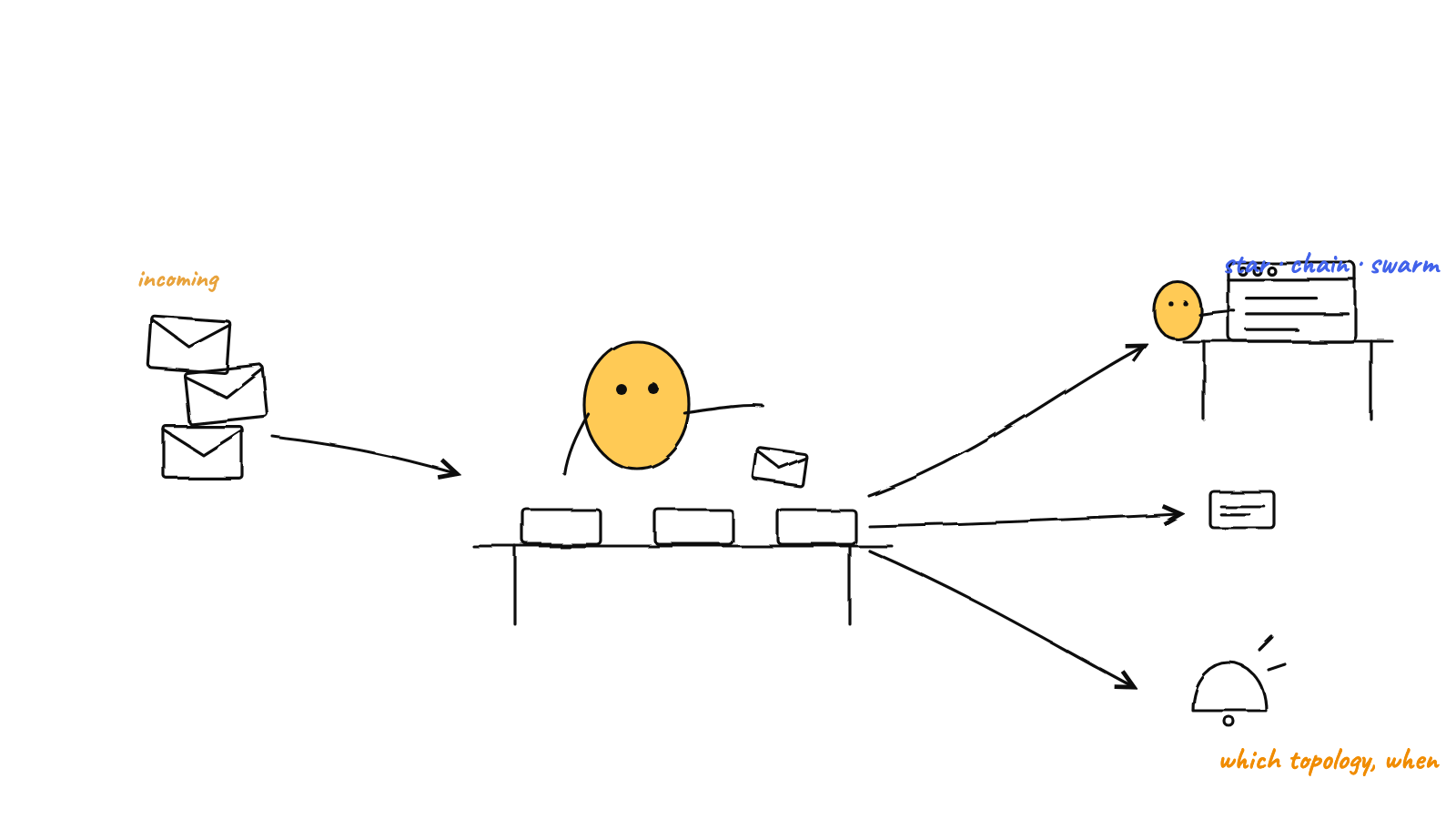
Multi-agent systems come in a few named topologies — orchestrator-worker (supervisor), pipeline, fan-out, debate/maker-checker, swarm, and blackboard. Orchestrator-worker is the 2026 default. But the most important fact is the anti-hype one: a single agent often matches or beats a multi-agent system on the same task, and many multi-agent pilots fail — usually from picking the wrong pattern. Rule: start with the simplest topology that fits, add agents only when the problem genuinely decomposes, and make whatever you pick survivable.
Once you’ve decided you need more than one agent, the next question is how they’re wired together — the topology. There’s a small, well-worn set of patterns, each suited to a different shape of problem. This is the catalog, when to reach for each, the honest caveats, and how the patterns show up in a real multi-agent hive.
The pattern catalog
- Orchestrator-worker (supervisor). A central orchestrator classifies the task, decomposes it, dispatches sub-tasks to specialized workers, and merges the results. One clear accountability point, and workers can run cheaper task-specific models — say, a research orchestrator that dispatches lookups to small, fast workers and reserves a strong model for the final synthesis. Use when you know the sub-tasks at design time and want one place that owns the outcome. This is the 2026 production workhorse.
- Hierarchical (supervisors of supervisors). Tiered orchestrator-worker: higher tiers plan and coordinate, lower tiers execute. Use when the work is too big for one orchestrator’s context — teams of teams.
- Sequential pipeline. Fixed linear stages, each consuming the previous output. Use when the order never changes and steps strictly depend on each other (extract → transform → validate).
- Parallel fan-out (scatter-gather). Dispatch N independent sub-tasks at once, then gather. Use when you have several tasks with no dependencies between them — the classic latency win.
- Debate / maker-checker. One agent produces, another critiques or verifies; iterate or vote. Use when accuracy matters more than speed — review loops, adversarial checks.
- Swarm / network (peer). Dynamic peer agents hand off to each other with no central conductor. Use when the path is emergent and data-dependent — and budget for it being the hardest to debug and bound.
- Blackboard. Agents read and write a shared workspace rather than messaging directly; the shared state coordinates them. Use when many agents contribute to one evolving artifact.
A decision framework
You can get most of the way with three rules:
- Default to supervisor / orchestrator-worker. It’s legible, accountable, and debuggable — which is why it dominates production.
- Match the topology to the dependency structure. Linear deps → pipeline. No deps → fan-out. Accuracy-critical → maker-checker. Emergent path → swarm (with guardrails).
- Start simple. Most teams over-architect. Reach for more agents only when a single agent genuinely can’t hold the task.
Patterns compose
Real systems rarely use one pattern in isolation — they nest. A supervisor’s workers might each run a maker-checker loop internally; a sequential pipeline might fan out within a single stage; a hierarchical team might keep a blackboard at each tier to pool findings. The patterns are a vocabulary, not a menu you pick one item from. The discipline is the same at every level of nesting: at each composition point, ask what the dependency structure of that sub-problem is, and choose the topology that fits it.
A common, effective shape is a supervisor on the outside — one accountable owner with clear decomposition — wrapping fan-out and maker-checker on the inside: run the independent sub-tasks in parallel, and route the risky or accuracy-critical ones through a verifier. Compose deliberately, though: every boundary you add is another place coordination can fail, and another handoff to debug.
The honest part: multi-agent isn’t free
Two findings are worth leading with, so this stays grounded and not hype:
- A single agent often wins. In benchmarking, a single agent matched or outperformed multi-agent systems on a majority of tasks when given the same tools and context. More agents add coordination overhead, latency, and cost — the payoff only appears when the task truly decomposes.
- Many pilots fail. A large share of multi-agent projects don’t survive their first months in production, commonly because the team picked the wrong pattern, or the right pattern without understanding its failure mode — a swarm with no hop cap loops; a fan-out with hidden cross-task dependencies corrupts its merge.
The corollary: the value isn’t “more agents,” it’s the right topology plus the resilience to survive its failure mode — hop caps, idempotent handling, isolation. (We wrote up those mechanics in recovering from agent failures.)
The 2026 framework landscape
If you’re building this on a framework, the control-vs-simplicity tension hasn’t converged — they differ mostly in orchestration model and ecosystem:
- LangGraph — a directed graph with conditional edges; the most control, the most boilerplate. The default for stateful, auditable, regulated workflows.
- CrewAI — role-based “crews” with process types; the fastest path to a working multi-agent team.
- AutoGen / AG2 — conversational group chat between agents.
- OpenAI Agents SDK — explicit handoffs between agents, with a built-in execution sandbox.
- Claude Agent SDK / Strands — simplicity over fine-grained orchestration.
The 2026 trend is convergence on common abstractions (graphs, roles, handoffs) with differentiation in ecosystem depth and ops tooling. Pick for the orchestration model you need, not the logo.
How the patterns map onto a hive
A concrete system makes the patterns less abstract. Munder Difflin runs several at once:
- Orchestrator-worker / supervisor — the god orchestrator classifies intent, decomposes it, dispatches to role-specialized agents, and owns integration. That’s the 2026 default, made local and watchable.
- Blackboard — the shared board and the append-only event log are a blackboard the team reads and writes.
- Fan-out — a broadcast message is scatter-gather over the active roster.
- Maker-checker — human-in-the-loop approval and adversarial review act as a consensus gate on risky output.
It’s the same lesson throughout: orchestration is how agents coordinate without colliding, and the pattern you choose is a big part of whether they do.
Pick the topology, then make it survivable
The patterns aren’t exotic — they’re the small vocabulary of multi-agent design, and most systems are one of them (or a couple composed). The skill is matching the topology to the problem’s dependency structure, resisting the urge to over-architect, and then hardening whatever you chose against its specific failure mode. A pattern without resilience is the project that fails in month three.
Want to watch the supervisor pattern run locally — a plain-language orchestrator decomposing your intent across a team you can actually see? You can download Munder Difflin free; it’s open source.
FAQ
What are the main multi-agent orchestration patterns?
Six recur: orchestrator-worker (a.k.a. supervisor — a central agent decomposes and delegates), hierarchical (supervisors of supervisors), sequential pipeline (fixed linear stages), parallel fan-out (scatter-gather over independent tasks), debate/maker-checker (one agent produces, another verifies), and blackboard (agents coordinate through shared state). Most production systems lean on orchestrator-worker.
Which orchestration pattern should I use?
Match it to your dependency structure: linear dependencies → pipeline; independent tasks → fan-out; accuracy-critical work → maker-checker; known sub-tasks with one accountable owner → orchestrator-worker (the 2026 default). Start with the simplest pattern that fits — most teams over-architect and add agents they don't need.
Is a multi-agent system always better than a single agent?
No. In benchmarks, a single agent matched or beat multi-agent systems on a majority of tasks when given the same tools and context, and a large share of multi-agent pilots fail in production — usually from the wrong pattern. More agents add coordination cost; they pay off only when the task genuinely decomposes.