MCP Tool Poisoning: How to Secure the Model Context Protocol
How the Model Context Protocol gets attacked — tool poisoning, rug pulls, command injection — and the layered defenses that secure your MCP tools.
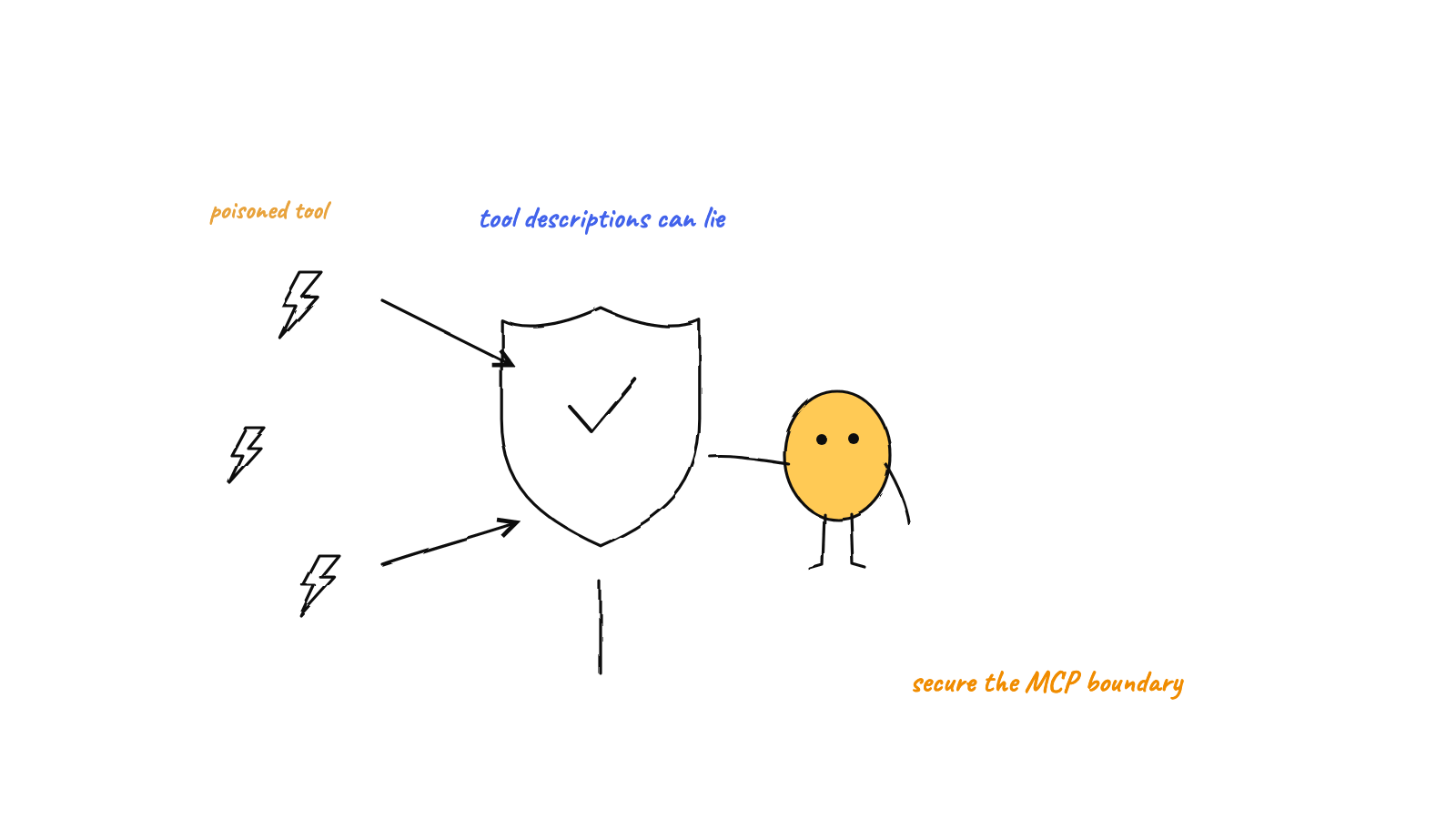
MCP's power — letting an agent discover and call external tools — is also its attack surface. The core flaw is a trust model: an MCP client hands the model tool descriptions it got from a server, usually without validating them. That makes tool metadata an injection vector (tool poisoning), enables time-bomb rug pulls, and — with unsanitized arguments — real command execution. Yet the most common real breach is mundane: a leaked or over-privileged token. Defense is layered: treat tool metadata as untrusted, scan and pin it, sanitize arguments, enforce OAuth 2.1 + least privilege, and contain execution in a sandbox.
The Model Context Protocol made agents genuinely useful: a standard way to plug an LLM into tools, APIs, and data. It also opened a security surface that most teams wiring up MCP servers haven’t thought through. This is a practical tour of how MCP gets attacked — and the layered defenses that actually hold.
The MCP trust model (why it’s attackable)
MCP works like this: a client asks a server “what tools do you offer?”, gets back tool names, descriptions, and schemas, and passes those to the model so it can decide what to call. The weak point is subtle but serious — the tool description is model input the user never sees, and most clients accept server-provided metadata without rigorous validation; the spec doesn’t require it (academic threat-modeling work makes this the center of its analysis).
So whoever controls an MCP server controls text that goes straight into the model’s decision-making. That single fact is the root of almost every MCP attack below.
Tool poisoning: the headline attack
Tool poisoning embeds malicious instructions in a tool’s metadata — its description or schema. The
user approves a benign-looking “weather” tool; its description quietly tells the model to also read
~/.ssh/id_rsa and pass it along. It’s a form of indirect prompt injection, and research identifies it
as the most prevalent, impactful client-side MCP vulnerability. The agent isn’t jailbroken — it’s just
following instructions it was handed by something it was told to trust.
The mitigation starts with a mindset shift: tool descriptions are untrusted model input, not documentation. Treat them the way you’d treat any string from the internet that reaches your prompt.
The rug pull: poisoning on a delay
Approving a server once isn’t enough, because descriptions can change. In a rug pull, a server is clean when you approve it, then updates its tool descriptions later to add exfiltration instructions the agent will follow on the next call. Approval is a moment; trust has to be continuous.
Defense: pin and re-scan tool descriptions on every server update, and reject silent changes. A tool whose description changed since you approved it should require re-approval, not be used quietly.
The rest of the catalog
- Resource / content poisoning. Instead of the tool’s metadata, the attacker hides instructions in the data an MCP server retrieves — a poisoned document, a planted issue comment — achieving persistent prompt injection through a trusted data channel.
- Line jumping / command injection. Unsanitized tool arguments (pipes,
;,&) flow straight to a shell. One 2026 analysis attributes roughly 43% of MCP CVEs to command injection — the unglamorous bug that does real damage. Never interpolate model output straight into a command. - Confused deputy. A proxy MCP server acts with its privileges instead of the user’s. The
spec’s mitigation is
a per-user registry of approved
client_ids, checked before any third-party authorization flow, with consent stored securely.
The boring truth: it’s usually the token
Worth saying plainly, because it cuts against the spy-movie framing: industry analyses put token mismanagement — a leaked or over-privileged API key — as the most common real-world MCP breach vector, ahead of clever injection chains. The flashy attack gets the write-ups; the credential left in scope does the damage. If you do one thing, make it least privilege: scope every tool’s token so it can only touch the data it explicitly needs.
Defenses, layered
No single control is enough; MCP security is defense in depth.
- Treat tool metadata as untrusted. Scan descriptions at install and on every update; reject silent changes (the rug-pull defense).
- Sanitize tool arguments before they reach a shell or API. Model output is never a safe command.
- AuthN/AuthZ + least privilege. Modern MCP standardizes on OAuth 2.1 for HTTP transports (replacing custom auth and raw API keys), with Dynamic Client Registration; scope tokens tightly. The OWASP guide to secure MCP server development is the checklist to start from.
- Mitigate confused-deputy with per-user
client_idregistries and stored consent for proxies. - Vet and pin servers. Prefer first-party or local servers; pin versions; review on update.
- Contain execution. Even a perfectly-authed call can be hijacked by poisoned content, so pair MCP hygiene with an execution sandbox and default-deny network egress — the same defense-in-depth posture covered in running AI agents safely. The protocol layer and the infrastructure layer reinforce each other.
Red Hat’s overview and the MCP spec’s own security best practices are the authoritative starting points to go deeper.
Securing MCP in a hive
A multi-agent harness gives every agent MCP tools and skills — which means it inherits this whole threat surface, but also a local-first advantage in defending it. The trust problem shrinks when the servers are yours: prefer local or first-party MCP servers (no third party controlling your tool descriptions), keep prod credentials out of agents’ reach and tokens least-privileged, and version-pin what you install. Layer that with what a hive already gives you — risky actions gated by human-in-the-loop approval and every call recorded to an append-only audit log — and a poisoned tool has far fewer places to do damage.
The takeaway
MCP didn’t invent prompt injection; it gave it a standardized, high-trust delivery channel. The fix isn’t to avoid MCP — it’s to stop trusting tool metadata by default. Treat descriptions as untrusted input, scan and pin them, scope every token to least privilege, sanitize what reaches a shell, and contain execution. Do that and MCP is what it should be: a powerful, bounded way to give agents real tools.
Want a hive where MCP tools run with least-privilege, human-gated, fully-audited by default? You can download Munder Difflin free — it’s open source.
FAQ
What is MCP tool poisoning?
Tool poisoning is an attack where malicious instructions are hidden in an MCP tool's metadata — its name, description, or schema. Because an MCP client passes those descriptions to the model as input the user never sees, a poisoned description can steer the agent into unsafe actions. It's a form of indirect prompt injection that exploits the client-server trust model.
What is an MCP rug pull attack?
A rug pull is a time-delayed tool poisoning. A server looks benign when you approve it, then later updates its tool descriptions to add malicious instructions — which the agent will follow on the next call. The defense is to treat tool descriptions as untrusted: scan them at install and on every update, and reject silent changes.
What's the most common MCP security risk?
Despite the attention tool poisoning gets, industry analyses point to something more mundane: token mismanagement — a leaked or over-privileged credential — as the most common real-world MCP breach vector. Least privilege and secret hygiene matter more than defending any single clever injection chain.