Recovering From Agent Failures: Resilience Patterns for a Hive
How multi-agent systems survive partial failure: retry with stale-lock recovery, poison-message quarantine, hop-cap circuit breaking, idempotent handling.
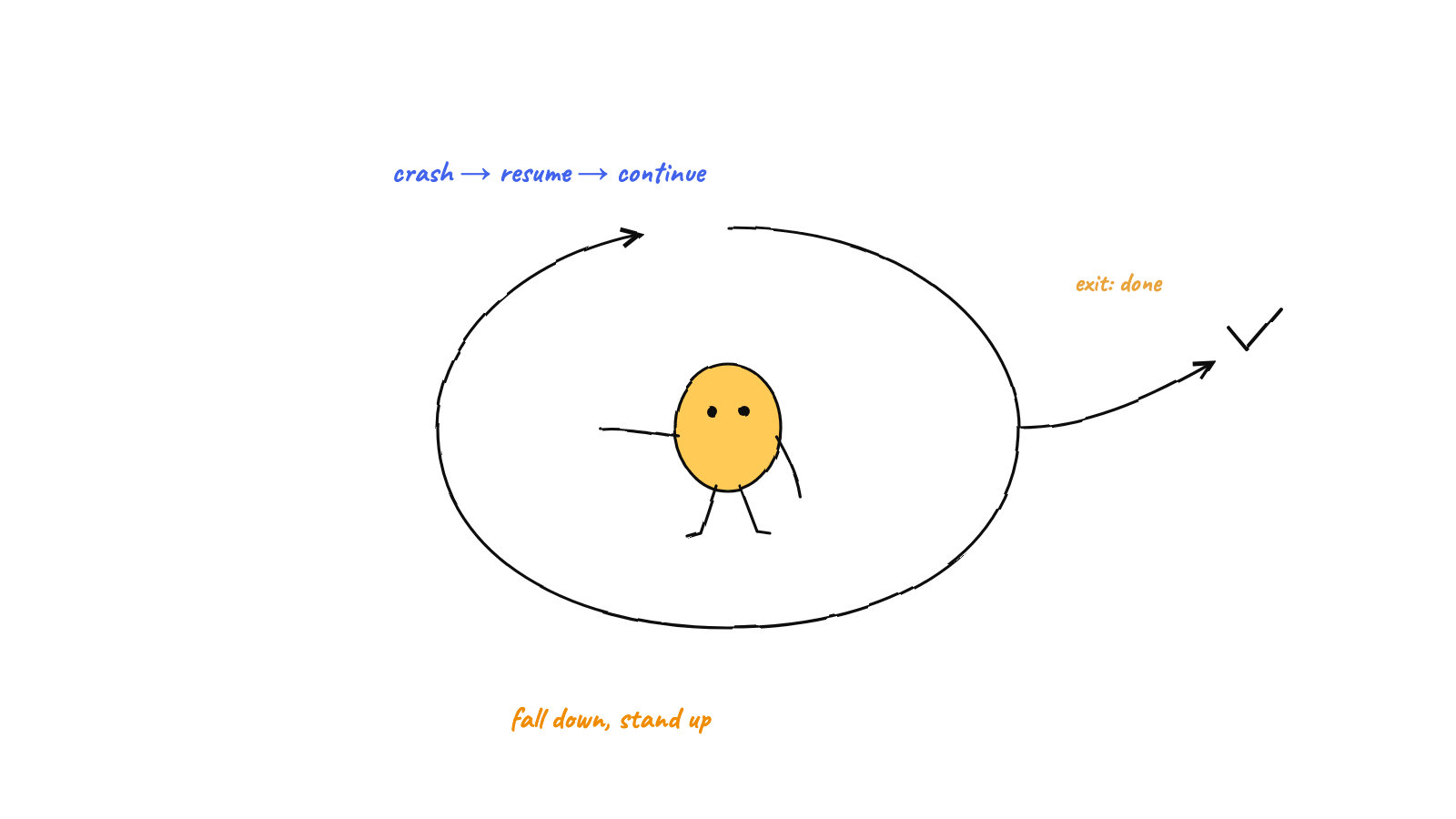
In a multi-agent system, partial failure is the default, not the exception — a crashed committer, a contended lock, a malformed message, a routing loop. Resilience isn't avoiding those; it's making each one local, recoverable, and idempotent. A handful of small patterns do most of the work: retry with backoff + stale-lock recovery for shared writes, quarantine for poison messages, a hop-cap circuit breaker for runaway loops, idempotent handling so replays are no-ops, and error isolation so one bad step never takes down the loop.
Run one agent and failures are simple: it works or it doesn’t. Run a hive of them sharing files and a message bus, and you inherit the unglamorous reality of distributed systems — things fail halfway, two writers collide, a message arrives twice or malformed, a conversation loops. The goal isn’t a system that never fails; it’s one where any single failure is contained and the team keeps moving. Here are the patterns that get you there, grounded in how a real multi-agent harness handles each.
Partial failure is the default
The mental shift is to stop treating failure as exceptional. With many agents writing files concurrently and a router draining their outboxes, on any given tick something can be mid-write, locked, or garbage. A resilient design assumes that and answers four questions up front: when a shared write collides, then what? When a message won’t parse, then what? When a conversation loops, then what? When one step throws, does the whole loop die? Good answers to those four are most of fault tolerance.
Make shared writes survivable
The hive commits all coordination to one git repo with a single committer. That removes interleaved writes, but the committer can still race itself or inherit a lock from a crashed run. So the commit isn’t a single shot — it’s a small retry loop with backoff and stale-lock recovery:
// src/main/hive.ts — commit under contention
for (let attempt = 0; attempt < 5; attempt++) {
  this.clearStaleLock(root);                 // a crashed run? clear a >10s-old index.lock
  const commit = this.git(['commit', '-q', '-m', message], root);
  if (commit.ok) return;
  if (/nothing to commit/i.test(out)) return;        // benign — done
  if (/index\.lock/i.test(commit.err)) {             // contended — back off and retry
    sleepSync(50 * (attempt + 1));
    continue;
  }
  return;  // a non-lock failure: bail quietly; the next mutation retries
}
Three resilience ideas are packed into those lines. Backoff: each retry waits longer (50 * (attempt+1)
ms), so a transient collision clears instead of hammering. Stale-lock recovery: a .git/index.lock
older than ten seconds is from a committer that died, so it’s safe to remove — otherwise one crash would
wedge the repo forever. And graceful give-up: a non-lock error doesn’t throw or block; it returns,
because the next mutation will stage and commit the same pending changes anyway. Nothing is lost by
bailing early.
Don’t choke on a poison message
A file-based mailbox will eventually contain a half-written or malformed JSON file. The naive router reads it, throws, and — if it retries the same file — spins on it forever. The fix is to quarantine:
try {
  const msg = this.normalize(JSON.parse(read(full)), id);
  this.routeMessage(msg);
  renameSync(full, join(outbox, '.sent', f));        // archive, don't reprocess
} catch {
  renameSync(full, join(outbox, '.sent', `bad-${f}`)); // quarantine so we don't spin on it
}
A message that won’t parse is moved aside with a bad- prefix and the router moves on. One corrupt file
can’t stall the bus, and the quarantined file is still on disk for you to inspect. (Successful messages
get archived too — moved out of the outbox so they’re never routed twice.)
Circuit-break the runaways
Two agents can get into a polite infinite loop — A asks B, B asks A, forever. Protocol etiquette helps
(only request/query/propose expect a reply; inform/done are terminal), but you still want a hard
backstop. Every message carries a hop count, and the router drops anything past the cap:
if (msg.hops > HOP_CAP) {
  this.appendLog({ kind: 'drop', reason: 'hop-cap', from: msg.from, to: msg.to, id: msg.id });
  return;
}
It’s deliberately blunt: it guarantees the conversation terminates. And because the drop is logged, a runaway leaves a breadcrumb instead of a silent hang — you can read the log and see exactly which thread ran away.
Idempotent by construction
The cheapest way to survive duplicates and replays is to make re-handling a no-op. In the hive, an agent
moves a message to inbox/.done/ once it’s handled, and the protocol is explicit: re-reading a message
you already moved to .done/ is a no-op — don’t reprocess. Delivery is at-least-once; handling is
idempotent. So a redelivered message, a crash-and-resume, or a curious re-read all do nothing the
second time. The same property underwrites the append-only event log:
each consumer tracks how far it has read, and re-reading a line it already processed changes no state.
Idempotency turns “did this run twice?” from a bug into a shrug.
Keep the loop alive, keep a record
The last pattern is error isolation: a failure in one step must not kill the whole system. The hive’s router wraps each pass so a single bad tick can’t bring it down —
try { this.routeOnce(); } catch { /* keep the loop alive */ }— and lifecycle handlers are written to “never crash” on a best-effort path. Pair that with two recovery
affordances and you can always get back to a known state: the append-only log.jsonl lets you replay
the system’s history to find exactly where it diverged, and agent archival means closing an agent
keeps its memory and history intact rather than deleting them — a stopped agent is recoverable, not gone.
This is the same timeline you’d reach for when debugging a multi-agent system;
resilience and debuggability come from the same record.
A resilience checklist
For any multi-agent system you build:
- Retry shared writes with backoff, and recover stale locks — never let one crash wedge shared state.
- Quarantine unparseable messages instead of retrying them forever.
- Cap the hops on your message path so conversations can’t loop infinitely.
- Make handling idempotent — “already done” should be a cheap, observable fact (a moved file, a cursor).
- Isolate failures so one thrown step doesn’t take down the loop.
- Keep an append-only record so any state is reconstructable and any agent is recoverable.
None of these are exotic — they’re the boring distributed-systems hygiene that turns a flaky pile of agents into a system you can trust to run unattended. Build them in once, at the orchestration layer, and every agent inherits them for free.
Want to see these patterns in a hive you can actually watch recover? You can download Munder Difflin free — it’s open source, and the whole coordination layer is right there to read.
FAQ
What happens when an AI agent in a multi-agent system fails?
In a well-built hive, a single failure stays local. A crashed step doesn't take down the router; a malformed message is quarantined instead of retried forever; a runaway loop is dropped by a hop cap; and shared state is protected by retries so one stalled write doesn't block the rest. The system keeps running and the failure is recoverable, not fatal.
How do you make agent message handling idempotent?
Make 'already handled' a cheap, observable fact. In a file-based hive, an agent moves a message to inbox/.done/ once handled, and re-reading a done message is a no-op. Delivery is at-least-once; handling is idempotent — so a duplicate or replayed message does nothing the second time. The same idea drives an append-only event log: re-reading a line you've already processed changes nothing.
How do you stop AI agents from looping forever?
Put a circuit breaker on the message path. Every message carries a hop count; once it exceeds a cap, the router drops it and logs the drop rather than letting two agents ping-pong indefinitely. It's a blunt instrument on purpose — it guarantees termination, and the dropped, logged message tells you where to look.