Treating a Hire Manifest as Untrusted Input
A shareable agent-config manifest is attacker input. How Munder Difflin's import pipeline stays inert: no auto-spawn, default-deny flags, and an SSRF-safe bounded fetch.
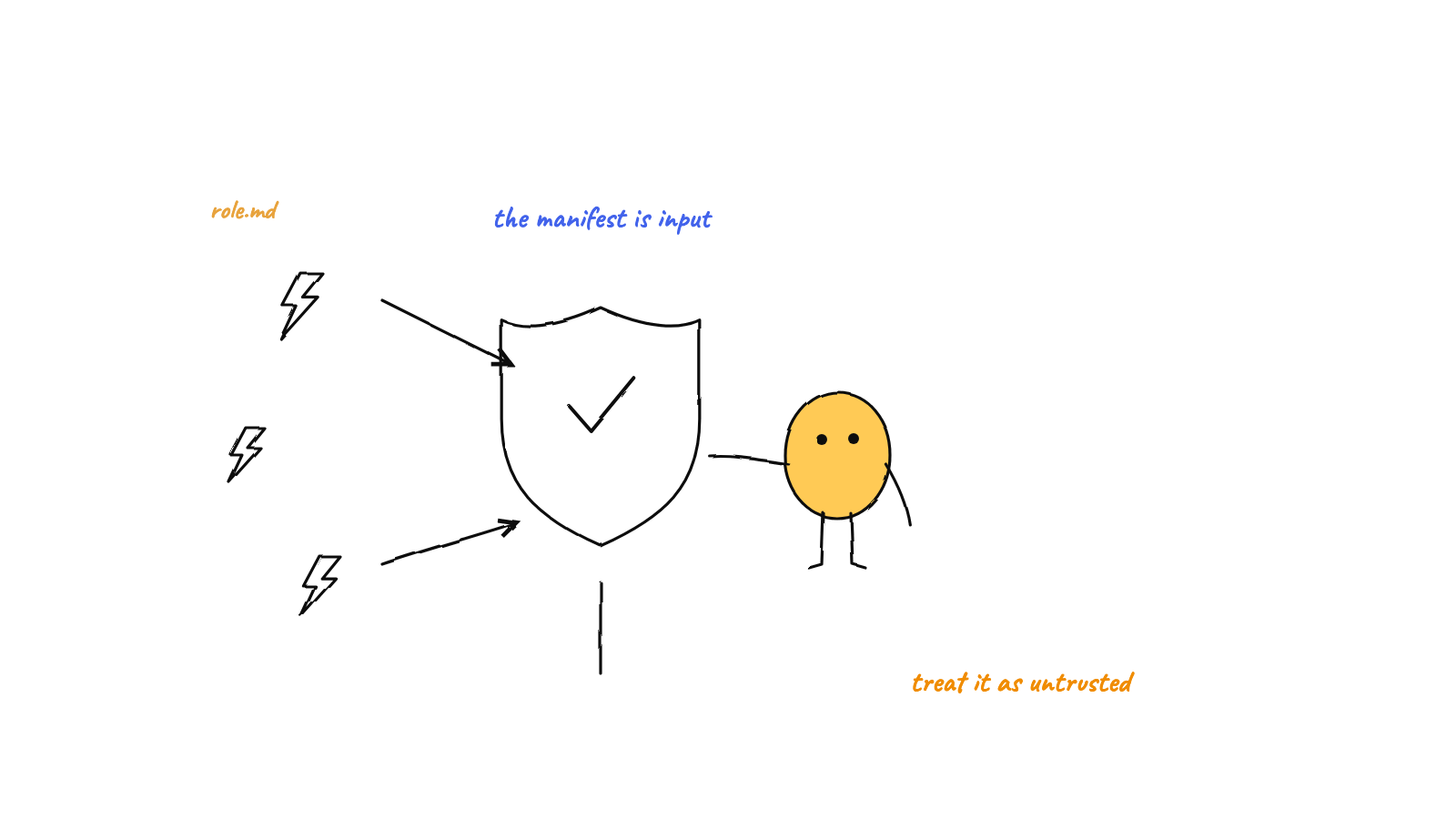
In v0.2.8 we shipped shareable hires — JSON manifests that configure an agent role and travel by link. A manifest is attacker-controlled input (you click a link, you download a file), so the import pipeline is a security boundary. The defenses: import never spawns (it only pre-fills a modal the human submits); no executable field (the binary comes from your own provider presets, custom is rejected); a default-deny flag allowlist (allowlist > denylist for hostile input); strict charset validation on every stringly-typed field plus a hardened cmd.exe quoter at the sink; and an SSRF-safe, bounded fetch that re-validates every redirect hop and caps the body at 64 KB. Validate at the boundary and quote at the sink — defense in depth, both layers.
A shareable hire is a nice feature with a sharp edge. You see a link — munderdifflin://hire?src=https://gallery.example/pr-reviewer.json — you click it, and the Add-Agent modal opens pre-filled with a tidy “PR Reviewer” role: a sprite, a model, a goal, a couple of flags. One more click and it’s on your office floor. The convenience is the whole point. The problem is that everything in that manifest came from someone else.
That makes a hire manifest the same category of thing as a downloaded file or a clicked URL: attacker-controlled input. Nobody audits a JSON file before importing it any more than they read a .dmg before opening it. So the import pipeline can’t treat the manifest as a trusted config object. It has to treat it as hostile bytes and prove, field by field, that nothing in it can turn into an action on your machine. This post is the threat model and the defense-in-depth that came out of a two-round security review — including one HIGH-severity bug that turned a clicked link into arbitrary code execution on Windows.
The shape of the feature
A “hire” is a JSON manifest tagged munder-difflin/hire@1. The interesting fields:
{
  "spec": "munder-difflin/hire@1",
  "name": "PR Reviewer",
  "sprite": "dwight",
  "provider": "claude",
  "model": "claude-sonnet-4-6",
  "commandFlags": ["--verbose"],
  "goal": "Review open PRs and leave inline comments.",
  "capabilities": ["read", "comment"],
  "tokenCap": 200000,
  "isolate": true
}
provider must be one of claude | antigravity | codex. There are two ways a manifest gets in: a munderdifflin://hire?src=<https-url> deep link, which the Electron main process fetches and validates, and a plain local-file import. Both paths funnel into one validator (src/shared/hire.ts) and end at the same place: the Add-Agent modal, pre-filled.
The single most important property of the whole design falls out of that last sentence.
Trust boundary #1: import never spawns
The manifest is data, never an action. Importing a hire does exactly one thing — it pre-fills the Add-Agent modal, behind an “imported” banner that tells you these values came from outside. It does not start anything. The agent spawns only when you click submit in that modal, after the fields are sitting in front of you.
There is no code path — not the deep link, not the file import, not a malformed-but-clever payload — that spawns an agent as a side effect of import. This is the cleanest defense there is, because it makes the human the spawn gate by construction. Every other layer below is about ensuring that the configuration a manifest proposes is safe to hand to a person for one-click approval. But even if a field slipped through, nothing runs until a human says so. Import proposes; the human disposes.
No executable field
The second structural defense is an absence. There is no command or executable field in the schema. A manifest cannot name the program that runs. The binary always comes from the user’s locally configured provider preset — the claude, agy, or codex you installed and pointed the app at. provider: "custom" is rejected by the validator outright, precisely because a custom provider is a user-side escape hatch for naming an arbitrary binary, and we will not let a downloaded file reach through it.
So the worst a manifest can do on the “what runs” axis is select among providers you already trust. It picks claude or codex; it cannot introduce curl or /bin/sh. That shrinks the attack surface to the arguments passed to a binary you already chose to install — which is exactly where the interesting bug lived.
The HIGH-severity bug: Windows command injection via model
The first review found it. commandFlags were validated tightly from day one — but model was only length-capped, never shape-checked. And model is not inert: it flows onto the spawn command line as --model <model>, quoted only if it contained whitespace.
That “quoted only if it contained whitespace” is the whole bug. Consider this manifest field:
"model": "x&calc"No whitespace, so the spawn logic passed it through unquoted. On macOS and Linux that’s harmless — argv goes straight to node-pty, no shell is involved, and x&calc is just one literal (nonsense) argument. But on Windows, when the provider binary is a .cmd or .bat shim — which is the default for an npm-installed claude / agy / codex — Node routes the spawn through cmd.exe /d /s /c. And cmd.exe’s argument quoter, at the time, only escaped space, tab, and ". It did not escape cmd metacharacters like &. So the command line became:
claude --model x & calccmd.exe reads & as a command separator. It runs claude --model x, then runs calc. One clicked munderdifflin://hire link → arbitrary code execution.
This is the classic failure mode for untrusted input, and worth naming precisely: untrusted JSON is supposed to stay inert, but a stringly-typed field leaked out of the data plane and into a shell. commandFlags got the scrutiny because it looked dangerous; model looked like a harmless label, so it was only length-checked — and a label that reaches a command line is not a label, it’s an argument, and on Windows an argument that reaches cmd.exe is potentially a command.
The two-layer fix (do both)
The fix is deliberately redundant, because the two layers fail differently and a defense-in-depth posture wants both.
Layer 1 — validate at the boundary. Constrain model to a safe charset so a hostile value never makes it past the validator in the first place:
const MODEL_RE = /^[A-Za-z0-9 ._()[\]\/:@+-]{1,80}$/;& is not in that class. Neither is | ^ < > ; $ % \ " '. The PoC x&calcfailsMODEL_RE.test(model)and the import is rejected with a validation error. This restores the invariant that *untrusted JSON stays inert* — a maliciousmodel` can’t even reach the modal, let alone a spawn.
Layer 2 — quote at the sink. Harden the Windows cmd.exe argument quoter so it also quotes any token containing & | ^ < > ( ) % !. This is the belt to the validation suspenders, and it’s broader than the hire feature: it guards every spawn path in the app, not just imported manifests. If some other future field ever leaks a metacharacter onto a command line, the quoter catches it even if a validator forgot to.
Why both? Because they protect against different mistakes. Validation is the specific fix — it knows model should look like a model id. The quoter is the general fix — it knows that no argument, from any source, should be able to break out of its slot on a Windows command line. Either one alone closes the PoC; together they mean a single forgotten check on one field is not, by itself, a code-execution bug. Validate at the boundary and quote at the sink is one of the durable lessons here.
Default-deny: the flag allowlist
commandFlags is the field most obviously capable of mischief, and it’s where the review process taught the cleanest lesson. The first version used a denylist — a set of dangerous flags to reject (--dangerously-*, settings overrides, MCP config, and so on). It was reasonable, and it leaked.
It leaked because the manifest’s provider is attacker-chosen, and each CLI — claude, agy, codex — keeps adding flags release over release. A denylist is a snapshot of “every bad flag we could think of,” and the moment a CLI ships a new dangerous flag (or you discover a codex/agy superset gap you’d missed), the denylist has a hole. Ours leaked across three review rounds: each round found another flag — a config-override here, a base-URL redirect there — that the denylist didn’t know to block.
So we flipped it. commandFlags is now a default-deny allowlist. Every flag-shaped token has to clear two gates:
const FLAG_RE = /^[A-Za-z0-9._\/=:,@+-]{1,100}$/;   // no whitespace, no shell metachars, no % env-expansion
const SAFE_FLAG_NAMES = new Set([ /* a small, curated set of known-harmless flags */ ]);
A token must (a) match FLAG_RE — so no whitespace, no shell metacharacters, no % (which would invite cmd.exe environment expansion) — and (b) have a flag name that’s in SAFE_FLAG_NAMES. Nothing system-prompt-related, settings-related, MCP-related, or provider/base-URL-related is ever allowlisted, because those are the flags that change what the agent trusts or where it talks to. And the args, once validated, go to node-pty as an argv array — never concatenated into a shell string.
The general principle is worth stating plainly: for attacker-controlled input, an allowlist beats a denylist. A denylist is a bet that you enumerated every bad value — and that bet loses every time the world adds a new bad value you didn’t anticipate. An allowlist is a bet that you enumerated every safe value — and the safe set is small, well-understood, and changes slowly. When the input is hostile and the surface keeps growing, you want to be betting on the small stable set, not the unbounded one.

SSRF-safe, bounded fetch
The deep link munderdifflin://hire?src=<url> hands the app a URL it will fetch from the main process — which has the network and the OS at its disposal. A naive fetch here is a classic server-side request forgery (SSRF) primitive: a remote page tells your app to make a request you didn’t intend. The transport (src/main/hire.ts) is hardened on three axes, each of which started out wrong in the first cut.
https-only, with a loopback carve-out
The fetch is https-only. Plain http is allowed only for loopback, so the local hire-gallery dev server works over http://127.0.0.1. The carve-out is deliberately narrow: a remote, public page can never point the app at an http:// target, so it can’t downgrade you onto an internal plaintext service.
Redirect SSRF, closed
The first version used fetch(url, { redirect: 'follow' }). That validates only the initial URL — the final hop after a redirect is never re-checked. So an attacker hosts https://evil.example/m.json, the app validates that (it’s https, it’s public, fine), and then the server answers 302 Location: http://127.0.0.1:PORT/... or → http://169.254.169.254/... (the cloud-metadata endpoint). fetch follows the redirect, and the app has now made a request to an internal address it would never have accepted directly.
The fix is to take over redirect handling:
redirect: 'manual'              // don't auto-follow
for hop in 0..5:                // cap at 5 hops
    if status is 3xx:
        loc  = response Location header
        next = new URL(loc, current)
        if next.protocol !== 'https:'  → reject   // a hop may not drop into http/loopback
        if !isPublicAddress(next.host)  → reject   // re-validate the resolved address
        current = next; continue
    else: this is the real response
Every Location is re-validated against the same https/public-address allowlist as the initial request, with a hard cap of ≤5 hops. https → https redirects (link shorteners, CDNs) still work; https → http://127.0.0.1 and https → 169.254.169.254 are dead. The same pass also closed an IPv6-bracket bypass in the host check — the host parser strips [/] before resolving, so https://[::1]/ and friends can’t sneak a loopback address past a string comparison.
Streamed byte cap
The first version trusted the content-length header, then did await res.text(). Two bugs in one line. First, it buffered the entire body before checking length — so a hostile host could just not send a content-length (or lie about it) and stream gigabytes, OOM-ing the main process. Second, .length on the resulting string counts UTF-16 code units, not bytes, so the cap it did apply was measuring the wrong thing.
The fix is a bounded reader (readBounded) that streams the response and aborts the moment the accumulated byte count exceeds 64 KB, never trusting content-length as anything but a hint. A 10-second timeout bounds the time axis too. A manifest is a few hundred bytes of JSON; anything claiming to be megabytes is, by definition, not a hire.
One validator, four copies in sync
A security boundary is only as good as its consistency. The validator in src/shared/hire.ts is dependency-free and pure — no I/O, no imports beyond the language — which is exactly what lets it run in three places at once: the Electron main process (for the deep-link path) and the renderer (for file import and modal pre-fill). The hire gallery mirrors the same rules in a client-side validator (docs/hires/validator.js), and a JSON schema (docs/hires/spec/hire.schema.json) encodes them once more for tooling. Same charset rules, same allowlist, same provider constraint, everywhere — so a manifest that the gallery says is valid is the manifest the app will accept, and there’s no soft spot where one copy is laxer than another.
What’s still on the human
The honest caveat. Two fields — goal and description — are free text, and they pre-fill the prompt the agent will run on. That’s a prompt-injection surface: a manifest can suggest a task, and the words of that task are attacker-influenced. v1 accepts this deliberately, on two grounds. First, the human reviews every field in the modal before clicking spawn — the goal text is right there to read. Second, the things that would turn a poisoned prompt into real damage are locked down upstream: the binary is your own provider, the flags are allowlisted, no settings or system-prompt overrides get through. The prompt can ask the agent to do something dubious, but the agent runs inside the same permission and sandboxing model as any other, and the human is in the loop on the actions that matter. The manifest never gets to be the spawn gate. A person does.
That’s the line we hold for v1, and we’re candid that it is a line and not a wall: free text into a prompt is, fundamentally, part of the lethal trifecta story, and the durable answer there is architectural, not a regex. Locking the binary and flags is how we keep a poisoned goal a nuisance rather than a breach.
The transferable lessons
Strip away the specifics and the hire pipeline is a small catalog of rules for any “import an untrusted config” feature:
- Make import inert. Importing data should never be an action. Pre-fill, then make a human commit. The spawn gate is a person, by construction.
- Don’t let data name the executable. Configs select among your trusted programs; they never introduce one. Reject the custom-provider escape hatch.
- Validate at the boundary and quote at the sink. A charset check on each field and a hardened quoter on the command line catch different mistakes; defense in depth wants both.
- Allowlist, don’t denylist, hostile input. A denylist bets you enumerated every bad value against a growing surface; an allowlist bets you enumerated the small, stable safe set. The latter doesn’t rot.
- Re-validate every redirect hop, and never trust
content-length. SSRF lives in the final hop and in unbounded bodies. Follow redirects manually, re-check each target’s protocol and resolved address, cap the hops, and stream the body to a hard byte limit with a timeout.
A shareable hire is a link you click. The whole point of the import pipeline is that clicking it stays as boring as it looks.
Shareable hires shipped in v0.2.8 — see the launch notes and the concept companion on shareable agent roles for the feature side, and the CHANGELOG for the full diff. The security posture here is the same one that runs through the rest of the harness: permission modes and sandboxing, the lethal trifecta, and human-in-the-loop on the actions that matter.
FAQ
Why is a shareable agent-config file a security problem?
Because importing one is the same trust event as opening any link or downloading any file: the bytes are attacker-controlled. A 'hire' manifest is a JSON document you get by clicking a munderdifflin:// link or saving a file someone sent you. If any field in it can influence what process runs, what flags get passed, or what URL the app fetches, then a manifest is no longer data — it's an action an attacker triggers on your machine. So the import pipeline is built as a security boundary, not a convenience.
Can importing a hire manifest spawn an agent on its own?
No. Import only pre-fills the Add-Agent modal behind an 'imported' banner. The agent spawns solely when the human clicks submit in that modal. There is no code path that spawns on import — the manifest is data that proposes a configuration; the human is always the spawn gate.
Can a manifest choose what program runs?
No. There is no command or executable field in the schema. The binary always comes from the user's locally configured provider preset — claude, antigravity, or codex. provider: "custom" is rejected outright. A manifest can only select among providers you already installed; it can never name a new program to run.
Why an allowlist for command flags instead of blocking the dangerous ones?
Because the manifest's provider is attacker-chosen and each CLI keeps adding flags, a denylist is a bet that you enumerated every dangerous value — and it drifts and leaks as the tools evolve (ours leaked across three review rounds). A default-deny allowlist (SAFE_FLAG_NAMES) is a bet that you enumerated every safe value, and the safe set is small and stable. For attacker-controlled input, allowlist beats denylist.
How does the deep-link fetch avoid SSRF?
The fetch is https-only (plain http allowed only for loopback, for local gallery dev), follows redirects manually and re-validates every Location hop against the same https/loopback allowlist (capped at 5 hops), resolves and blocks private/loopback/link-local addresses including the 169.254.169.254 cloud-metadata endpoint, and streams the body through a bounded reader that aborts past 64 KB with a 10s timeout. A remote page can never redirect the app into http://127.0.0.1 or a metadata IP, and a hostile host can't OOM the main process by streaming an unbounded body.
What risk is still left after all this?
Free-text fields — goal and description — pre-fill the prompt the agent will run on, which is a prompt-injection surface. v1 accepts this because the human reviews every field before spawning and the binary and flags are locked down. The human remains the spawn gate; the manifest can suggest a task, but a person decides to run it.