File-Based Coordination vs Message Queues for AI Agents
Why a local agent hive coordinates through plain files, not Redis or RabbitMQ: the zero-ops wins, the real tradeoffs, and where files hit a ceiling.
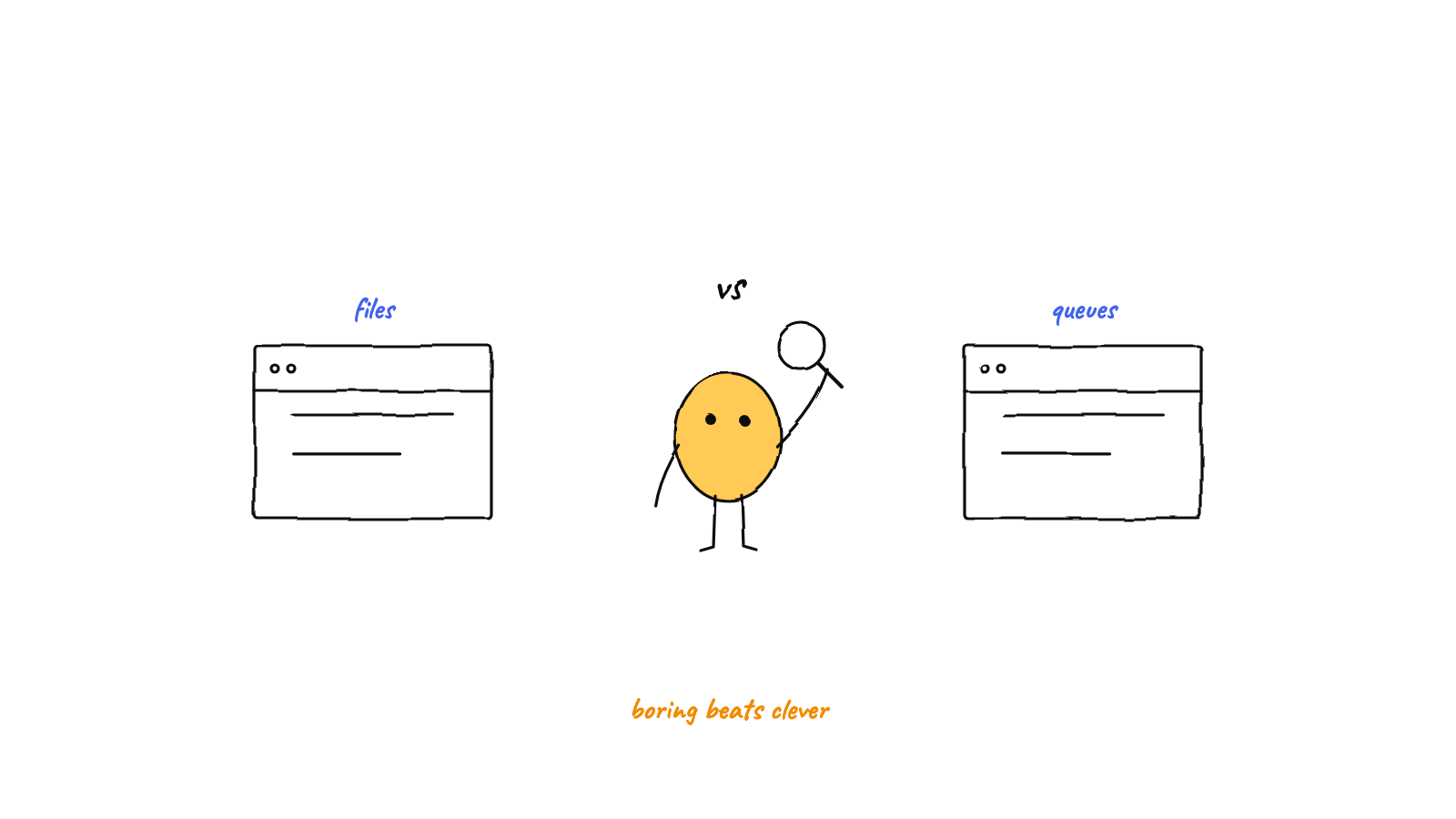
A message broker like Redis or RabbitMQ is the reflex for "how do agents talk?" — but for a local hive of a few dozen agents, plain files win. One JSON file per message, append-only logs, a shared markdown board, and a single committer give you coordination that's durable, human-readable, git-versioned, and zero-ops. You give up push-latency and built-in fan-out — neither of which a supervised hive needs until it leaves one machine. Files are the right default; a broker is what you graduate to.
When you wire up your first multi-agent system, the instinct is to grab a message queue. It’s what backend services use to talk, so surely agents need one too. For a local, human-supervised hive, that instinct is usually wrong. Here’s the case for coordinating agents through plain files instead — and an honest look at where that choice runs out.
What “file-based coordination” actually means
It’s not one trick; it’s a few small, boring mechanisms that compose:
hive/
  agents/
    pam/
      inbox/        one JSON file per incoming message
      outbox/       one JSON file per outgoing message
      memory.md     durable notes the agent appends to
      cursor.json   last-processed marker (exactly-once surfacing)
  board.md          shared plan, one scribe
  log.jsonl         append-only event log
Agents communicate by writing a message file into a peer’s inbox; a router moves each outbox file to its recipient. Shared plans live in one markdown board. History is an append-only log. Nothing here is a database or a daemon — it’s files on disk, and that’s the point.
Why files beat a broker for a hive
You can read it. A message is a file you can cat. The whole system state is a directory you can
list. When something goes wrong, you debug by looking — no broker admin UI, no “drain the queue to see
what’s stuck.” For agents, whose behavior is already hard to inspect, legible coordination is worth a lot.
It’s durable by default. Files survive a crash, a restart, a laptop sleep. There’s no in-memory queue to lose, no “did the broker persist that?” A message sits in the inbox until it’s handled, full stop.
It’s version-controlled. Put the hive in git and you get an audit trail for free: who said what, when, diffable, replayable. You can time-travel the entire coordination history. No broker gives you that without bolting on extra logging.
It degrades gracefully. If the UI crashes or the semantic index breaks, the files still work — agents keep reading and writing. The coordination layer has no single runtime dependency that takes the whole system down with it.
It’s zero-ops and local. No broker to install, secure, monitor, or pay for. Everything stays on your machine, which is also a smaller attack surface.
The honest tradeoffs
Files are not magic. Choosing them means accepting real limits:
- Latency is pull, not push. You learn about a new message by scanning a directory or waiting on a filesystem watcher — sub-second to a few seconds, versus a broker’s instant push. Fine for turns measured in seconds; wrong for high-frequency streaming.
- You build the semantics yourself. Ordering, exactly-once delivery, and fan-out aren’t free. A
per-agent
cursor.jsongives exactly-once surfacing; a router gives delivery — but you wrote those. A broker ships them. - Concurrency needs a discipline. Many writers to one file is a recipe for corruption. The fix is structural: one file per message (single writer), and a single committer for shared state like the board and the git history. Agents never contend; they just drop files.
- It doesn’t cross machines. Files coordinate processes on one host. The moment your agents live on different boxes, you need something networked.
When to actually reach for a queue
Use the decision, not the dogma. Files are right when your hive is local, supervised, and dozens of agents — where debuggability, durability, and zero-ops dominate. Switch to a broker (Redis, RabbitMQ, NATS, Kafka) when you genuinely need one of: distribution across machines or services, high throughput (thousands of messages/second), pub-sub fan-out to many consumers, or backpressure at scale. Those are real needs — they’re just not the needs of a coding-agent hive on your laptop.
A useful hybrid, worth noting: files for coordination (mailboxes, board, log — the durable, inspectable substrate) and a lightweight local socket for live telemetry where you do want push. That’s exactly the split a hook shim makes — events stream over a Unix socket in real time while the durable record stays in files.
FAQ
Doesn’t a broker scale better? Yes — that’s its whole job. The question is whether you need that scale. A supervised hive of dozens of agents trading messages every few seconds is nowhere near a broker’s problem domain, and pays for the scale it isn’t using in ops and opacity.
What about losing messages? A file in an inbox is the message. It can’t be lost to a process restart because it was never in a process — it’s on disk until something handles it and moves it. That’s stronger durability than a default in-memory queue.
Can I migrate later? Easily. Files give you a clean seam: the router that moves messages is the one place that’d swap to a broker. Coordinate through files now; if you outgrow a single machine, change the transport without rewriting the agents.
Munder Difflin coordinates a whole hive of Claude Code agents through plain files — inboxes, a shared board, an append-only log, and a single committer — so the whole system is durable, git-versioned, and debuggable by just looking. Download Munder Difflin to run it locally; it’s free and open source.
FAQ
Why not just use Redis or RabbitMQ for agent messaging?
Because a message broker is infrastructure you have to run, secure, and monitor — and for a local hive of a few dozen agents it buys you throughput and distribution you don't need, at the cost of debuggability you very much do. Plain files give you durable, human-readable, git-versioned coordination with zero ops. You reach for a broker when you outgrow a single machine, not before.
Isn't file-based messaging slow?
It's higher-latency than a push-based broker — you're bounded by how often you scan a directory or how fast a filesystem watcher fires, typically sub-second to a few seconds. For agent turns that take seconds to minutes, that latency is irrelevant. It would matter at thousands of messages per second; a supervised hive isn't operating there.
How do you avoid two writers clobbering each other?
Write each message as its own file (one writer per file, atomic create-then-rename), and funnel commits to shared state through a single committer. No two processes ever edit the same file, so there's no lock to contend and no torn write to recover from.