Why Local-First Matters for Your AI Agents
The control, privacy, and cost case for keeping your AI agents and their memory on your own machine — and what cloud orchestration quietly costs.
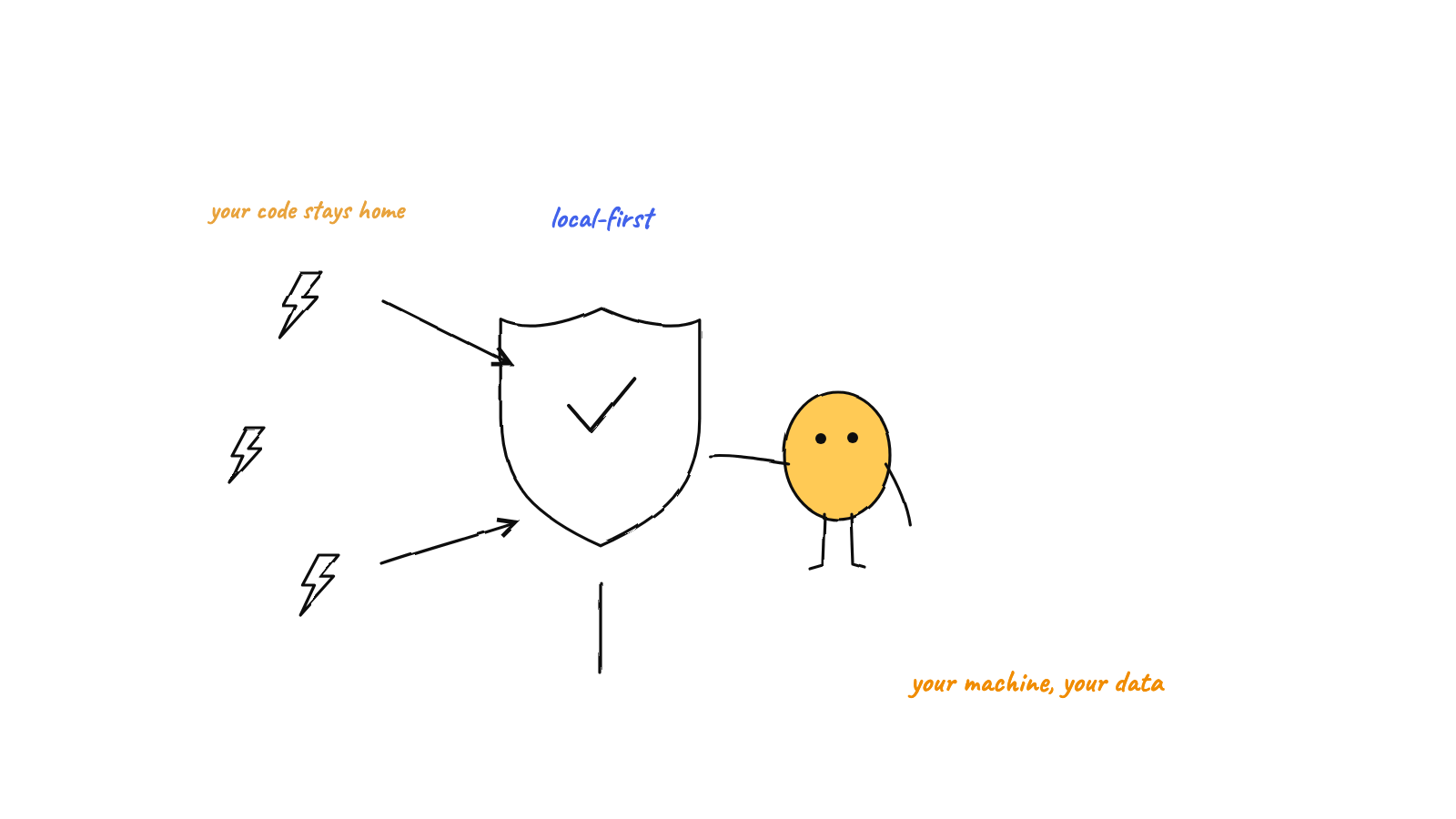
Local-first means your agents, their orchestration, and their memory live on your machine — not in a vendor's cloud. You get more control (it's your files and your rules), more privacy (code and memory don't leave the box), and more predictable cost (no per-seat platform fees on top of model usage). For AI agents that touch your whole codebase, that's not a detail — it's the foundation.
When people evaluate multi-agent tools, they fixate on features and skip the question that quietly shapes everything: where does this actually run? For agents that read and edit your entire codebase, the answer matters more than any single feature.
What “local-first” actually means
Local-first doesn’t mean “no internet.” Your agents still call the model — that request goes to Anthropic the same way your editor’s does. Local-first is about where the rest lives:
- the orchestration that routes work between agents,
- the files the agents read and write,
- the memory the team accumulates, and
- the message history and event log of what happened.
In a local-first setup, all of that stays on your machine. In a cloud platform, much of it lives on someone else’s servers. Same agents, very different trust model.
Three reasons it matters
1. Control — it’s your machine, your rules
Local agents work against your real working tree, your git, your environment, your tools. Nothing is mediated by a platform’s sandbox or subject to its outages, rate limits, or deprecations. When the team is local, you own the failure modes — and you can fix them.
2. Privacy — your code and memory don’t leave the box
Agents that touch your whole repo accumulate a lot of context: source, secrets-adjacent config, internal docs, and a memory store full of your project’s hard-won knowledge. Keeping orchestration and memory local means there’s no third party storing your codebase’s working notes. For client work, regulated environments, or just good hygiene, that’s a real advantage.
3. Cost — predictable, without a platform tax
Cloud agent platforms typically charge per seat or per run on top of your model usage. Local-first adds no platform tax — you pay for the model calls you’d make anyway. As you scale from a couple of agents to a team, that difference compounds.
What you give up in the cloud
It’s only fair to name the trade. Cloud platforms can offer zero-setup onboarding, managed scaling, and team features out of the box. If you need a hosted, shared, always-on service for a distributed team, that convenience is real. The same trade shows up in personal assistants, as our look at Grok Bot alternatives shows.
But for an individual developer or a small team running agents against their own code, the convenience rarely outweighs handing over control, privacy, and predictable cost. You can have the coordination and keep it local.

Local-first doesn’t mean uncoordinated
The old assumption was that local meant primitive — a few terminals, no shared brain. That’s no longer true. A local multi-agent harness gives you the full coordination layer — shared memory, inter-agent messaging, an orchestrator, a visual floor — entirely on your machine. You don’t trade coordination for control; you get both.
That’s the bet behind running an office of AI agents locally, and it’s why the shift from one terminal to a team doesn’t require moving to the cloud.
The bottom line
For agents that live inside your codebase, where it runs is a first-class feature. Local-first buys control, privacy, and predictable cost — and modern tooling means you no longer sacrifice coordination to get them.
Munder Difflin is local-first by design: the hive, the orchestrator, and MemPalace all run on your machine, on macOS, Windows, and Linux. Download Munder Difflin — free and open source.
FAQ
What does local-first mean for AI agents?
Local-first means the orchestration layer, the agents, and their memory all run on your own machine — not in a vendor's cloud. Your agents still call the model API, but the coordination, files, and stored knowledge stay local.
Is local-first more private than cloud agent platforms?
Generally yes for everything except the model call itself. Your code, memory, message history, and orchestration never leave your machine, so there's a far smaller surface where your project data could be stored or exposed.