Run an Office of AI Agents While You Sleep
What it takes to run a self-coordinating office of AI coding agents that keeps shipping after you log off — and the guardrails that keep it sane.
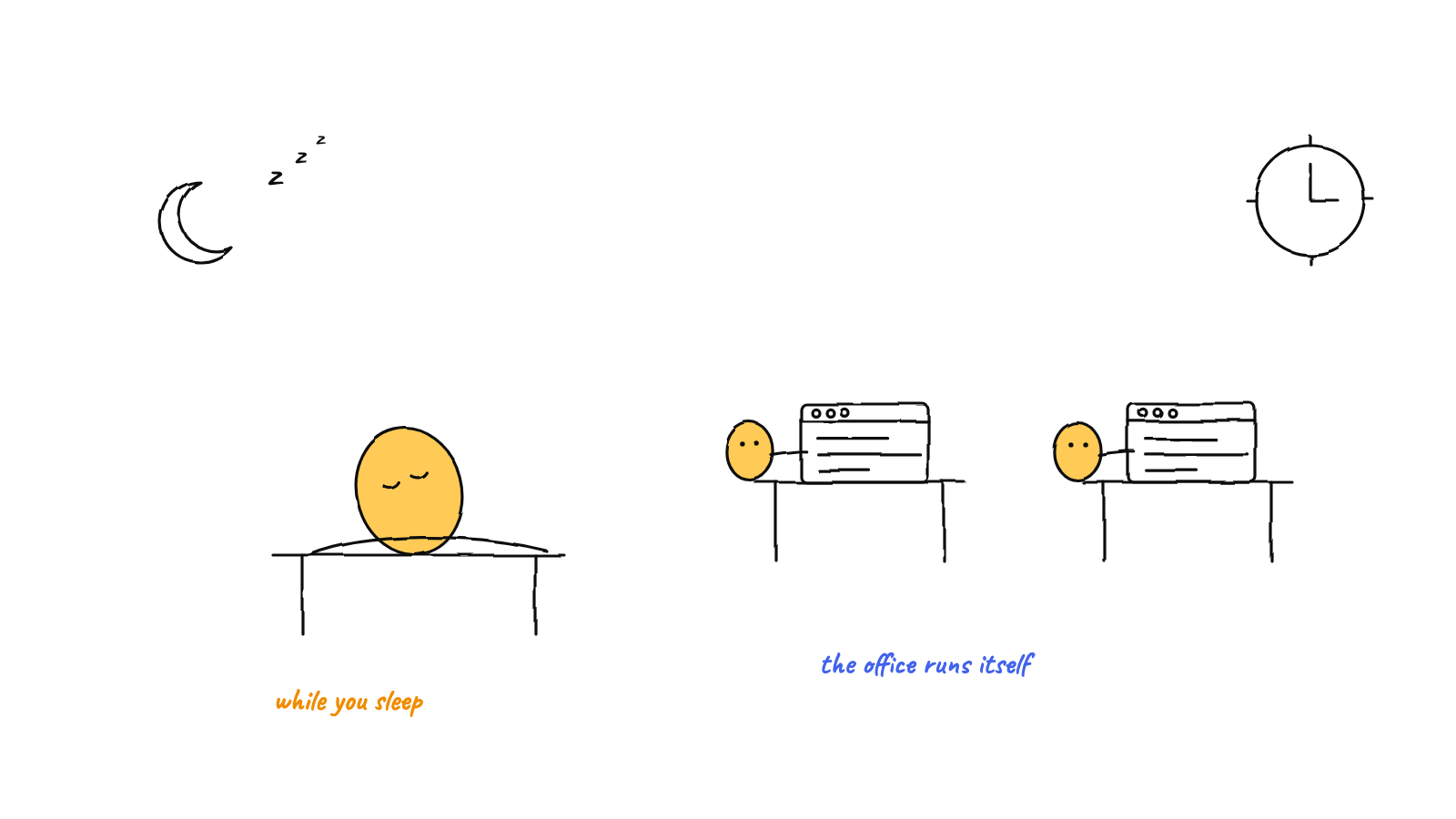
Imagine an office of AI agents — each with a role, a shared memory, and a coordinator — that keeps working a backlog after you close the laptop. It's not magic and it's not hands-off forever: it works because of roles, shared memory, messaging, an orchestrator, and guardrails that escalate the risky calls to you. Here's the realistic version of the dream.
There’s a specific fantasy that pulls people toward multi-agent tools: log off at night, and a team of agents keeps shipping. It’s a good fantasy — and a more achievable one than it sounds, if you build it on the right foundations. Here’s what that office actually looks like.
The picture
Picture a floor of agents, each at a desk with a job. One’s writing tests. One’s chewing through a refactor. One’s updating docs to match. A coordinator — you talk to it like a manager — has the backlog and routes the next task to whoever’s free. They message each other when work hands off. They share a memory of the project so nobody re-learns what’s already known. You can watch it happen, or close the laptop and check the morning’s progress over coffee.
That’s not a metaphor for Munder Difflin — it’s literally the office floor. But the picture only works because of what’s underneath it.
What makes it actually work
A self-running office isn’t “point agents at a repo and hope.” Four pieces carry the weight:
Roles
Each agent has a scoped job, so it doesn’t wander into another’s work or duplicate effort. Roles make “who does this?” obvious and keep parallel agents out of each other’s lanes.
Shared memory
The team reads from and writes to a shared long-term memory. When the test-writer learns a convention, the refactorer inherits it. Knowledge compounds overnight instead of resetting each session.
Messaging + an orchestrator
Agents hand work to each other through mailboxes, and an orchestrator decomposes your intent and routes the pieces. That’s the difference between a team and a pile of parallel sessions — and it’s what lets work flow while you’re away.
Guardrails
This is the part the fantasy skips. Unattended agents need a human-in-the-loop line: routine work proceeds, but the risky stuff — spending real money, destructive operations, big scope changes — queues for your approval. You wake up to progress, not surprises.

What’s realistic (and what isn’t)
Honesty matters here, because over-promising is how people get burned:
- Realistic: a team grinding through a well-scoped backlog of bounded tasks overnight — tests, refactors, docs, migrations, investigations — with a clear record of what each agent did.
- Realistic: waking up to mostly-done work that you review and finish, having saved hours of context-switching.
- Not realistic: handing over an ambiguous, open-ended goal and expecting a finished product with zero review. Agents are leveraged labor, not oracles.
The skill is in the scoping and the guardrails, not in trusting blindly. Done right, the leverage is real.
How to get there
You don’t start with an overnight office — you grow into one. The arc is always the same: one session, then a few manual terminals, then a coordinated team. We map that progression in from one terminal to a team, and the foundational habits in how to run multiple Claude Code agents.
Keeping the whole office local-first is what makes it sane to leave running: it’s your machine, your files, your rules.
Munder Difflin is exactly this office — roles, shared memory, messaging, a GOD orchestrator, and a floor you can watch, all local. Download Munder Difflin and staff your own; it’s free and open source.