The Hook Shim Pattern: Wiring Agent Hooks to a Live Process
How a tiny shim bridges Claude Code's lifecycle hooks to one live process over a Unix socket, turning per-event hooks into a telemetry and control channel.
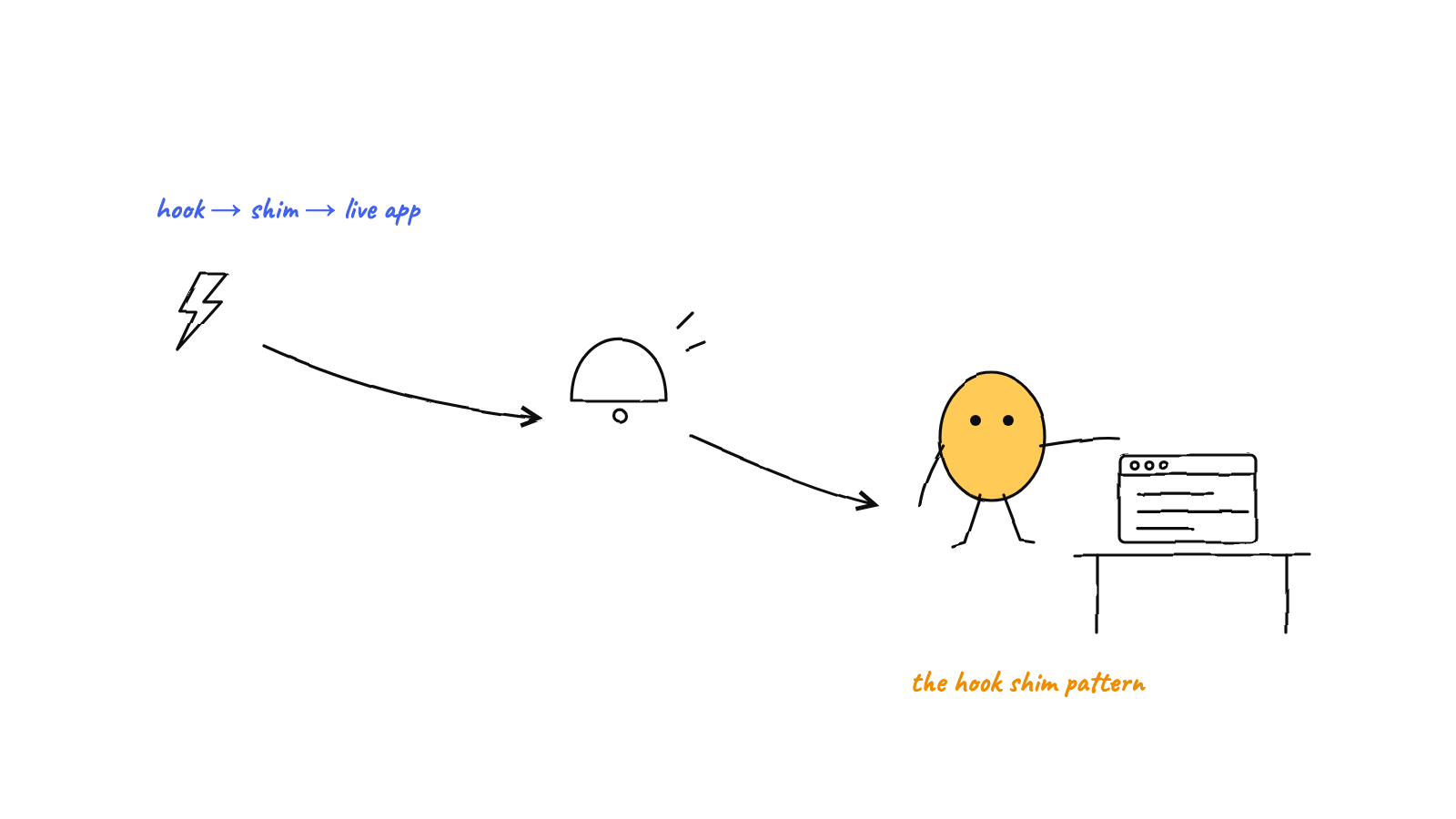
Claude Code fires lifecycle hooks (Stop, PreToolUse, Notification…) as shell commands. Putting real logic in those commands is a trap — it's per-event, lives in the user's repo, and can't share state. The hook shim pattern fixes it: each hook runs a tiny shim that forwards its payload over a Unix-domain socket to one long-running process holding all the logic. The shim is a dumb pipe that never crashes a turn; the main process gets a live telemetry feed and a control channel back.
Claude Code hooks are a great extension point: at defined moments — a tool is about to run, the agent stopped, a notification fired — Claude Code runs a shell command you configure, hands it a JSON payload on stdin, and reads a JSON response from stdout. Simple and powerful.
The trap is doing the work in that command. If you’re building something live — a UI that shows what each agent is doing, an autonomous loop that re-engages an idle agent — a per-event shell script is the wrong home for that logic. Here’s the pattern we use instead, and why it holds up.
Why logic-in-the-hook doesn’t scale
A hook command has three problems as a place for real behavior:
- It’s short-lived. Each event spawns a fresh process that dies immediately. There’s nowhere to keep state — avatar status, a per-agent cursor, an event log — without re-reading it from disk every time.
- It lives in the user’s settings. Hook config is attached to a session via
--settings. Bake logic in and every code change means rewriting that config; it also can’t easily reach your app’s in-memory state. - It’s risky. A hook that throws or hangs can stall the agent. Logic and the agent’s turn shouldn’t share a failure mode.
You want the trigger to stay at the edge and the logic to live in one place. That’s exactly what a shim buys you.
The shim: a dumb pipe
The harness writes a tiny script — cth-hook.cjs — into the hive directory and points every hook at it.
Its entire job is to forward:
// read the hook payload on stdin, tag it, forward to the socket, relay the reply
const net = require('net');
let data = '';
process.stdin.on('data', (d) => { data += d; });
process.stdin.on('end', () => {
  const payload = JSON.parse(data || '{}');
  payload.agent_id ||= process.env.AGENT_ID;
  const sock = process.env.HIVE_SOCK;
  if (!sock) process.exit(0);
  const c = net.createConnection(sock, () => c.write(JSON.stringify(payload) + '\n'));
  let resp = '';
  c.on('data', (d) => { resp += d; });
  c.on('end', () => { if (resp) process.stdout.write(resp); process.exit(0); });
  c.on('error', () => process.exit(0));
  setTimeout(() => process.exit(0), 5000).unref();
});
Notice what it does not do: no decisions, no disk, no state. It tags the payload with the agent’s id
(from an env var the agent was spawned with), opens a Unix-domain socket to the main process, writes one
line of JSON, and relays whatever comes back. And notice the guards — missing socket, connection error,
and a 5-second timeout all exit(0). The shim can never crash the agent’s turn. That’s the contract.
All the logic lives in one process
On the other end, the app’s main process listens on that socket and holds everything:
const server = createServer((conn) => {
  let buf = '';
  conn.on('data', (d) => {
    buf += d.toString();
    const nl = buf.indexOf('\n');
    if (nl === -1) return;                 // wait for the full line
    const payload = JSON.parse(buf.slice(0, nl));
    conn.end(JSON.stringify(handle(payload)));
  });
});
server.listen(sockPath);
handle() is where the real work happens — and because it’s one resident process, it can keep live state
the per-event hooks never could. PreToolUse / PostToolUse / Notification events drive each agent’s avatar
on the office floor; the same feed can append to an
event log. The hooks settings route all the relevant events
(Stop, SubagentStop, PreToolUse, PostToolUse, UserPromptSubmit, Notification, SessionStart)
through the one shim, so the main process sees the whole lifecycle of every agent in real time.
The real payoff: a control channel, not just telemetry
Because Claude Code reads the hook’s JSON response, the shim isn’t a one-way feed — it’s a round trip. The main process can answer. That’s what turns observation into control.
The clearest example is the autonomous loop. When an agent hits Stop, the main process checks that
agent’s inbox. If a message is waiting, it replies with
{"decision":"block","reason":"<the message>"} — and Claude Code keeps the agent working to handle it
instead of going idle. An agent that another agent (or the orchestrator)
just messaged picks the work up on its own.
The danger with any “keep going” mechanism is an infinite loop, so the payload carries a stop_hook_active
flag: if a previous Stop already blocked this turn, the process lets the agent stop. Re-engage once, never
forever. A genuine stop with an empty inbox falls through to a desktop “idle” notification.
Why this pattern is worth copying
If you’re wiring agent lifecycle hooks into anything stateful, the shim pattern gives you four things at once: decoupling (refresh the shim from code on startup; the session’s hook config never moves), a single source of truth (one process, real in-memory state), safety (the edge can fail without stalling the agent), and a control channel (reply with a decision, don’t just log). The trigger stays tiny and dumb; the brains stay in one testable place.
FAQ
Why a Unix socket and not HTTP? It’s local-only, fast, and needs no port or auth — the shim and the app are on the same machine. The payload is one line of newline-delimited JSON, so framing is trivial.
What happens if the main app isn’t running? The shim finds no socket (or fails to connect) and exits 0. The agent’s turn proceeds normally; you lose telemetry for that event, not the agent.
Does this only work for Claude Code? The pattern is general: any tool that runs a command per event and reads a response can be bridged this way. Claude Code’s hook payloads and decision response just make it a clean fit.
Munder Difflin uses exactly this shim to drive a live office floor and an autonomous inbox-drain loop for a whole hive of Claude Code agents — all local, with the agent’s turn never at the mercy of the bridge. Download Munder Difflin to see it run; it’s free and open source.
FAQ
Why not put the logic directly in the hook command?
Because a hook is a per-event shell command, and burying real logic there means editing the user's repo settings, re-installing on every code change, and duplicating state across short-lived processes. A shim forwards the event to one long-running process that holds all the logic — so you change behavior in one place, and the hook config never has to move.
What does the shim actually do?
Almost nothing, on purpose. It reads the hook payload from stdin, tags it with the agent's id, opens a Unix-domain socket to the main process, writes the payload, relays the response back to stdout, and exits. Every failure path exits 0 so it can never crash the agent's turn.
Can a hook do more than observe — can it steer the agent?
Yes. Claude Code reads the hook's JSON response, so the main process can reply with a decision — for example {"decision":"block","reason":"..."} on a Stop event to keep the agent working. That's how an autonomous inbox-drain loop is built, guarded so it can never loop forever.