Compressing Agent Memory Without Losing the Original
How and why to compress an agent's long-term memory: the toolbox, the lossy trap, and keeping a lossless original beside a compact copy.
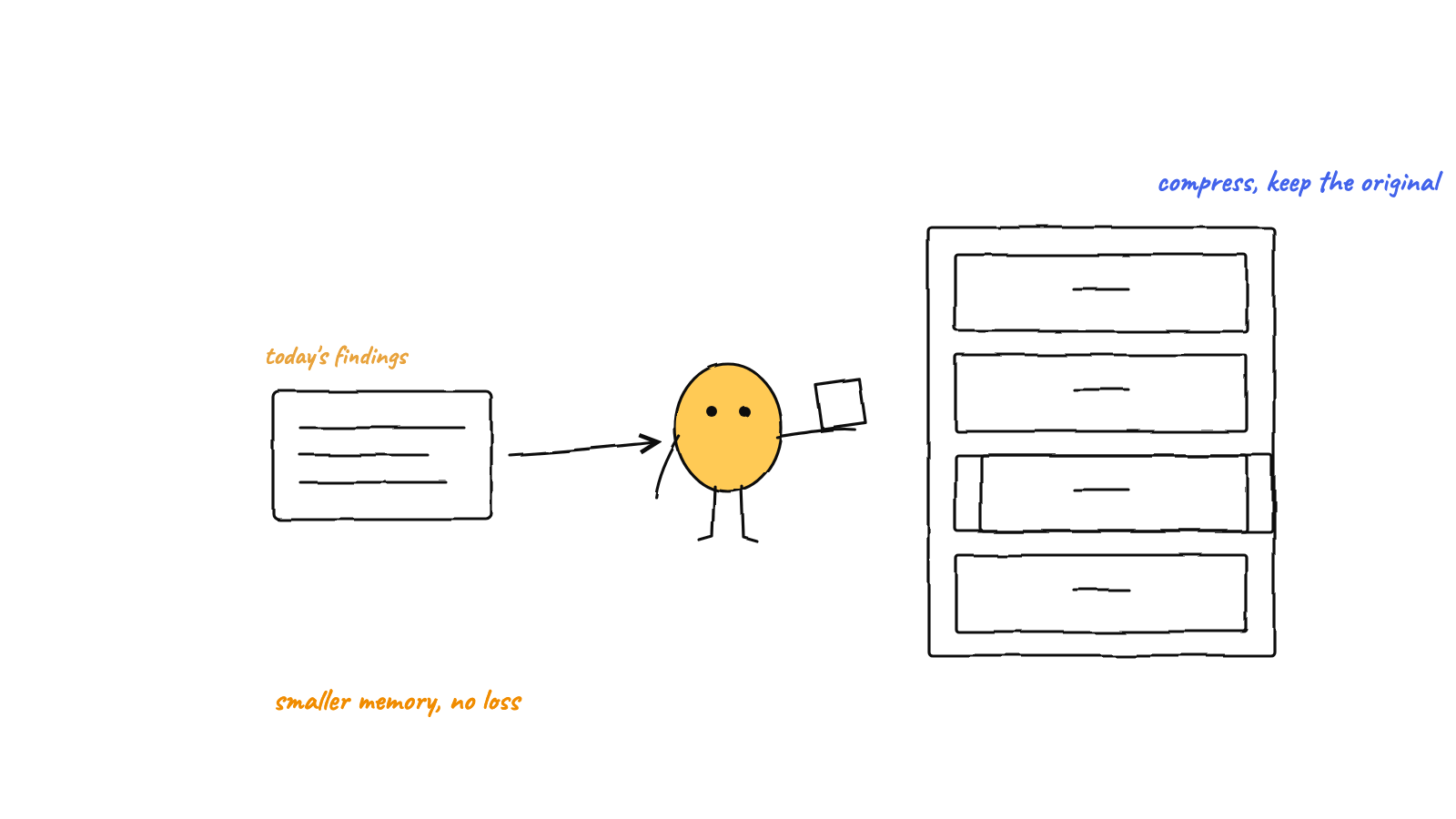
An agent's memory grows forever; its context window does not. The 2026 answer isn't a bigger window — it's compression: store dense, high-signal memory so a session can load months of history in a few thousand tokens. The catch is that compression is lossy in unpredictable ways. The pattern that makes it safe: keep the lossless original on disk and compress a copy for fast recall — never let the summary become the only record.
Every useful agent accumulates memory — decisions, facts, what worked and what didn’t. That store only grows, while the context window an agent can actually read stays fixed. So “memory” for agents is really a compression problem: how do you let the knowledge base grow for months without dragging all of it back into a finite, expensive context every session? Here’s how to think about compressing agent memory, the trap to avoid, and the pattern that keeps it safe.
Why compress at all
The reflex is to reach for a larger context window. In 2026 the better instinct is the opposite. Teams building the most capable agents have stopped chasing window size and started deliberately reducing what the agent carries forward — because more context means more noise, higher cost per call, and a window that still fills up. Compression buys three things at once:
- A bounded wake-up. An agent should start a session by loading what it knows in a small, fixed token budget — not by re-reading everything. Compression is what keeps that digest small as the store grows.
- Lower cost. Tokens are the bill. Denser memory is a cheaper agent, every call.
- Better signal. A tight, distilled memory recalls sharper than a transcript dump. This is the same reason memory hygiene matters — what you feed the recall layer decides what it returns.
The compression toolbox
A few techniques, cheapest to deepest:
- Summarization — roll older history into summaries (hierarchical, so summaries-of-summaries keep the oldest material tiny).
- Selective retention / pruning — keep mission-critical facts, drop the noise. Not everything is worth remembering.
- Offloading — push bulky content to disk and keep a pointer plus a short preview, re-reading the full thing only on demand.
- Provider-side compaction — some APIs compress older conversation turns at a threshold (reductions around 80% are reported) so a long session keeps running.
- Structured distillation — pack each exchange into a dense, symbolic form. Reported ratios reach ~11x on engineering conversations, and purpose-built memory dialects claim far higher.
These differ in where they run, but they share one goal: fewer tokens, same meaning.
The trap: lossy in ways you can’t predict
Compression is not deterministically lossy — it can drop exactly the wrong thing. A revenue definition is simple until it includes “except for multi-year prepayment contracts”; summarize the exception away and the answer looks clean and computes the wrong number. A table summary that drops the upstream source kills auditability. A summary that drops a data-classification tag forgets that something was sensitive. You can’t reliably detect these losses after the fact, because each individual summary reads as plausible.
The governance rule that follows: every compressed chunk should retain a pointer back to its source — version and timestamp included — so the system can always route from the dense form back to the exact original. Which leads to the pattern worth copying.
The pattern: keep the original, compress a copy
The clean answer is to refuse the false choice between “lossless but huge” and “compact but lossy” — and keep both. This is how the hive’s semantic memory layer (MemPalace) is built, and it’s the part most worth stealing:
- Each raw memory lives in a drawer that holds the complete original, verbatim — never summarized, never paraphrased. Search returns the exact words you stored.
- When you turn compression on, a closet sits beside that drawer holding a compact, symbolic summary (MemPalace’s AAAK dialect reports roughly 30x reduction) that preserves the semantic and relational gist.
- At wake-up, an agent loads the compressed closets — absorbing a large span of history in a few thousand tokens — while any deep lookup can still pull the lossless drawer.
The harness side is deliberately thin: every agent writes plain
markdown memory, and a background miner feeds those notes into the
shared palace; recall is a search or a wake-up away. The markdown is the source of truth; the
compressed index is an accelerator built on top of it — never instead of it. That ordering is the whole
trick: compression buys speed; the preserved original buys correctness. You get the small wake-up
digest without ever betting your only copy on a summary.
When not to compress
Compression is a tradeoff, not a default. Skip it (or always keep the original alongside) when the working set already fits comfortably — compressing tiny context adds latency and lossy risk for no gain; when the task is audit- or compliance-critical and you need the exact source; when the content is full of exceptions and edge-cases a summary tends to flatten; or when data carries classification or provenance that must travel with it. The cross-cutting rule again: never let the compressed copy become the only copy of something you might need to defend or trace.
FAQ
Is this the same as RAG? Related but not the same. Retrieval fetches relevant chunks; compression changes how densely those chunks are stored and loaded. They compose — you retrieve, and what you retrieve can be compressed for a smaller, sharper context.
How much can I compress safely? As much as you like if the lossless original is preserved and pointer-linked. The compressed form’s job is fast recall; correctness lives in the untouched source you can always fall back to.
Does compression help cost or just context size? Both. Fewer tokens loaded per session is directly fewer tokens billed — compression is one of the cheapest levers on an agent’s running cost.
Munder Difflin gives every Claude Code agent markdown memory plus a shared semantic palace that keeps the lossless original and a compact, recall-fast copy — so months of context load in a few thousand tokens, locally. Download Munder Difflin to give your agents memory that compresses without forgetting; it’s free and open source.
FAQ
Why compress an agent's memory instead of using a bigger context window?
Because a bigger window carries more noise, costs more per call, and still fills up. The 2026 consensus is to compress what the agent carries forward — fewer, denser tokens of signal — rather than chase a larger window. Compression is what lets a memory store grow for months while the wake-up context an agent loads stays small.
Doesn't compressing memory lose information?
It can — compression is non-deterministically lossy, and a summary can silently drop the one exception or classification tag that mattered. The fix is to never make the compressed copy the only copy: keep the lossless original on disk and treat the compressed form as a fast-recall accelerator built from it, not a replacement.
What actually gets compressed — the stored memory or the prompt?
Both are valid, at different layers. You can compact the live conversation as it approaches the window limit, and you can compress long-term stored memory so a session can absorb months of history in a few thousand tokens at wake-up. This post is mostly about the second: durable memory you recall across sessions.