Gemini 4 Neon vs Claude Opus 5.5: Price and Limits (Nov 2026)
Gemini 4 Neon costs $18 for 1M input plus 1M output tokens, Claude Opus 5.5 costs $24. Limits, agent tools and vendor scores, checked 19 Nov 2026.
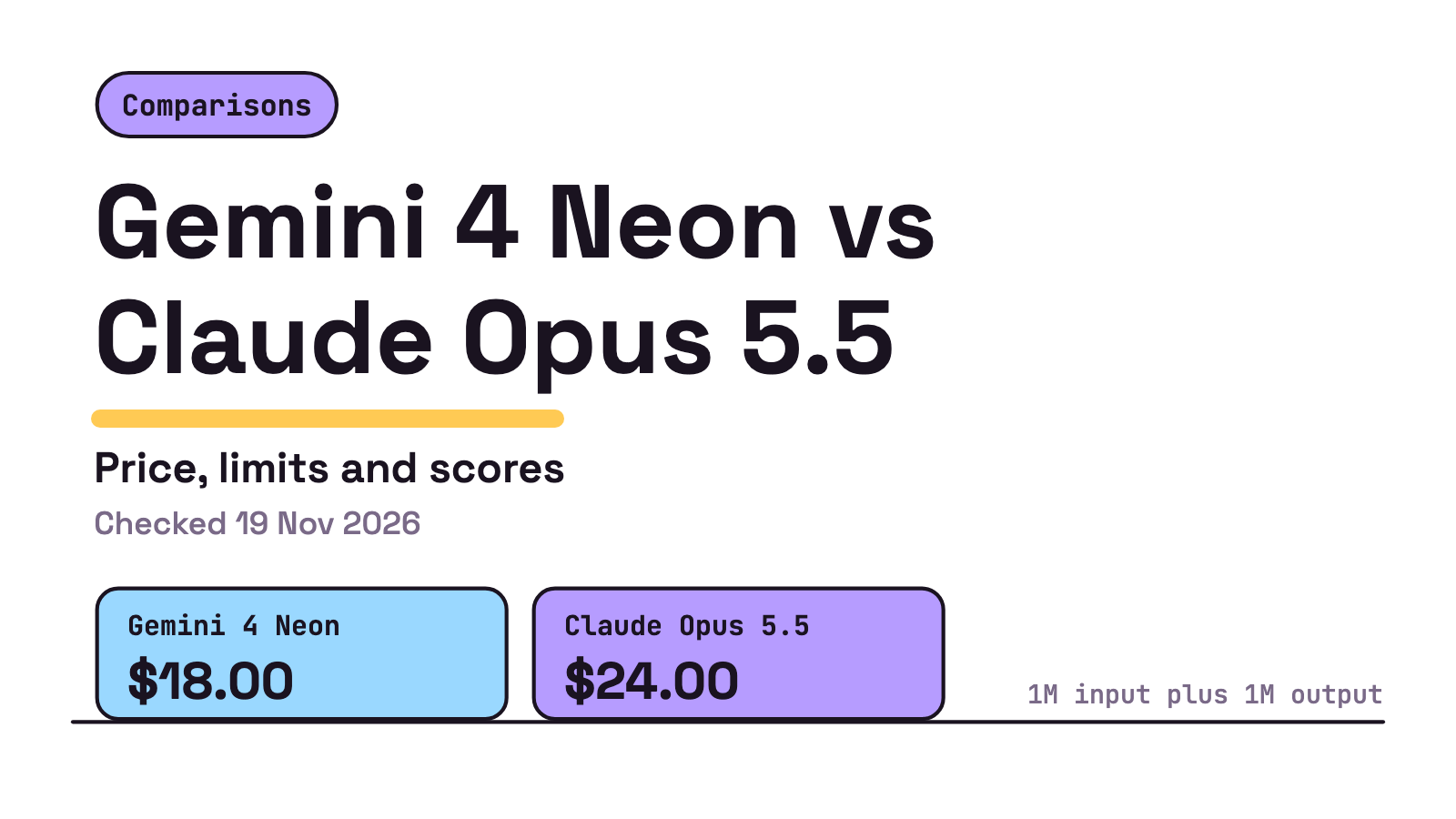
Gemini 4 Neon is the cheaper model, at $18.00 against $24.00 for 1M input plus 1M output tokens on 19 Nov 2026, while Claude Opus 5.5 has the larger default output limit and is what Claude Code runs by default. Both take a context of about 1M tokens.
Our Gemini 4 Neon page covers the launch; Gemini 4 Argon vs Claude Opus 5.5 covers Argon.
Gemini 4 Neon vs Claude Opus 5.5 at a glance (checked 19 Nov 2026)
Neon wins on price, Opus 5.5 on default output and knowledge cutoff.
| Gemini 4 Neon | Claude Opus 5.5 | |
|---|---|---|
| Released | 18 Nov 2026 | 22 Sep 2026 |
| Model ID | gemini-4-neon |
claude-opus-5-5 |
| Input, per 1M tokens | $3.00 | $4 |
| Output, per 1M tokens | $15.00 | $20 |
| Cache read, per 1M tokens | $0.15 | $0.20 |
| Context window | 1,048,576 tokens | 1M tokens |
| Max output | 65,536 by default; up to 1,048,576 with long decode | 128K tokens |
| Thinking | Four levels, default high | Adaptive, default effort medium |
| Knowledge cutoff | March 2026 | Jun 2026 |
Sources, checked on 19 Nov 2026: Google’s launch post, model page, pricing and model card; Anthropic’s models overview, pricing and Opus 5.5 post.
Which is cheaper, Gemini 4 Neon or Claude Opus 5.5?
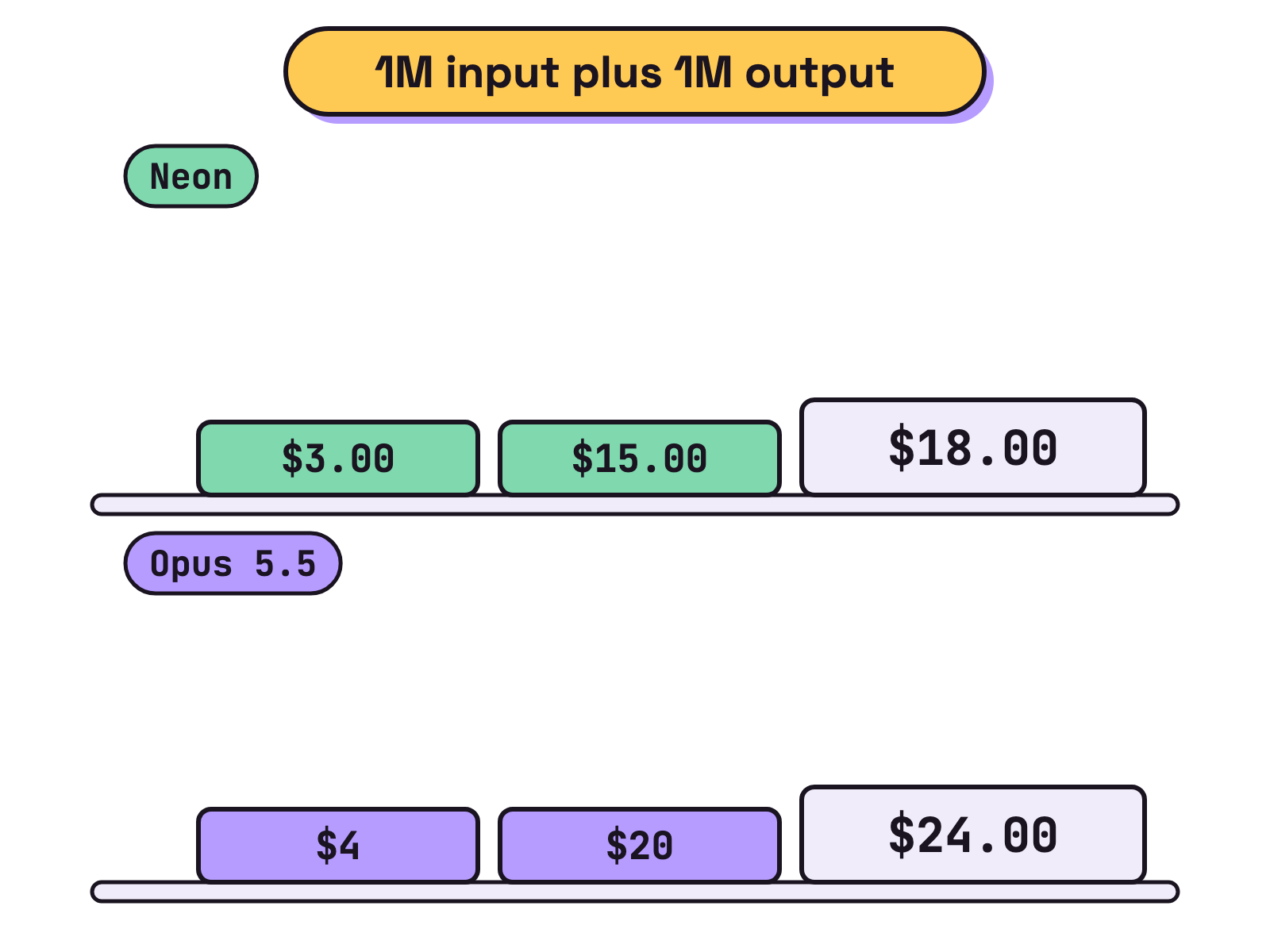
Gemini 4 Neon, by a quarter for the same tokens. On 19 Nov 2026 Google’s pricing page listed Neon at $3.00 per million input tokens and $15.00 per million output tokens on the paid tier, and Anthropic’s pricing page listed $4 and $20 for Claude Opus 5.5. For 1M input plus 1M output tokens on 19 Nov 2026:
- Gemini 4 Neon: $3.00 + $15.00 = $18.00
- Claude Opus 5.5: $4 + $20 = $24.00
Batch keeps the gap: Google lists Neon’s Batch tier at $1.50 and $7.50, and Anthropic’s Batch API takes 50% off, to $2 and $10, so the pair costs $9.00 against $12.00 on 19 Nov 2026. Cache reads on 19 Nov 2026 cost $0.15 for Neon (implicit caching only) and $0.20 for Opus 5.5.
Google’s page adds that Neon “is not available on the Free tier” and bills thinking tokens as output. Neither vendor charges more for long prompts: Google’s developer guide says Neon “uses flat pricing across the full 1M context window”, and Anthropic says Claude 4.6 and later models, except Haiku 5.5, “include the full 1M token context window at standard pricing”.
Which has the bigger limits?
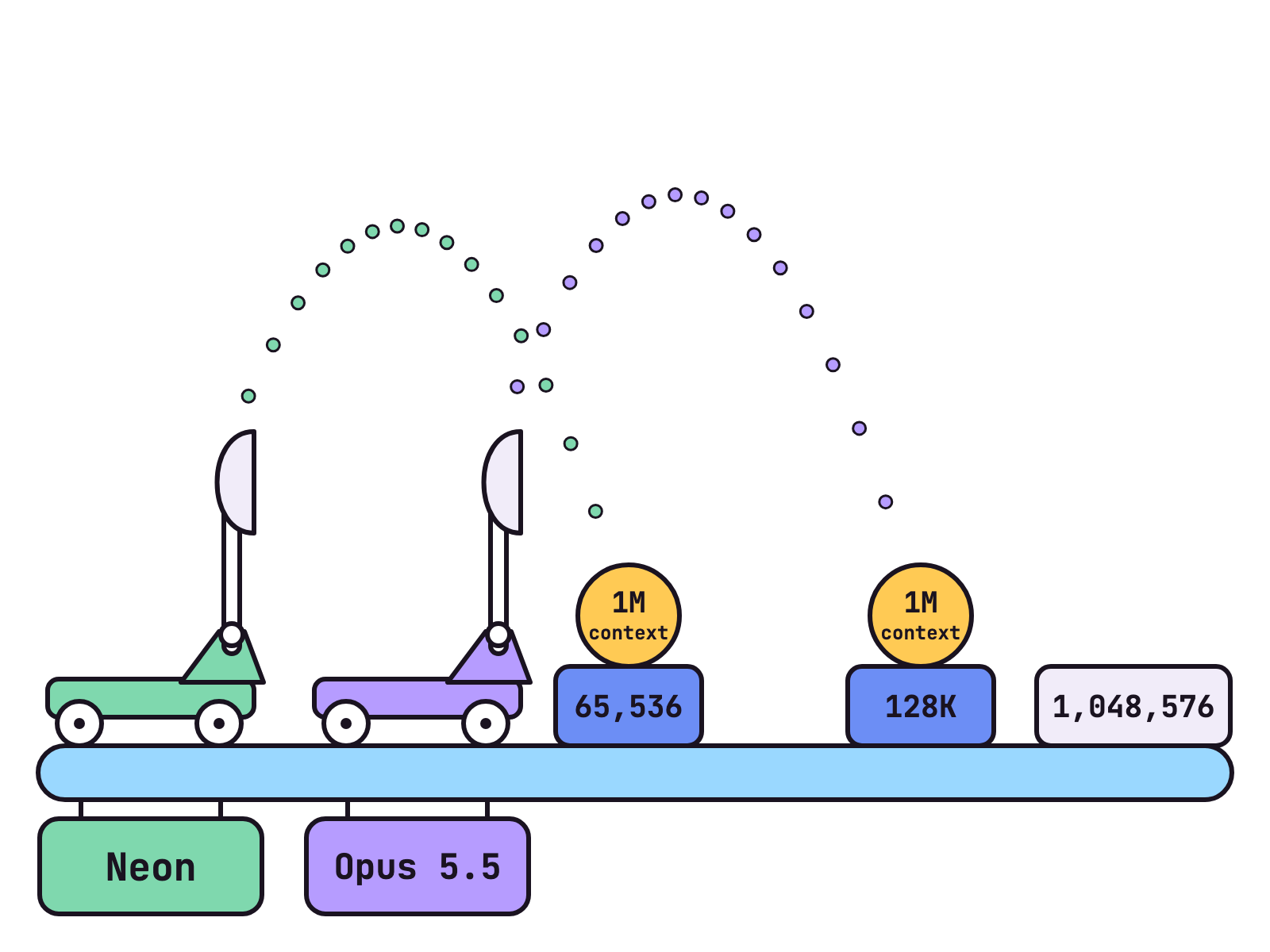
They tie on context and split on output. Google’s model page lists a context window of 1,048,576 tokens for Neon, “unified input and output”, and Anthropic’s models overview lists 1M tokens for Opus 5.5, both read 19 Nov 2026, so both take a 1M context.
Anthropic lists 128K tokens of max output for Opus 5.5. Google lists 65,536 for Neon as the “default synchronous” limit, and “up to 1,048,576 (with long decode)”, which its developer guide runs in the background in 64K hops.
Neon reads “Text, Image, Video, Audio, and PDF”; Anthropic says current Claude models “support text and image input, text output”. Neon’s model card of 18 Nov 2026 gives a knowledge cutoff of March 2026, and Anthropic’s overview gives Jun 2026 for Opus 5.5.
How does each run with Claude Code, Gemini CLI and other agent tools?
Opus 5.5 is Claude Code’s default; Google names no Gemini CLI route for Neon. Each page, read 19 Nov 2026:
- Claude Code: its model configuration page makes Opus 5.5 the default on Pro, Max, Ultra, Team, Enterprise and the Anthropic API; it “requires v2.1.280 or later”.
- Munder Difflin: free and open source: a desktop app that runs a team of AI agents for all kinds of knowledge work, coding included, on your own computer. It can run Claude Code and Gemini CLI as engines.
- Gemini CLI: its README says it is “Not tuned for the Gemini 4 series (for example, Gemini 4 Argon) or future releases in this or later generations” and names Antigravity CLI for Gemini 4 Argon and later. Its release notes, up to v0.70.0-preview.0 of 19 Nov 2026, do not mention Neon.
- Google Antigravity: Google’s launch post lists it for paid Google AI Pro and Ultra subscribers, with Neon “standalone or acting as a fast, high-judgment Orchestrator directing parallel Hydrogen subagents”.
Our view: Opus 5.5 fits anyone already in Claude Code; Neon fits teams on the Gemini API or in Antigravity.
What do the vendors’ own benchmarks say?
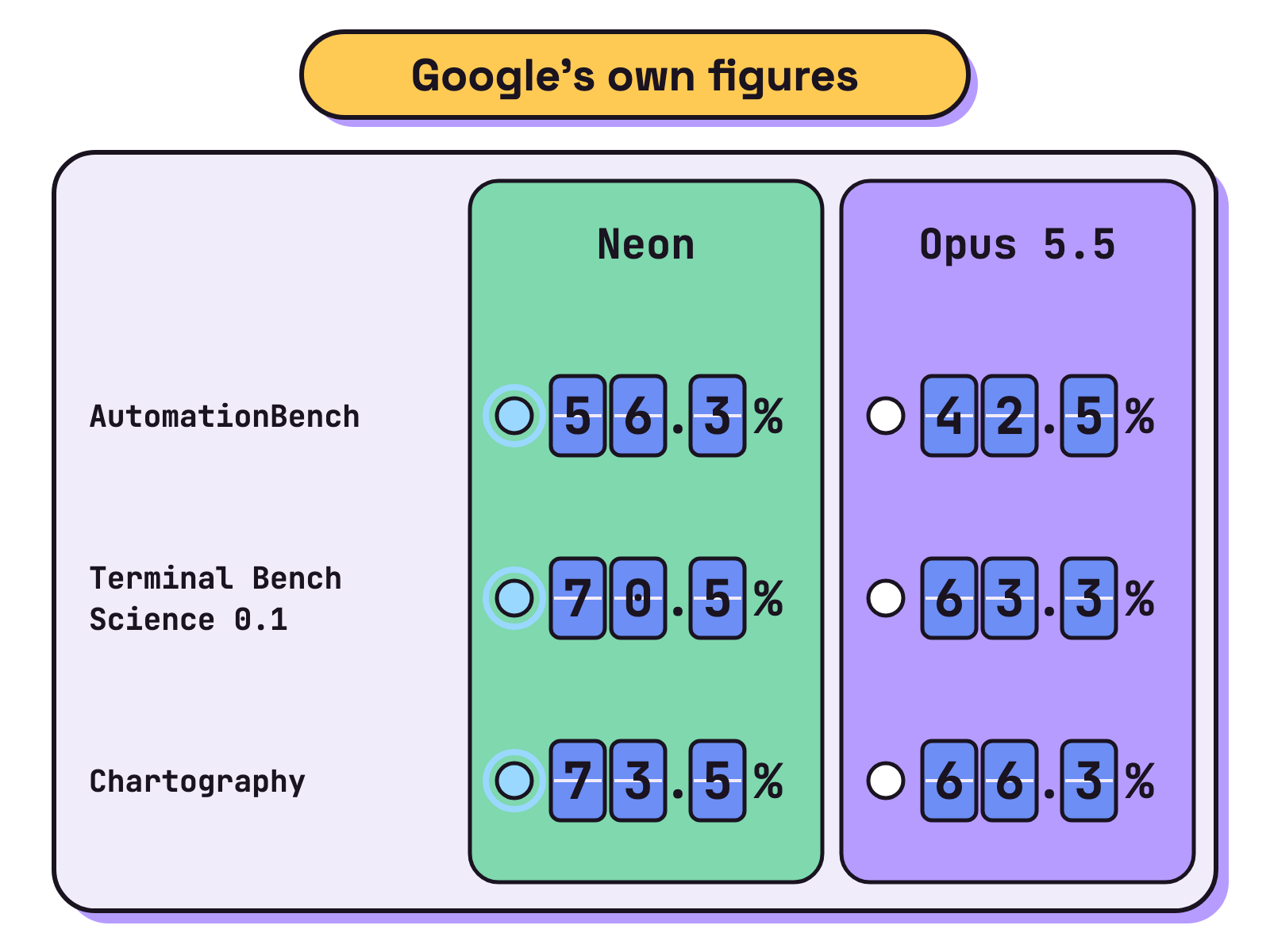
On Google’s own figures, Neon leads Opus 5.5 on all three tests both vendors report by the same name. Google’s model card of 18 Nov 2026 scores both models in one table:
| Same named test | Gemini 4 Neon, Google’s own figure | Claude Opus 5.5, Google’s own figure |
|---|---|---|
| AutomationBench | 56.3% | 42.5% |
| Terminal Bench Science 0.1 | 70.5% | 63.3% |
| Chartography | 73.5% | 66.3% |
Anthropic’s own figures for Opus 5.5 come from other setups. Its post of 22 Sep 2026 gives 40.0% on AutomationBench, 58.7% on Terminal Bench Science 0.1 (officially Terminal-Bench-Science 0.1) and 89.0% with tools on Chartography, and says “Unless otherwise noted, all Claude Opus 5.5 results use adaptive thinking at max effort” and “AutomationBench results were run and reported by Zapier”.
On the same card of 18 Nov 2026, Opus 5.5 leads two rows: Terminal-bench 4.1 (cheating adjusted accuracy), 65.8% to Neon’s 65.2%, and FrontierCode 2.0, 47.3% to 46.2%. Anthropic’s post reports Terminal-Bench 4.0 and FrontierCode v1.1 instead.
Our view: these are sellers’ numbers, and Anthropic’s post says “benchmark margins have become a less reliable guide to real-world differences.” Test both on your own work.
How to choose
Our view: pick on price, output and your tools.
Pick Gemini 4 Neon if:
- The token bill decides it: $18.00 against $24.00 for 1M input plus 1M output on 19 Nov 2026.
- You need very long single answers, up to 1,048,576 tokens with long decode.
- Your inputs include video, audio or PDF.
Pick Claude Opus 5.5 if:
- You use Claude Code on a Pro, Max, Ultra, Team or Enterprise plan, where it is the default.
- You want 128K tokens of output in an ordinary request.
- A later knowledge cutoff matters: Jun 2026 against March 2026.
- You buy through Amazon Web Services, Google Cloud or Microsoft Azure, which Anthropic’s post of 22 Sep 2026 names.
Where does a team of agents fit?
We think a team works best when each model gets the jobs it is cheapest or strongest at. Munder Difflin runs agents on engines such as Claude Code, Codex and Gemini CLI, takes work in from Slack and webhooks, and uses MCP servers, skills and plugins. Its Cloud Office runs agents in the cloud, always on, so work goes on with your computer off. Start with the install guide; OmniAgent alternatives compares other tools that run several agents.
FAQ
Is Gemini 4 Neon cheaper than Claude Opus 5.5?
Yes, by a quarter at list prices on 19 Nov 2026. One million input tokens plus one million output tokens cost $18.00 on Gemini 4 Neon ($3.00 plus $15.00, Google's pricing page) and $24.00 on Claude Opus 5.5 ($4 plus $20, Anthropic's pricing page). At each vendor's batch prices the same pair costs $9.00 and $12.00.
Which has the bigger context window and output limit?
The context windows match: Google's model page lists 1,048,576 tokens for Gemini 4 Neon and Anthropic's models overview lists 1M tokens for Claude Opus 5.5, both read 19 Nov 2026. Opus 5.5 lists 128K tokens of max output. Neon stops at 65,536 by default and goes up to 1,048,576 with long decode.
Can I use Gemini 4 Neon in Gemini CLI or Claude Code?
Google's launch post of 18 Nov 2026 names neither; it lists the Gemini API, Google AI Studio, Android Studio, Gemini for business, Google Antigravity and the Gemini app. Gemini CLI's README, read 19 Nov 2026, says it is "Not tuned for the Gemini 4 series". Claude Code runs Claude Opus 5.5 by default on Pro, Max, Ultra, Team, Enterprise and the Anthropic API.
Is Gemini 4 Neon better than Claude Opus 5.5 on benchmarks?
On Google's own figures, yes, on all three tests both vendors report by name. Google's model card of 18 Nov 2026 gives Neon 56.3% on AutomationBench, 70.5% on Terminal Bench Science 0.1 and 73.5% on Chartography, against 42.5%, 63.3% and 66.3% for Opus 5.5. Anthropic's own figures for Opus 5.5 come from other setups: 40.0%, 58.7% and 89.0% with tools.