Muse Code vs Claude Code: Plans, Prices, Models and Where They Run
Muse Code vs Claude Code, checked 14 Oct 2026: the main plans and monthly prices, the models each runs, where each installs, and which one to pick.
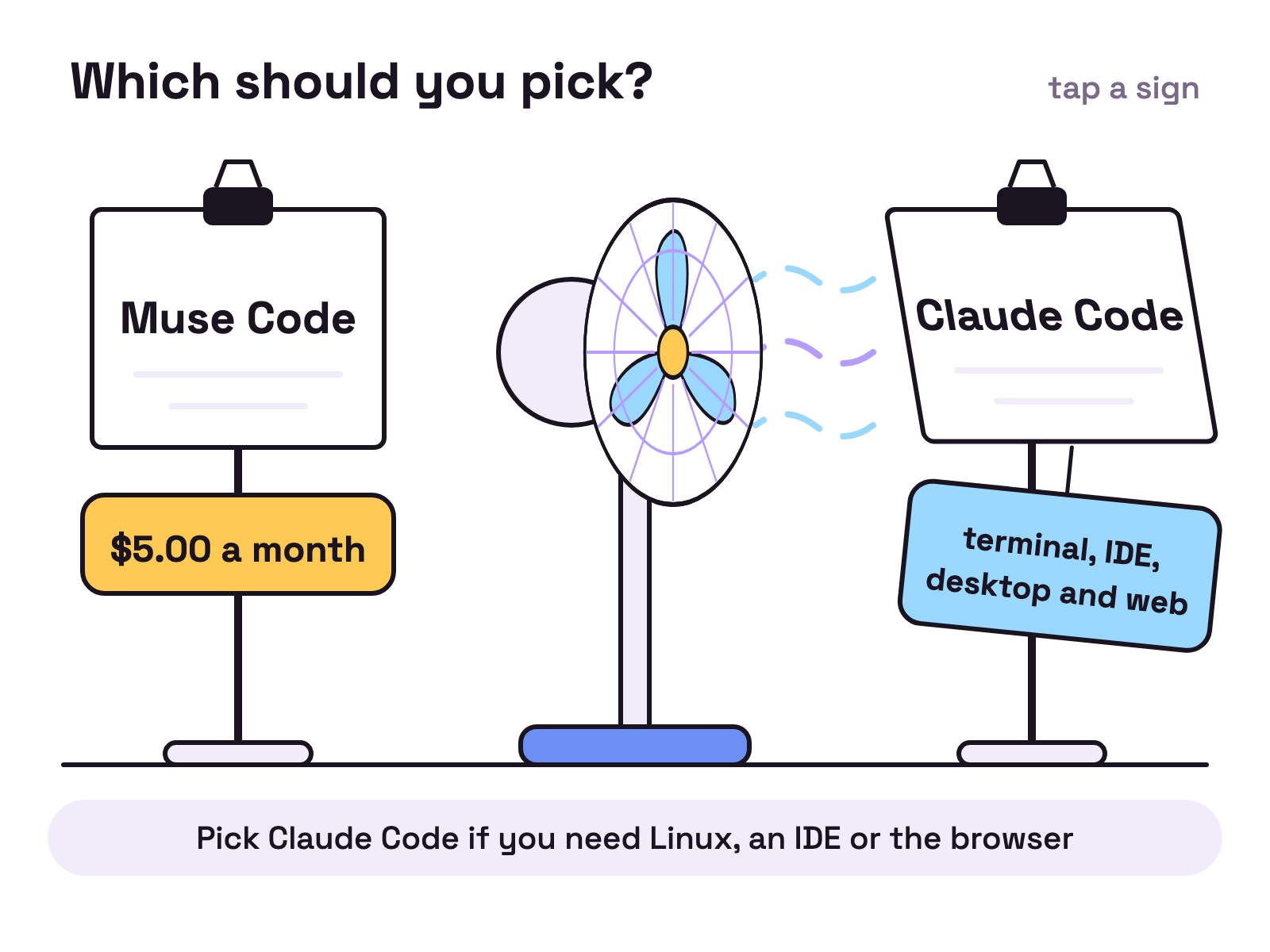
Pick Muse Code if price matters most: on 14 Oct 2026 Muse Code’s cheapest plan was $5.00 a month, against $20 a month for Claude Pro billed monthly. Pick Claude Code if you need Linux, an IDE or the browser: Anthropic’s docs list all three, and Meta’s Muse Code page lists MacOS and Windows. Checked 14 Oct 2026.
Both are coding agents made by AI labs to run their own models. For Meta’s new models in detail, read our Muse Wonder explainer. More head to heads sit in our Comparisons hub.
What is the difference between Muse Code and Claude Code?
Muse Code runs Meta’s Muse models and Claude Code runs Anthropic’s Claude models. Meta’s Muse Code page calls it “A coding agent for your most complex coding workstreams” and “powered by Muse models”. Anthropic’s Claude Code overview calls Claude Code “an agentic coding tool that reads your codebase, edits files, runs commands, and integrates with your development tools.”
Meta’s page highlights parallel work: “Multiple agents coordinate on every task. Workers in parallel, reviewers in the background”. Claude Code’s overview points to background agents for running several full sessions in parallel and watching them from one screen.
How much do Muse Code and Claude Code cost?
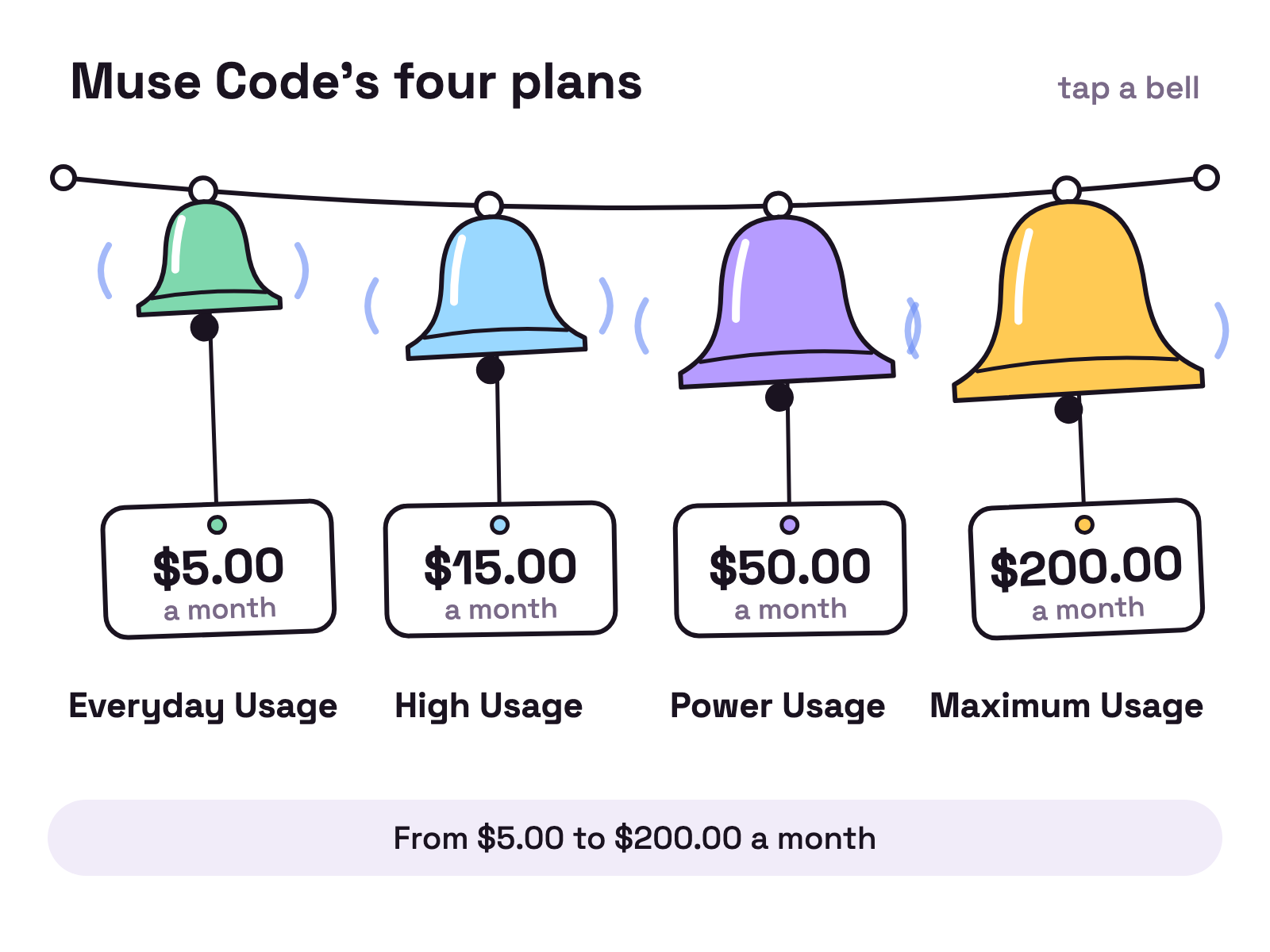
Muse Code starts lower, at $5.00 a month on 14 Oct 2026; Claude Code needs a paid Claude plan or a Console account, though its CLI and IDE extensions also accept third party providers. The rows below are our selection of plans and what each vendor lists, in the vendor’s own wording, from Meta’s Muse Code page and Anthropic’s pricing page, both read 14 Oct 2026.
| Plan | Monthly price listed on 14 Oct 2026 | What it lists |
|---|---|---|
| Muse Code Everyday Usage | $5.00/month | Muse Spark, Muse Wonder and Muse Image; 10 to 50 prompts every 5 hours |
| Muse Code High Usage | $15.00/month | 5x more usage than the Everyday Usage plan |
| Muse Code Power Usage | $50.00/month | Muse Wonder Full; 20x more usage than the Everyday Usage plan |
| Muse Code Maximum Usage | $200.00/month | 80x more usage than the Everyday Usage plan |
| Claude Free | $0 | No Claude Code |
| Claude Pro | $17 per month with annual subscription discount ($200 billed up front); $20 if billed monthly | Claude Code |
| Claude Max | From $100 per month | 5x or 20x more usage than Pro |
Both sell usage in 5 hour windows. Anthropic’s pricing page says every plan’s limits reset on a rolling five-hour session window, paid plans add weekly limits, and Claude Code “shares the same usage limits as the rest of your plan”. Meta’s page gives no weekly limit for Muse Code. Our Claude Code pricing guide covers the API route too.
Which models do they use?
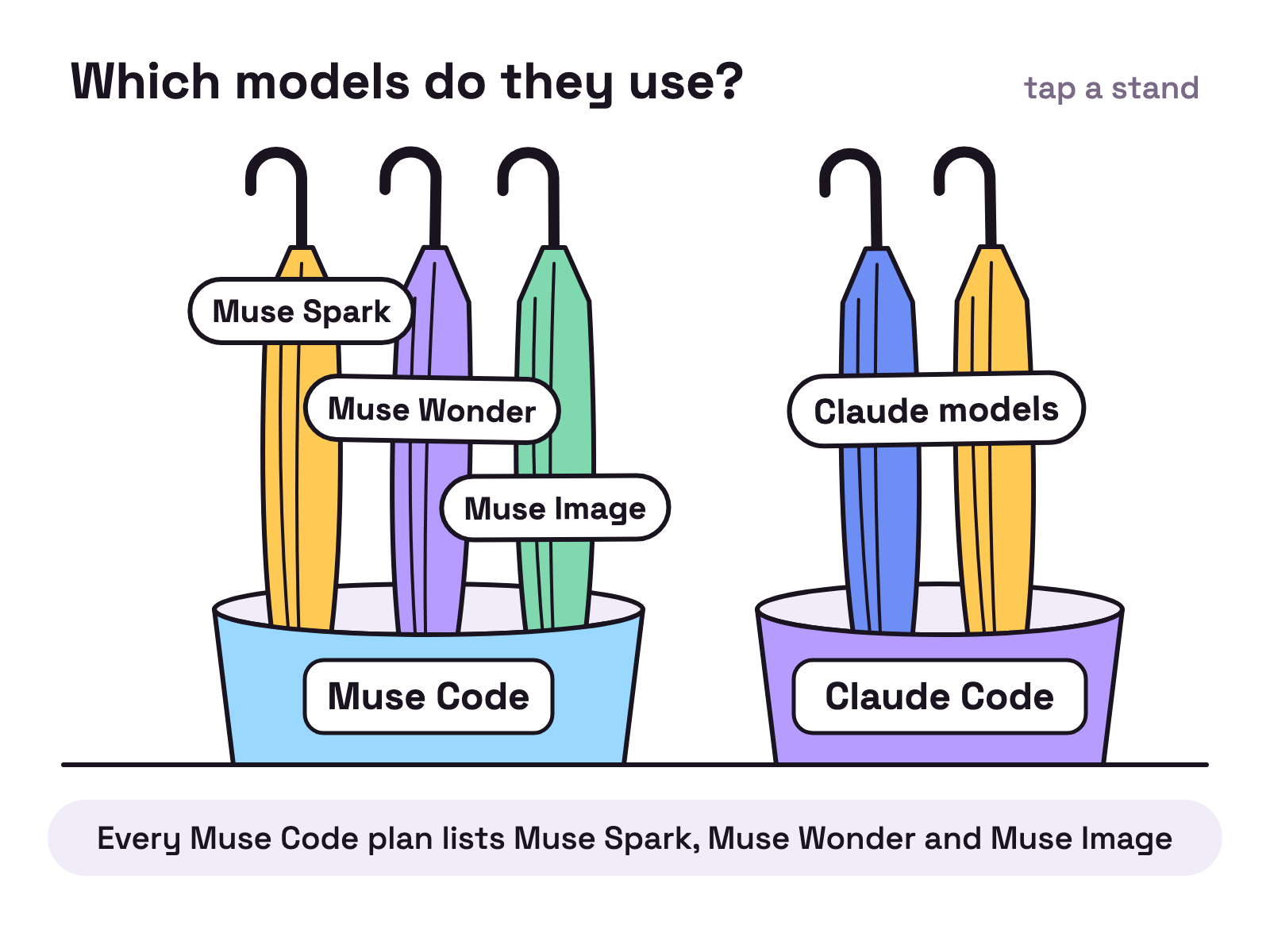
Muse Code uses Meta’s Muse models, and Claude Code uses Claude models. Every Muse Code plan lists Muse Spark, Muse Wonder and Muse Image, and Power Usage adds “the most powerful Muse models, including Muse Wonder Full”. Meta’s page also claims Muse Code is “Co-trained” with those models for “Better tool use, fewer retries and higher-quality output than a generic wrapper.”
The model table on Meta’s Muse Code page listed muse-spark-1.3 with a 1M context window at $1.25 input and $4.25 output per Mtok on 14 Oct 2026, and a contributor version at $0.10 and $0.20; the page says that version’s data is used to improve Meta’s products. On 14 Oct 2026, Anthropic’s pricing page listed Opus 5.5, its “Daily driver for agentic coding and enterprise work”, at $4 input and $20 output per MTok at standard pricing.
Where do they run?
Claude Code runs on more surfaces, by each vendor’s own list. Claude Code’s overview names the terminal, IDE extensions for VS Code and JetBrains, a desktop app and the web at claude.ai/code. Meta’s page offers “Muse Code in your CLI” and says “Available for MacOS and Windows.”
The terminal installs are near twins, down to the pipe into bash:
# Muse Code, from Meta's Muse Code page
curl -fsSL https://dev.meta.ai/install.sh | bash

# Claude Code on macOS, Linux and WSL, from Anthropic's overview
curl -fsSL https://claude.ai/install.sh | bash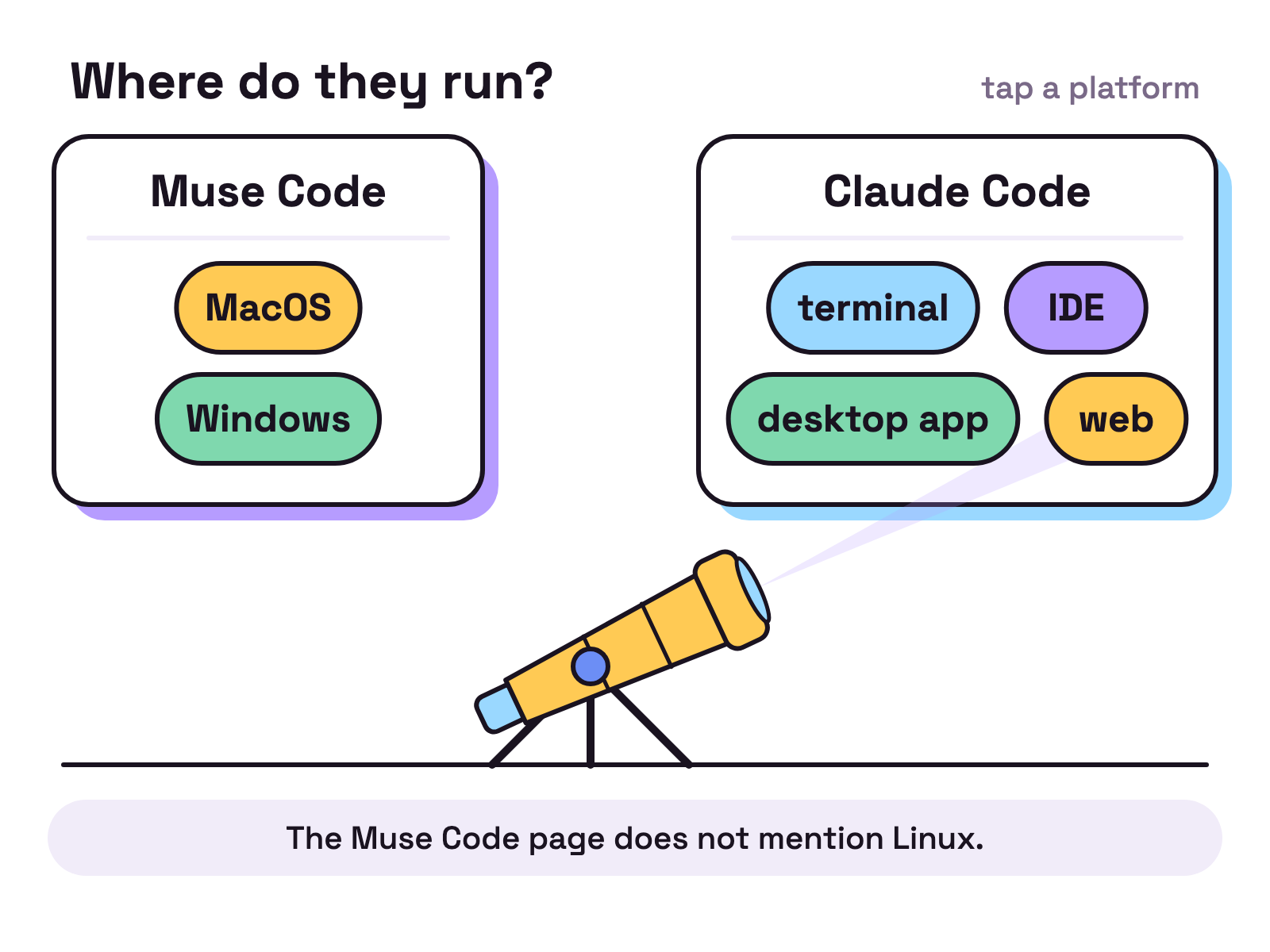
Claude Code’s overview also lists Windows PowerShell and CMD installs and a desktop app in beta on Ubuntu or Debian. The Muse Code page does not mention Linux.
Which should you pick?
Our view: pick by budget and platform, since each comes from one lab and runs that lab’s models.
- Pick Muse Code if you want the lowest monthly price to start, you want to try Muse Wonder, and you work on a Mac or Windows machine.
- Pick Claude Code if you are on Linux, want it inside VS Code, JetBrains or a browser, or already pay for Claude Pro or Max, which include it.
We think the models matter more than the agents here, so try both on a real task from your own repo before you move a team. For a third lab’s agent, see Codex vs Claude Code.
Can you use both?
Yes. They are separate installs with separate sign-ins, and both vendors list MacOS and Windows. Munder Difflin is free and open source: a desktop app that runs a team of coding agents such as Claude Code, Codex and Gemini CLI on your own computer. Muse Code is not on its list of supported agents, so run Muse Code in its own terminal. Start with how to install and use Munder Difflin.
FAQ
What is Muse Code?
Muse Code is Meta's coding agent. Meta's Muse Code page calls it a coding agent for your most complex coding workstreams, powered by Muse models. On 14 Oct 2026 the page gave a one line curl install and said it is available for MacOS and Windows.
How much does Muse Code cost?
Meta's Muse Code page listed four plans on 14 Oct 2026: Everyday Usage at $5.00/month, High Usage at $15.00/month, Power Usage at $50.00/month and Maximum Usage at $200.00/month. Usage grows from 10 to 50 prompts every 5 hours on Everyday Usage to 80x that on Maximum Usage.
Is Claude Code included in Claude Pro?
Yes. Anthropic's pricing page says Claude Code is included in all paid plans and shares the same usage limits as the rest of your plan. On 14 Oct 2026 Pro was $20 billed monthly, or $17 a month with the annual discount ($200 billed up front). The Free plan does not include Claude Code.
Does Muse Code run on Linux?
Meta's Muse Code page did not list Linux on 14 Oct 2026. It said Available for MacOS and Windows. Claude Code's docs give an install command for macOS, Linux and WSL, plus separate commands for Windows PowerShell and CMD.
Which models does Muse Code use?
Muse models, going by Meta's page. Every Muse Code plan lists access to Muse Spark, Muse Wonder and Muse Image, and the Power Usage plan adds the most powerful Muse models, including Muse Wonder Full. Our Muse Wonder explainer covers those models.