Looking for a Claude Squad Alternative?
What Claude Squad does well, where it stops, and why a memory-backed, orchestrated hive may be the Claude Squad alternative you're after.
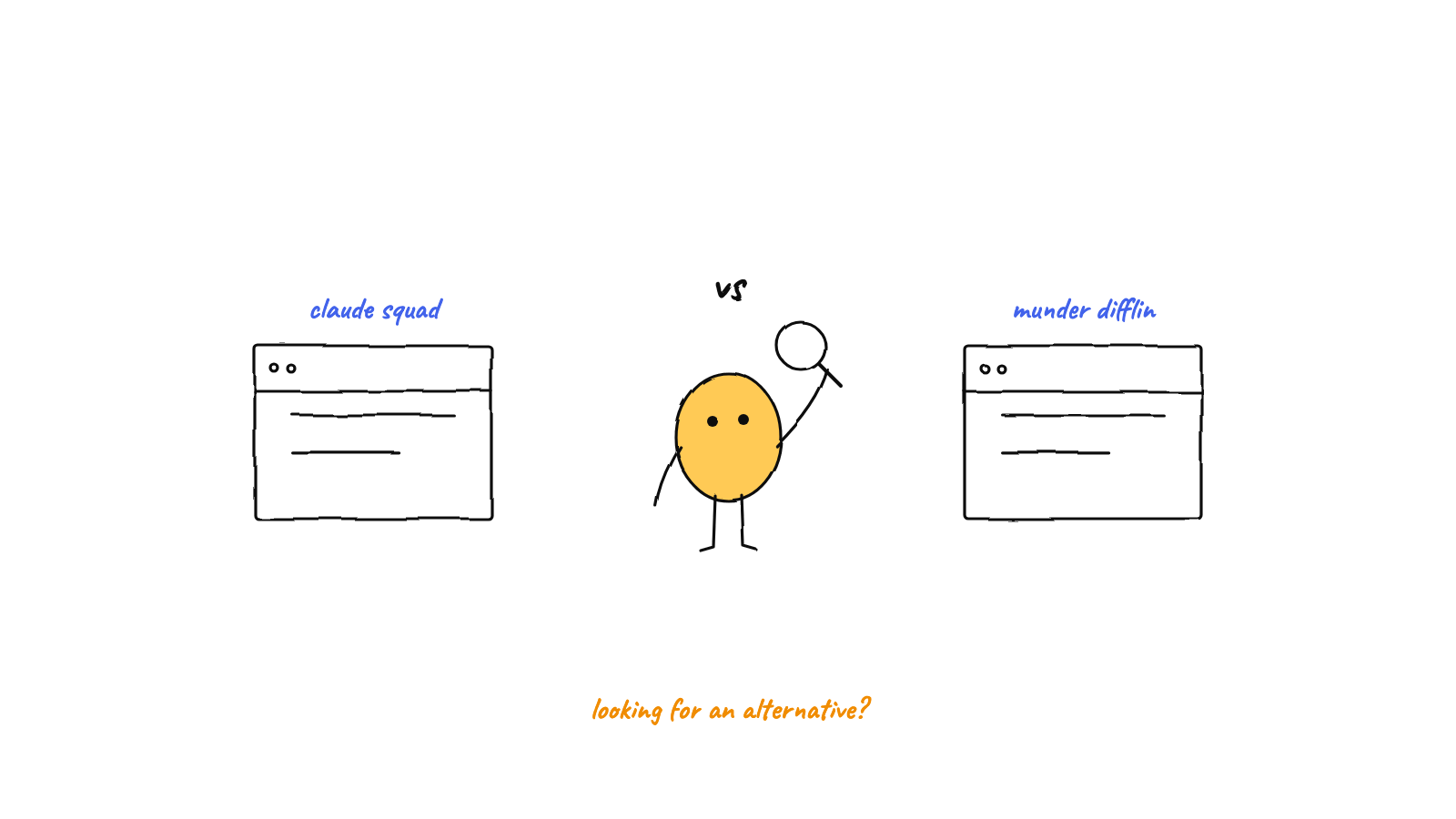
Claude Squad is an excellent lean, terminal-based way to run several Claude Code agents in parallel using tmux and git worktrees. If you're looking for a Claude Squad alternative, it's usually because you want what a session manager doesn't do: agents that share memory, message each other, and are routed by an orchestrator — plus a way to actually see the work. That's the gap a coordinated hive fills.
Claude Squad is a genuinely good tool. Before we talk alternatives, let’s be fair about what it gets right — because the reason to switch is specific.
What Claude Squad does well
Claude Squad is a terminal UI that manages multiple AI coding agents — Claude Code included — each in its own tmux session, with git worktrees isolating their changes. From one keyboard-driven interface you launch agents, switch between them, background long-running ones, and review their work.
- It’s featherweight. No GUI, no Electron, minimal setup. It starts fast and stays out of the way.
- It’s terminal-native and SSH-friendly. Run it on a remote box and drive a fleet of agents over a single connection.
- Worktree isolation is built in. Each agent works in its own git worktree, so parallel agents don’t clobber each other’s files.
If your need is “run a few independent Claude Code tasks in parallel from the terminal,” Claude Squad may be all you ever want. Switching costs you simplicity — so switch only for a real reason.

Where a session manager stops
A session manager parallelizes agents; it doesn’t coordinate them. Three things stay your job:
1. Agents don’t share what they learn
Each session has its own context. What agent A discovered, agent B can’t use — unless you copy it across yourself. There’s no shared, durable long-term memory, so the team forgets between (and across) runs.
2. Agents can’t talk to each other
Coordination flows through you. There’s no mailbox for agent A to hand a result to agent B; you’re the message bus, relaying findings between sessions.
3. Nothing routes the work
You assign every task by hand. For three agents that’s fine; for a dozen, deciding who does what becomes the bottleneck — and there’s no orchestrator to take it off your plate.
None of these are bugs — they’re simply outside a session manager’s scope. They’re also exactly the things people go looking for an alternative to solve.
What a coordinated hive adds
The alternative isn’t “a fancier terminal.” It’s a different shape: a multi-agent harness that wraps the agents you already run and adds the coordination layer on top.
- Shared memory. A semantic memory store (MemPalace) every agent reads and writes, so knowledge compounds instead of evaporating at the end of each session.
- Inter-agent messaging. Each agent has a mailbox; a router delivers messages between them, so agent A hands work to agent B directly — no human courier.
- An orchestrator. A GOD agent you talk to in plain language decomposes your intent and routes work across the team, so you stop hand-assigning everything.
- Visibility. The whole floor is rendered as avatars at their desks, so “what’s everyone doing?” has an answer at a glance.
That’s Munder Difflin: a local, open-source alternative built around coordination rather than just parallelism. It’s the same Claude Code you already run — just wired into a team.
Which should you pick?
- Stay with Claude Squad if you value minimalism, live in the terminal, and your tasks are genuinely independent. It’s the right tool for that job.
- Move to a hive if your agents need to share context, hand work to each other, or be routed for you — and if seeing the work matters.
For a head-to-head on exactly this, read Claude Squad vs Munder Difflin, and for the wider field see the best tools to run multiple Claude Code agents.
If “agents that remember and coordinate” is the alternative you’re after, the quickest way to feel the difference is to try it: download Munder Difflin — free, open source, and local-first on macOS, Windows, and Linux.