Long-Running Agents: The 2026 Shift from Minutes to Hours
Agents used to answer in seconds; now they run for hours. The data behind the shift — and why a longer agent is a different problem, not just a bigger one.
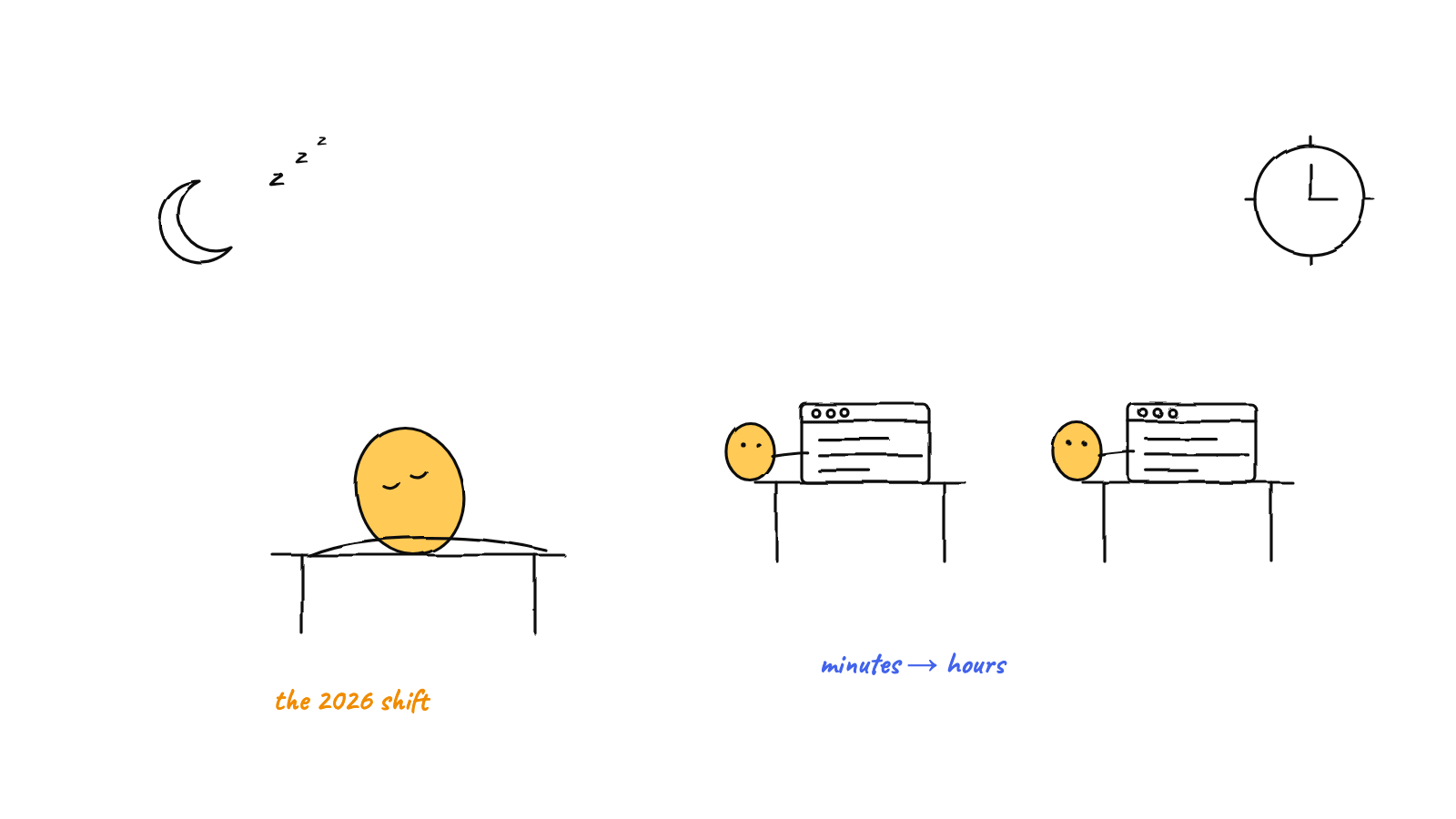
The defining change in agentic AI this year: agents stopped being seconds-long assistants and became hours-long workers. METR's data shows the length of task an agent can complete autonomously has been doubling roughly every seven months — lately faster — and model makers now report single autonomous runs lasting tens of hours. But a longer agent is a different engineering problem, not just a bigger one: it has to stay coherent, not drift, manage a filling context window, and recover from failure — over hours. The teams ready for it are the ones who already treat memory, reliability, and context as first-class.
For most of the short history of AI coding tools, the interaction was a conversation: you asked, the model answered in seconds, you asked again. The agent was a fast assistant you steered turn by turn. The biggest shift of 2026 is that this is no longer the ceiling. Agents now run for hours — taking a goal and working toward it across hundreds of steps before they need you again. That changes what an agent can do, and it changes what you have to build to make it work.
OpenAI’s ChatGPT dots, launched on 29 Sep 2026, push the idea one step further: an agent that keeps a standing responsibility instead of one goal.
The trend, in numbers
This isn’t a vibe; it’s measurable. METR tracks AI capability by a clever metric: the length of task an agent can complete autonomously at about 50% reliability — its “time horizon.” Their headline finding is that this time horizon has been doubling roughly every seven months since 2019, and the pace has accelerated to around every four months in the most recent stretch. A capability that doubles on that cadence doesn’t creep; it compounds. Tasks that were out of reach a year ago — multi-hour, multi-file, multi-decision work — land inside the frontier fast.
The model makers’ own reports track the same curve from the other side. Anthropic has described Claude models sustaining focus on a single multi-step task for tens of hours of continuous autonomous coding — the kind of run that can produce a working application end-to-end, not just a snippet. (Simon Willison’s field notes on scaling long-running autonomous coding are a good practitioner’s-eye view of what that actually looks like in practice.) Whichever number you watch, the direction is the same: minutes became hours.
What hours unlock
The jump from minutes to hours isn’t quantitative, it’s qualitative. A ten-minute agent fixes a bug. A ten-hour agent can own a whole feature, work through a migration that sat on the backlog for a year, or grind out the unglamorous refactor nobody scheduled. The unit of delegation changes from “this edit” to “this outcome” — you hand over a goal and get back a result, not a turn in a conversation. That’s the promise people mean when they say agents are starting to feel less like autocomplete and more like teammates.
Why “longer” is a different problem
Here’s the catch, and it’s the part the headline numbers skip: a longer agent fails in new ways.
A short agent mostly has one job — get this answer right. A long-running agent has that job plus several it never had to worry about before:
- Coherence over time. It has to remember what it decided an hour ago and not contradict itself on step 300.
- Not drifting. Over a long run it can slowly wander off the original goal, optimizing something adjacent to what you asked for.
- A filling context window. Hours of tool output and history pile up; without management, the window bloats and quality degrades — the thing we’ve called context rot elsewhere.
- Failure along the way. Across hundreds of steps, something will error, time out, or come back wrong. A short agent that fails just gets re-run. A long one that fails at hour nine can’t afford to throw away nine hours.
In other words, capability gets the agent into a ten-hour run; engineering is what keeps it from falling apart in the middle of one. That’s why the boring infrastructure suddenly matters more than the demo.
What long-running agents actually need
The capabilities that were “nice to have” for a quick assistant become load-bearing the moment an agent runs for hours:
- Durable memory and state. Progress has to live somewhere it survives a crash, so hour nine doesn’t reset to zero. Persistent, markdown-first memory and semantic recall are how an agent carries what it learned across a long run without dragging it all through the window.
- Context engineering. With hours of history, what stays in the window is a constant decision — curate the relevant, shed the stale, and keep the stable prefix cacheable so you’re not re-paying for it every turn.
- Reliability by design. Bounded retries, validation at the boundary, and recovery from a known-good state are what let a long run survive its inevitable failures instead of dying on them — the whole case for building reliable agents.
- Observability. When an agent works for hours unattended, you need to be able to see what it did and debug it after the fact — a long silent run you can’t inspect is a liability, not a feature.
None of these are new ideas. What’s new is that the shift to long-running agents turned them from optional polish into the price of admission.
One long agent, or a coordinated team?
There’s a tempting picture of a single heroic agent grinding autonomously for ten hours. Often the better answer is a team. A long-horizon goal can be decomposed across coordinated agents working in parallel — each on a scoped slice, each with a small context, sharing durable state through files — so the work fans out instead of stretching into one fragile linear marathon. It keeps every agent’s window lean, contains the blast radius when one stumbles, and finishes wall-clock faster. The shift to long-running work and the move to multi-agent hives are, in that sense, two sides of the same coin: both are answers to “how do we get more done autonomously without it collapsing under its own length?”
FAQ
What is a long-running AI agent? One that works autonomously toward a goal for an extended stretch — minutes to hours — across many steps and tool calls, rather than answering a single prompt and stopping. The unit of delegation becomes an outcome (a whole feature, a migration) instead of a single edit.
How fast is agent task length growing? METR’s “time horizon” metric — the task length an agent completes at ~50% reliability — has doubled about every seven months since 2019, accelerating to roughly every four months recently. Extrapolated, that points to agents handling work that takes humans hours, then days, within a few years.
Why is a longer agent harder, not just bigger? The failure modes change: it must stay coherent over hours, avoid drifting off-goal, manage a filling context window, and recover from the failures that inevitably occur. Capability enables the long run; engineering keeps it from collapsing partway.
The bottom line
The minutes-to-hours shift is real and measurable, and it rewrites the priority list. When agents answered in seconds, you could get away with thin memory and no recovery story. When they run for hours, durable memory, context discipline, reliability, and observability stop being optional. The teams that will get the most out of long-running agents are the ones who built for the long run before the runs got long.
Munder Difflin is designed for exactly that — persistent memory, reliable-by-design agents, and a coordinated hive that splits long work across a team. Download Munder Difflin to run agents built for the hours-long era; it’s free and open source.
Sources: METR — Measuring AI Ability to Complete Long Tasks; Simon Willison — Scaling long-running autonomous coding.
FAQ
What is a long-running AI agent?
It's an agent that works autonomously on a task for an extended stretch — minutes to hours — rather than answering a single prompt and stopping. Instead of a turn-by-turn assistant you steer constantly, a long-running agent takes a goal and pursues it across many steps, tool calls, and decisions before coming back to you. Owning a whole feature or a migration end-to-end, rather than one edit at a time, is the difference.
How fast is agent task length actually growing?
METR, which measures the length of tasks AI can complete autonomously at roughly 50% reliability, found this 'time horizon' has doubled about every seven months since 2019 — and accelerated to roughly every four months in the 2024–2025 window. Extrapolated, that points toward agents handling tasks that take humans many hours, then days, within a few years.
Why is a longer agent harder, not just bigger?
Because the failure modes change. A short agent mostly needs the right answer. A long-running one also has to stay coherent over hours, avoid drifting off the goal, manage a context window that keeps filling, and recover from the failures that inevitably happen along the way. Capability gets you the long run; engineering keeps it from falling apart partway through.
Do I need one giant agent or several coordinated ones?
Often several. A long-horizon goal can be split across a coordinated team of agents working in parallel — each on a scoped piece, sharing durable state — instead of one agent grinding linearly for ten hours. That keeps each agent's context small and contains the blast radius if one stumbles.