Building Reliable AI Agents: Failure Is the Default
Agents fail constantly: tools error, steps stall, output goes wrong. Reliability isn't avoiding failure — it's making each one contained and recoverable.
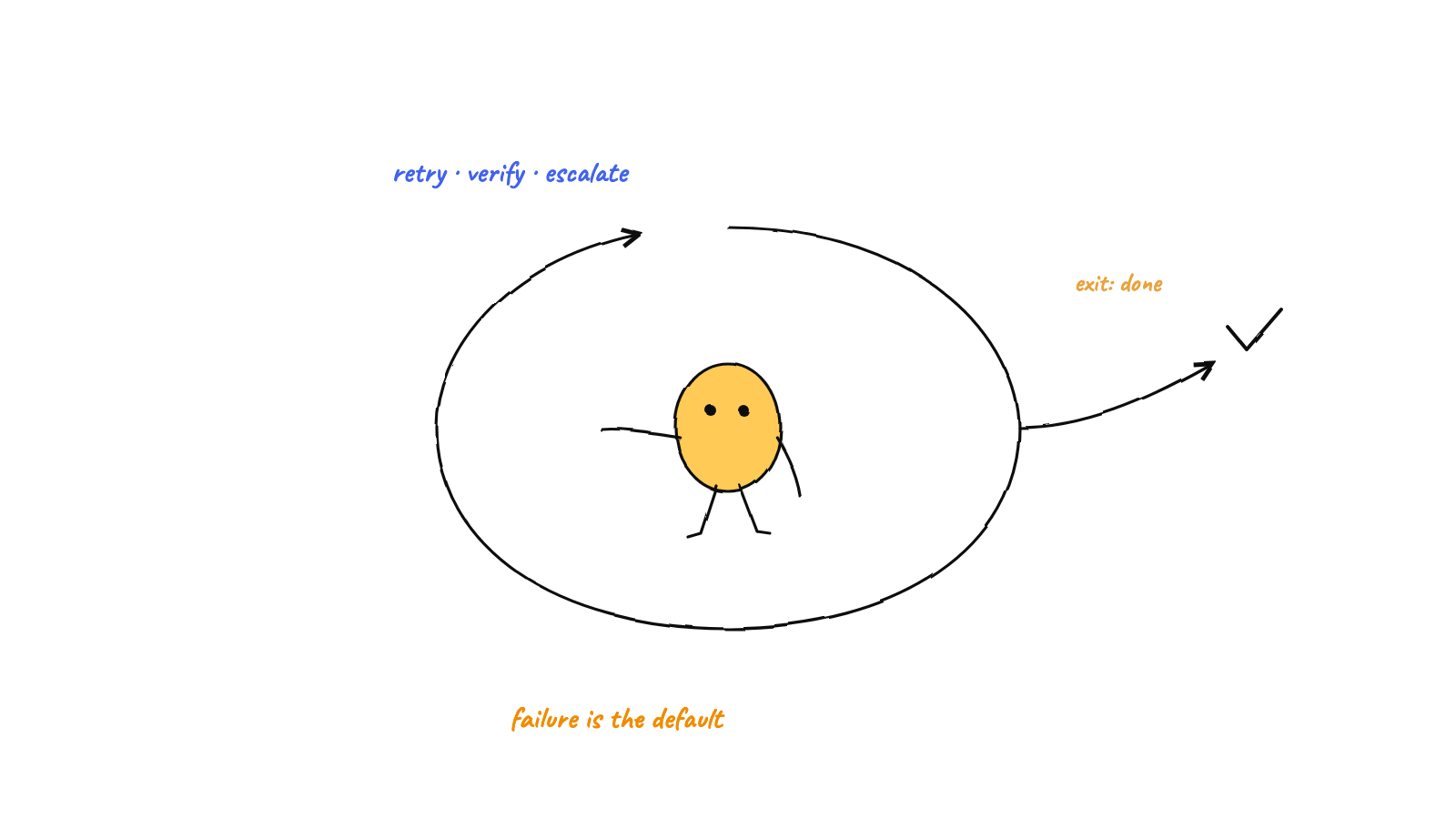
Agents fail constantly — a tool errors, a step hangs, the model returns nonsense, an external API is down. Reliability isn't the absence of failure; it's the property that every failure is contained and recoverable. The building blocks: bounded retries for transient errors, durable state so progress survives a crash, isolation so one agent's failure doesn't sink the rest, and a replayable log so you can resume instead of restart. Design for failure as the default and an agent that breaks often can still finish reliably.
The fantasy of an AI agent is a smooth, autonomous run from prompt to finished work. The reality is a chain of fallible steps: a model call that can hallucinate or time out, a tool call that can throw, a filesystem or API that can be momentarily unavailable. Any one link can break the chain. Once you accept that failure is the default operating condition — not a rare edge case — you stop trying to build an agent that never fails and start building one that fails safely. That shift is what reliability actually means here.
Where agents break
It helps to name the failure modes, because each wants a different response:
- Transient errors — a timeout, a rate limit, a flaky network call. The step would probably succeed if you just tried again.
- Hard errors — a tool throws a real exception, an input is malformed, a precondition isn’t met. Retrying the same thing changes nothing.
- Bad output — the call “succeeds” but returns something wrong: a hallucinated fact, malformed JSON, a plan that doesn’t make sense. The agent thinks it’s fine and marches on.
- Stuck states — the agent loops, repeats itself, or waits forever on something that will never arrive.
The mistake is treating all four the same — usually by retrying everything. Retrying a transient error is smart; retrying a hard error is a waste; retrying bad output without checking it just compounds the problem; and retrying a stuck state forever is how you get a runaway bill. Reliability starts with telling them apart.
Bounded retries for the transient
For transient errors, retry — but with a budget. Three rules keep retries from becoming the problem:
- Cap the attempts. Two or three tries, not infinite. If it hasn’t worked by then, it’s probably not transient.
- Back off between them. Wait a little longer each time so you don’t hammer a struggling service.
- Escalate at the cap. When retries are exhausted, don’t silently give up or loop — surface it: try a different approach, or hand it to a human.
An unbounded retry is the single most common way a “resilient” agent turns into a money fire. The retry budget is what makes retrying a feature instead of a hazard.
Catch bad output before it spreads
The sneakiest failure is the one that looks like success. A model returns confident nonsense, or JSON that’s almost-but-not-quite valid, and the agent acts on it. The defense is to validate at the boundary: check structured output against a schema, sanity-check values before using them, and have the agent (or a second one) review work that matters before it’s committed. Catching a bad result one step after it’s produced is cheap; catching it ten steps later, after it’s been built on, is expensive — and sometimes irreversible.
This is the proactive cousin of debugging a multi-agent system: debugging finds out why it broke after the fact; validation stops the break from propagating in the moment.
Make state durable, so a crash isn’t a restart
Here’s the property that separates fragile agents from reliable ones: where does the work-state live? If an agent’s progress exists only in its running memory, a crash loses everything and you start over. If the state lives in files — the plan, the messages, the record of what’s been done — then a crash is a pause, not a reset. You restart the process and it picks up where it left off.
This is why the architecture choices underneath an agent matter so much for reliability:
- An append-only event log records every action as it happens, so after a failure you can see exactly how far the agent got and replay from there instead of guessing.
- Atomic, single-writer file mailboxes mean a message is either fully written or not at all — a crash mid-send can’t leave a half-message that corrupts the next read.
- A single-committer git pattern keeps concurrent agents from clobbering each other’s commits, so the shared repo stays consistent even when many agents fail and resume independently.
None of these prevent failure. They make failure survivable — which is the whole game.
Isolation: contain the blast radius
In a single agent, a failure is local by definition. In a hive, the danger is that one agent’s failure takes the others down with it. The antidote is isolation: each agent gets its own context and its own lane, and they coordinate through durable files rather than a shared, fragile in-memory bus. When one agent crashes, hangs, or goes off the rails, the others don’t even notice — their state is intact, their mailboxes are untouched, and the orchestrator can restart or reassign the failed work without a system-wide reset.
Contain the blast radius and a single failure stays a single failure, instead of becoming an outage.

A reliability checklist
When an agent run dies and takes its progress with it, it usually skipped one of these:
- Are retries bounded? A cap, backoff, and an escalation path — not an infinite loop.
- Is output validated at the boundary? Schema-check and sanity-check before acting on a result.
- Does work-state live in files, not just memory? If a crash means starting over, state isn’t durable enough.
- Can the run be replayed? A log of what happened lets you resume from the failure point.
- Is failure isolated? One agent going down shouldn’t corrupt or block the rest.
- Is there a human escape hatch? When automated recovery is exhausted, something should ask for help rather than spin.
FAQ
Why do AI agents fail so often? Because an agent chains many fallible steps — model calls that can hallucinate or time out, tool calls that can error, external systems that can be down — and any one can derail the run. The more autonomous and multi-step the agent, the more places it can break. Failure isn’t an edge case; it’s the normal operating condition you design around.
What’s the difference between retrying and recovering? Retrying re-runs the same step hoping for a better result — right for transient errors like a timeout or rate limit. Recovering restores a known-good state and continues from there — right when the agent is genuinely stuck or has corrupted its progress. Reliable agents do both and know which is which, instead of blindly retrying forever.
How does a hive stay reliable when one agent fails? Through isolation and durable state. If each agent has its own context and its work-state lives in files rather than memory, one agent crashing doesn’t corrupt the others or lose the shared record. The append-only log and single-writer files let the system be inspected and resumed after a failure instead of restarted.
Should a failing agent keep retrying automatically? Only with a bound. Unbounded retries turn one stuck step into an infinite, expensive loop. Cap the attempts, back off between them, and escalate to a human or a different approach once the cap is hit.
The bottom line
Reliable agents aren’t the ones that never fail — those don’t exist. They’re the ones where failure is designed for: transient errors retry within a budget, bad output is caught at the boundary, progress is durable on disk, and one agent’s bad day stays its own. Build on that foundation and you get the thing that actually matters in production — not an agent that never breaks, but one you can trust to finish the job anyway.
Munder Difflin is built this way from the ground up — a replayable log, atomic mailboxes, single-writer files, and isolated agents — so a hive keeps going when individual agents stumble. Download Munder Difflin to run an agent team that’s resilient by design; it’s free and open source.
FAQ
Why do AI agents fail so often?
Because an agent strings together many fallible steps — model calls that can hallucinate or time out, tool calls that can error, and external systems that can be down — and any one of them can derail the run. The more autonomous and multi-step the agent, the more places it can go wrong. Failure isn't an edge case for agents; it's the normal operating condition you design around.
What's the difference between retrying and recovering?
Retrying re-runs the same step hoping for a better roll — useful for transient errors like a timeout or a rate limit. Recovering is restoring a known-good state and continuing from there — useful when the agent is genuinely stuck or has corrupted its own progress. Reliable agents do both: retry the transient, recover from the structural, and know which is which instead of blindly retrying forever.
How does a multi-agent system stay reliable when one agent fails?
Through isolation and durable state. If each agent has its own context and its work-state lives in files rather than in memory, one agent crashing doesn't corrupt the others or lose the shared record. The append-only log and single-writer files mean the system can be inspected and resumed after a failure instead of having to start over.
Should a failing agent keep retrying automatically?
Only with a bound. Unbounded retries turn one stuck step into an infinite, expensive loop. Cap the attempts, back off between them, and escalate to a human or a different approach once the cap is hit. A retry budget is the difference between resilience and a runaway.