What Is Harness Engineering?
Harness engineering is the discipline of building everything around the model — PTY plumbing, lifecycle hooks, mailboxes, memory, budgets, human gates, observability — because that's where agent reliability actually comes from. A definition, and four case studies from inside Munder Difflin.
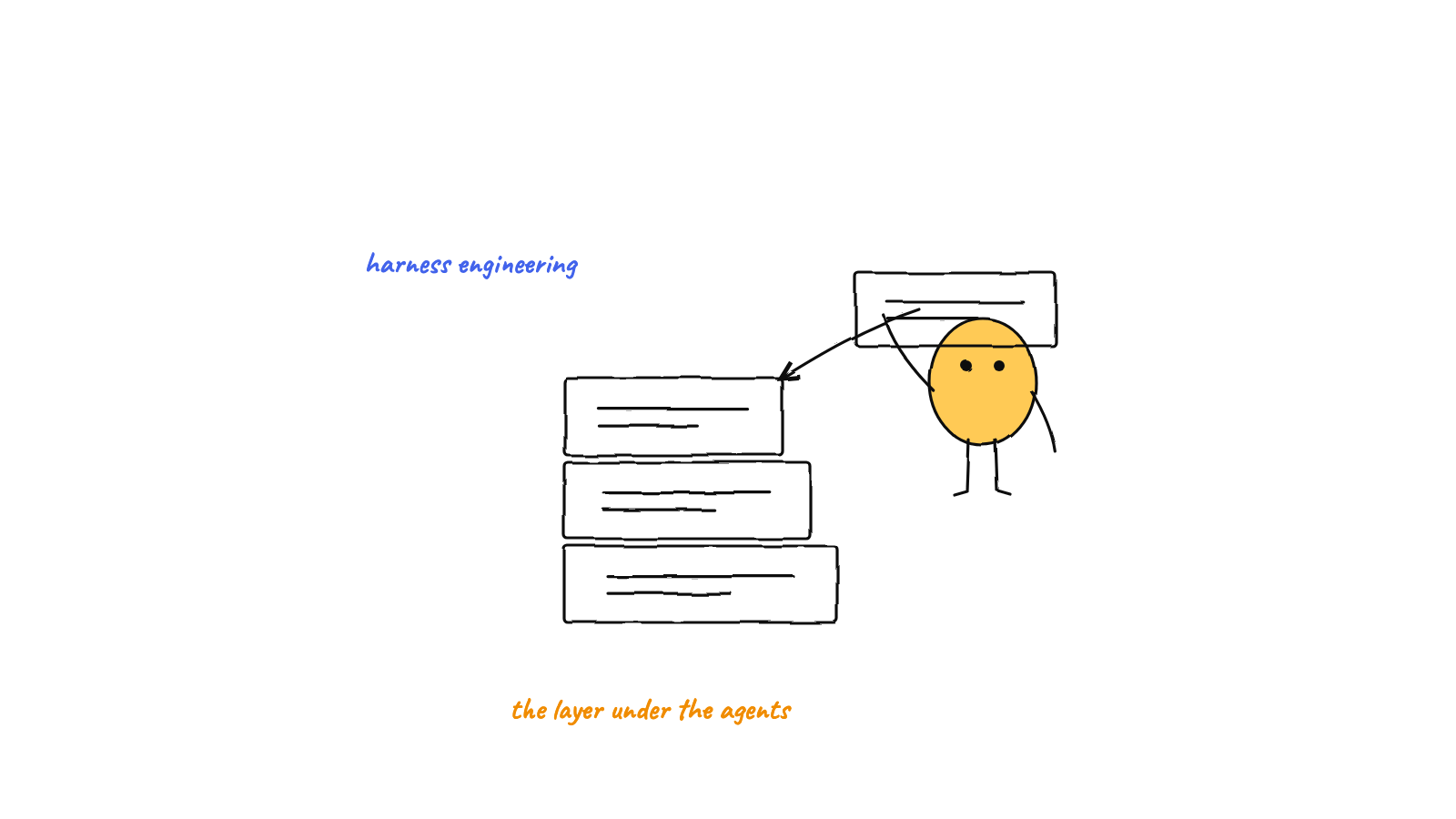
Harness engineering is the discipline of building everything around the model — the PTY plumbing, lifecycle hooks, mailboxes, memory, budgets, human gates, observability, and session resume that turn a capable model into a reliable agent. The 2026 consensus, popularized by Mitchell Hashimoto: the model is a commodity; the harness is where reliability comes from. Every time an agent fails, you engineer the harness so that failure becomes structurally impossible. Munder Difflin is this discipline shipped as a product — and its hook shim, node-pty layer, MemPalace, and circuit breaker are worked examples.
Ask why an agent failed and you’ll almost never hear “the model wasn’t smart enough.” You’ll hear: it looped for forty minutes, it forgot what it learned yesterday, it blew the budget overnight, it dropped a message and nobody noticed, the process died and took the session with it.
None of those are model problems. All of them are harness problems. And in 2026, fixing them got a name.
The term, and where it came from
Harness engineering was popularized by Mitchell Hashimoto (co-founder of HashiCorp) in a February 2026 post on his AI adoption journey. His formulation is disarmingly simple: any time you find an agent makes a mistake, you take the time to engineer a solution such that the agent never makes that mistake again. Not a better prompt. Not a smarter model. A structural fix in the environment the agent operates in, so the failure class is closed permanently.
The broader discourse picked the term up fast, and a rough consensus formed: harness engineering is the third phase of agent-engineering maturity — after prompt engineering (shape one call) and context engineering (shape what the model sees), you shape the entire system the model operates inside. Industry write-ups like Faros AI’s guide converge on the same anatomy — tool orchestration, verification loops, context and memory, guardrails, observability — and point at the evidence that motivates it: teams have jumped whole leaderboards on agent benchmarks (Faros cites LangChain climbing Terminal Bench 2.0 from 30th to 5th) without changing the model at all. Same model, different harness, different outcome.
That’s the whole thesis in one line: the model is a commodity input; the harness is the differentiated system. Frontier models leapfrog each other every quarter, and every serious agent product supports several of them interchangeably. What doesn’t come off a shelf is the machinery that makes any of them dependable.
What a harness actually contains
Strip the buzzwords and a production harness is a specific list of unglamorous subsystems:
- Execution plumbing. A real place for the agent to act — a pseudo-terminal, a sandbox, a worktree — not a simulated one.
- Lifecycle hooks. Structured signals for turn start, turn end, and tool use, so the harness knows what the agent is doing rather than guessing from stdout.
- Mailboxes and routing. Inter-agent messages with delivery guarantees; a dropped handoff must bounce somewhere visible, never vanish.
- Memory. Durable, recallable knowledge that survives the session, so agents stop re-deriving the same facts.
- Budgets and breakers. Hard ceilings on tokens and cost, plus a mechanism that intervenes when an agent runs away.
- Human gates. Approval checkpoints on spend, scope changes, and destructive operations — human-in-the-loop by design.
- Observability. Traces, per-agent cost attribution, live telemetry — you can’t operate a fleet you can’t see.
- Session resume. A restart — of the app, the machine, or one agent — must reattach state, not destroy it.
Notice what’s absent: anything about making the model smarter. Harness engineering takes model capability as given and engineers everything else. (For how this differs from a single-agent wrapper, see what a multi-agent harness is.)
Four case studies from inside Munder Difflin
Munder Difflin is this discipline shipped as a product, so its internals make good worked examples.
The hook shim — lifecycle truth instead of stdout guessing. Every provider speaks lifecycle differently: Claude Code has native hooks, Antigravity needed a purpose-built agy-hook bridge, Codex gets the protocol injected as its initial prompt. The harness normalizes all of them into one hook server (hooks.ts) that receives structured POST payloads — so “the agent finished its turn” is a signal, not an inference from a quiet terminal. And where a provider has no bridge at all, the harness engineers around the gap honestly: GitHub Copilot CLI’s print mode can’t drain an inbox, so routed mail bounces to the GOD orchestrator instead of silently dropping. That is Hashimoto’s rule applied — the “silently lost message” failure class is closed structurally.
node-pty — real terminals, not string simulations. Each agent is a real CLI process in its own pseudo-terminal, byte-for-byte authentic, with full read/write/resize/kill — paired with per-agent git worktrees so agents never collide on branches. The unglamorous plumbing (a PtyManager, per-id IPC streams, a postinstall that rebuilds the native addon against Electron’s ABI) is exactly the kind of work the model can never do for you, and exactly what makes the agent’s terminal access real.
MemPalace — memory as infrastructure. Agents write markdown-first long-term memory, mined into a shared semantic index for instant recall, with a MemoryReflector that condenses it so it doesn’t grow without bound. “The agent forgot” stops being a shrug and becomes a subsystem with behavior you can engineer — the deep dive is in semantic memory for AI agents.
The circuit breaker — graduated intervention, not a kill switch. The cost/runaway guard runs a steer → constrain → stop ladder: nudge an agent that’s looping, constrain it if it persists, stop it if it storms errors or blows its per-agent token budget. Paired with approval gates on spend and destructive ops, this is what makes 24/7 autonomy something you can actually sleep through — part of the larger practice of building reliable AI agents.
Why this is a discipline, not a feature list
The pattern across all four: reliability was engineered into the environment, not prompted into the model. Each subsystem exists because a specific failure mode exists, and each closes that failure mode for every model, every provider, permanently. Swap Claude for Codex or a local model tomorrow — the breaker still breaks, the mail still routes, the memory still recalls. That’s what “the model is a commodity” means in practice: the harness is the part that compounds.
If you want to see a harness rather than read about one, download Munder Difflin — free, MIT-licensed, local-first — and if the idea resonates, a GitHub star helps more people find it.
Sources: Mitchell Hashimoto — My AI Adoption Journey; Faros AI — Harness Engineering: Making AI Coding Agents Work in 2026.
FAQ
What is harness engineering?
Harness engineering is the discipline of building the environment around an AI model that turns it into a reliable agent: the process plumbing, lifecycle hooks, message routing, memory, budgets, human approval gates, observability, and recovery mechanics. The working equation is agent = model + harness. The model supplies raw capability; the harness determines whether that capability shows up predictably, safely, and repeatably in production.
Who coined the term harness engineering?
The term was popularized by Mitchell Hashimoto, co-founder of HashiCorp, in a February 2026 blog post about his AI adoption journey. His core premise: any time an agent makes a mistake, you engineer a solution so the agent never makes that mistake again. The 2026 agent-engineering discourse has since adopted it as the phase that follows prompt engineering and context engineering.
Why is the harness more important than the model?
Because models are increasingly interchangeable commodities and their failure modes are structural, not intelligence-limited. An agent that loops, forgets, overspends, or silently drops a message doesn't need a smarter model — it needs a circuit breaker, a memory layer, a budget, and a mailbox with delivery guarantees. Reported results back this up: teams have climbed agent benchmarks significantly by changing only the harness, with the model held constant.
What are the components of an agent harness?
A production harness typically covers: real execution plumbing (PTYs or sandboxes the agent acts through), lifecycle hooks (structured signals for turn start/end and tool use), inter-agent messaging with delivery guarantees, long-term memory, token budgets and cost controls, human-in-the-loop gates for destructive or expensive actions, observability (traces, costs, per-agent telemetry), and session resume so a restart doesn't destroy state.
Is harness engineering the same as prompt engineering?
No, but it absorbs it. Prompt engineering shapes a single model call; context engineering shapes what the model sees across a task; harness engineering shapes the entire system the model operates inside — including what happens when a call fails, a process dies, a budget is exceeded, or two agents need to hand off work. Prompts are one component of the harness, not a substitute for it.
Is Munder Difflin a harness?
Yes — that's the category. Munder Difflin is a free, MIT-licensed, local-first multi-agent harness: it wraps the agent CLIs you already run (Claude Code, Codex, Antigravity, OpenCode, Crush, pi.dev, GitHub Copilot CLI) in node-pty pseudo-terminals, wires them into a hive with mailboxes, shared memory, budgets, a circuit breaker, human approval gates, and observability, and puts a GOD orchestrator in charge.