DeepSeek Harness Alternatives: 6 Picks by Why You Are Leaving (Nov 2026)
DeepSeek Harness is a developer preview with breaking changes coming. Six alternatives by reason for leaving, with models and prices checked 2 Nov 2026.
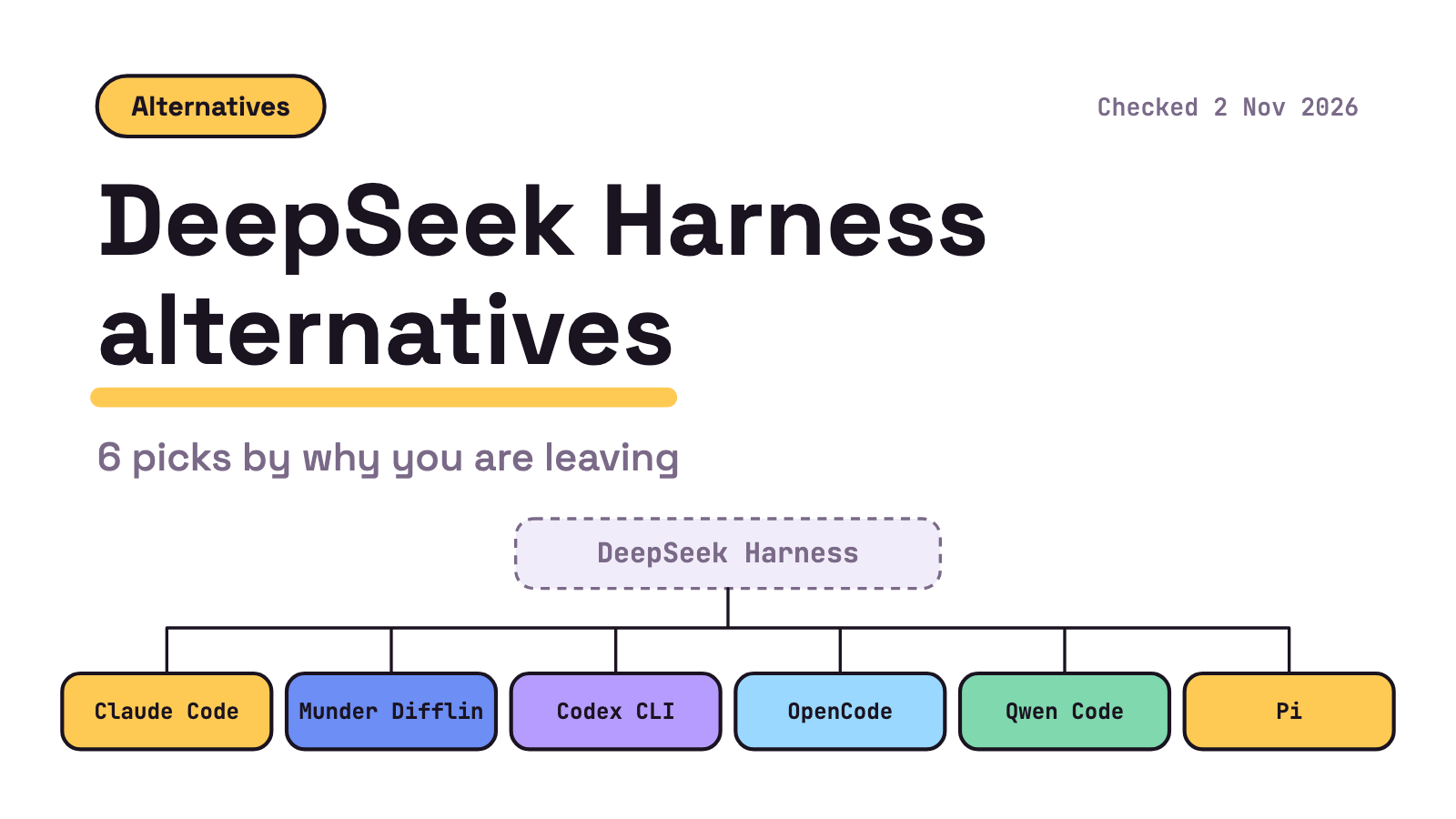
Our view: Claude Code is the first DeepSeek Harness alternative to try if you want a shipped product, because DeepSeek itself calls its tool a developer preview with breaking changes coming. You can also keep DeepSeek’s models and drop only the harness. Checked 2 Nov 2026.
Munder Difflin is free and open source: a desktop app that runs a team of AI agents for all kinds of knowledge work, coding included, on your own computer. More pages like this are in our Comparisons hub.
What is DeepSeek Harness?
DeepSeek Harness (dsh) is an open source agent harness from DeepSeek, MIT licensed, built on what its README, read 2 Nov 2026, calls an “everything-is-a-plugin” architecture. You start it with npx @deepseek-ai/dsh web, which serves a local Web UI.
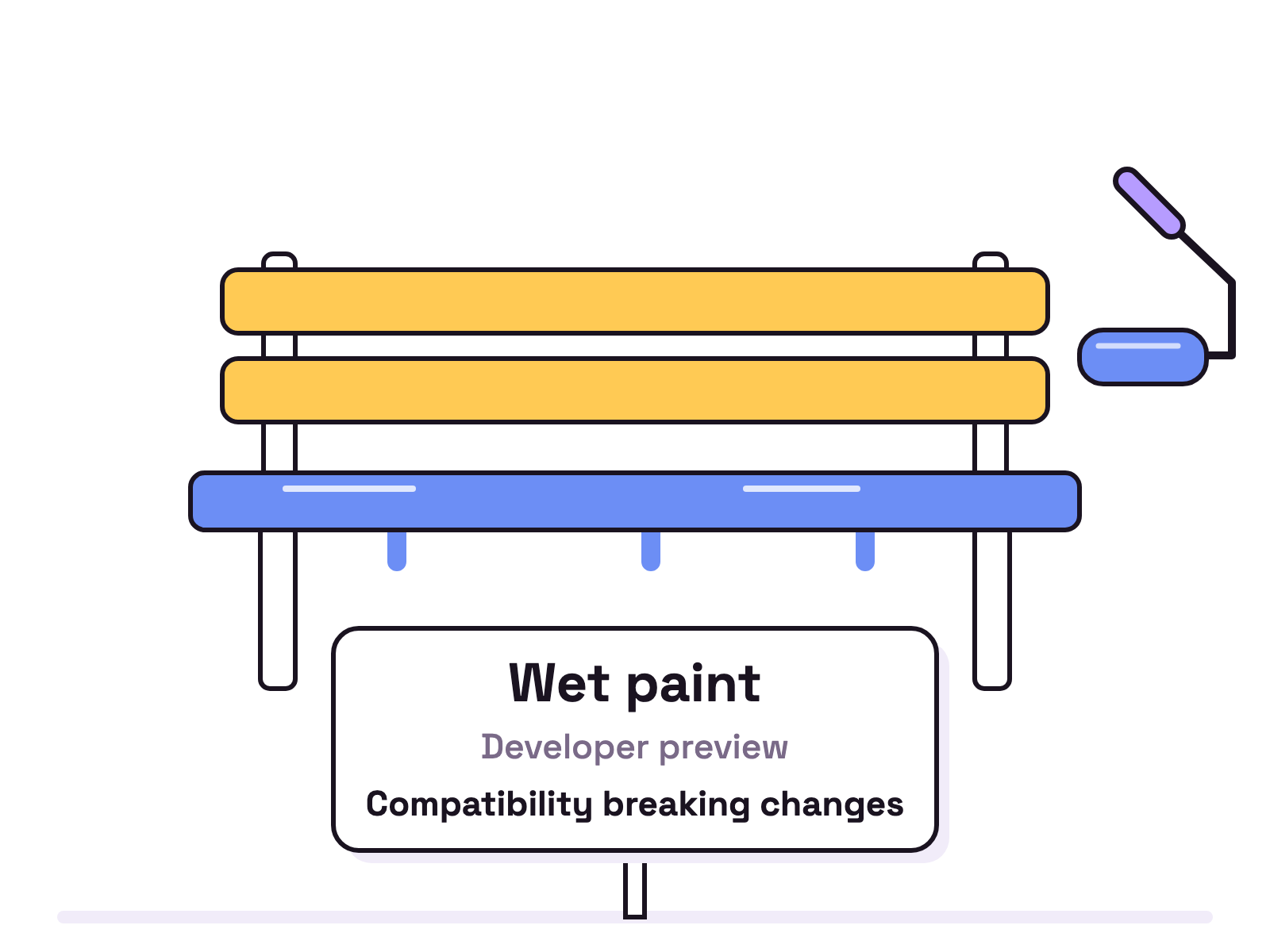
The README says: “DeepSeek Harness is in developer preview and iterating rapidly. THERE WILL BE COMPATIBILITY-BREAKING CHANGES.” READMEs rarely shout, so take that one at its word. The safety notice adds: “It has not undergone a security audit and must not be treated as secure or production-ready.” The newest release, dsh-v0.2.1-rc.5 of 30 Oct 2026, is a prerelease.
The repo showed 268,602 stars on 2 Nov 2026. Stars can rise for reasons other than use, so that number shows attention, not adoption.
What does DeepSeek Harness cost, and which models can it use?
The software is free, you pay for the model, and it is not limited to DeepSeek. Its model guide, read 2 Nov 2026, takes a DeepSeek key first, then provider ids such as anthropic and openai, plus custom APIs in OpenAI or Anthropic formats.
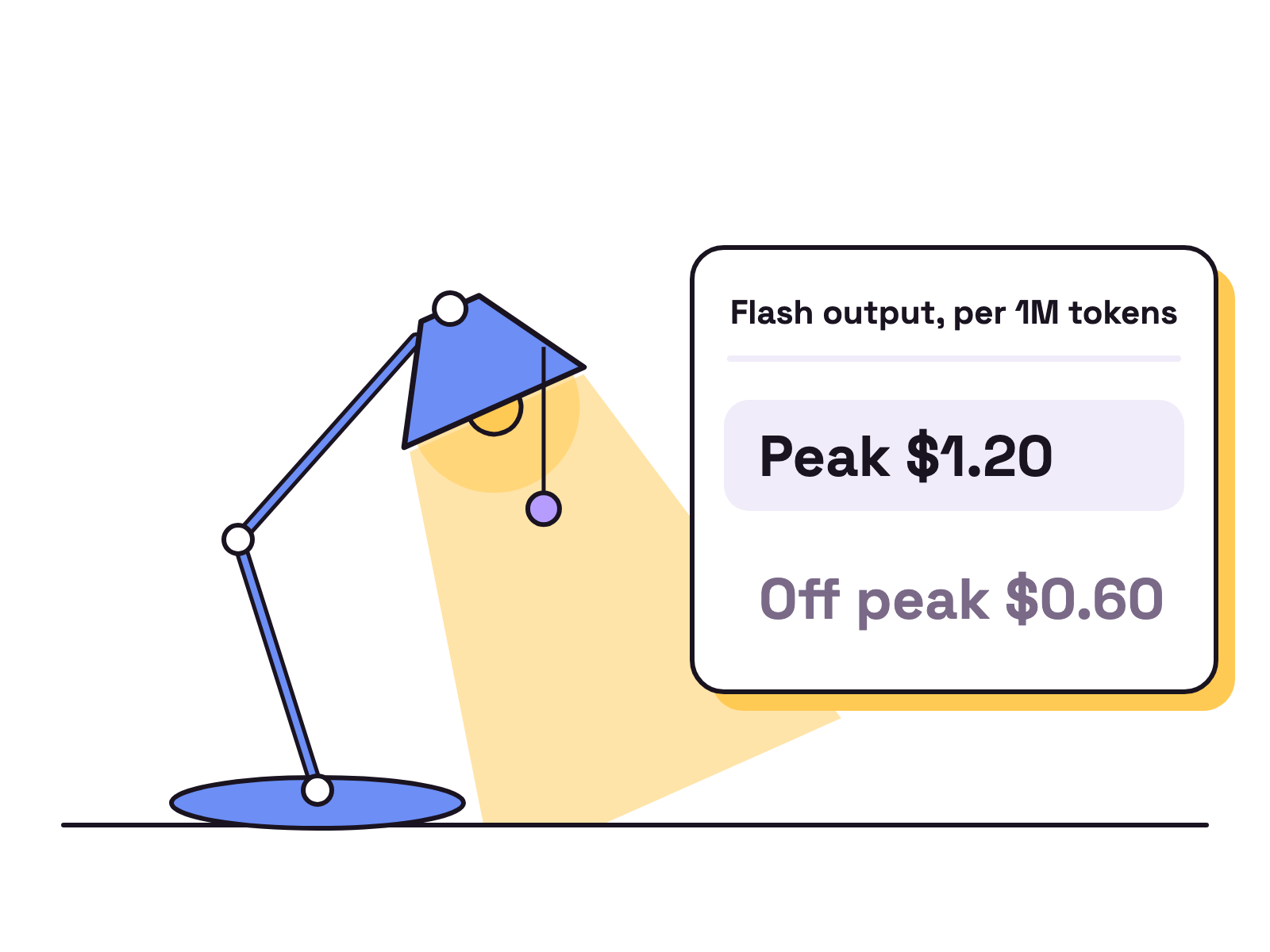
DeepSeek’s pricing page, read 2 Nov 2026, lists peak rates per 1M tokens: deepseek-flash at $0.30 input on a cache miss and $1.20 output, deepseek-v4-pro at $1.32 and $3.96. Off peak rates are half, so Flash output drops to $0.60. Search and Fetch cost $0.75 per 1,000 successful requests, billed from 1 Nov 2026 Beijing time even through DeepSeek Harness.
What are the best DeepSeek Harness alternatives?
Six, sorted by why you would leave. Every page below was read on 2 Nov 2026, and models are in each section.
| Alternative | What it is | Where it runs | Price or licence, 2 Nov 2026 |
|---|---|---|---|
| Claude Code | Anthropic’s coding agent | Terminal, IDE, desktop, web | All rights reserved. Pro from $17 a month. |
| Munder Difflin | A team of AI agents for knowledge work, coding included | Your computer | Free and open source. |
| Codex CLI | OpenAI’s coding agent | Your computer, plus IDE and desktop | Apache 2.0. Plus $20 a month or API pricing. |
| OpenCode | Open source coding agent | Terminal, beta desktop app | MIT. Optional Go $10 a month. |
| Qwen Code | Open source coding agent | Terminal, editor, desktop, browser, chat | Apache 2.0. Provider costs. |
| Pi | Minimal agent harness | Terminal | MIT. Provider costs. |
1. Claude Code: if you want a shipped product
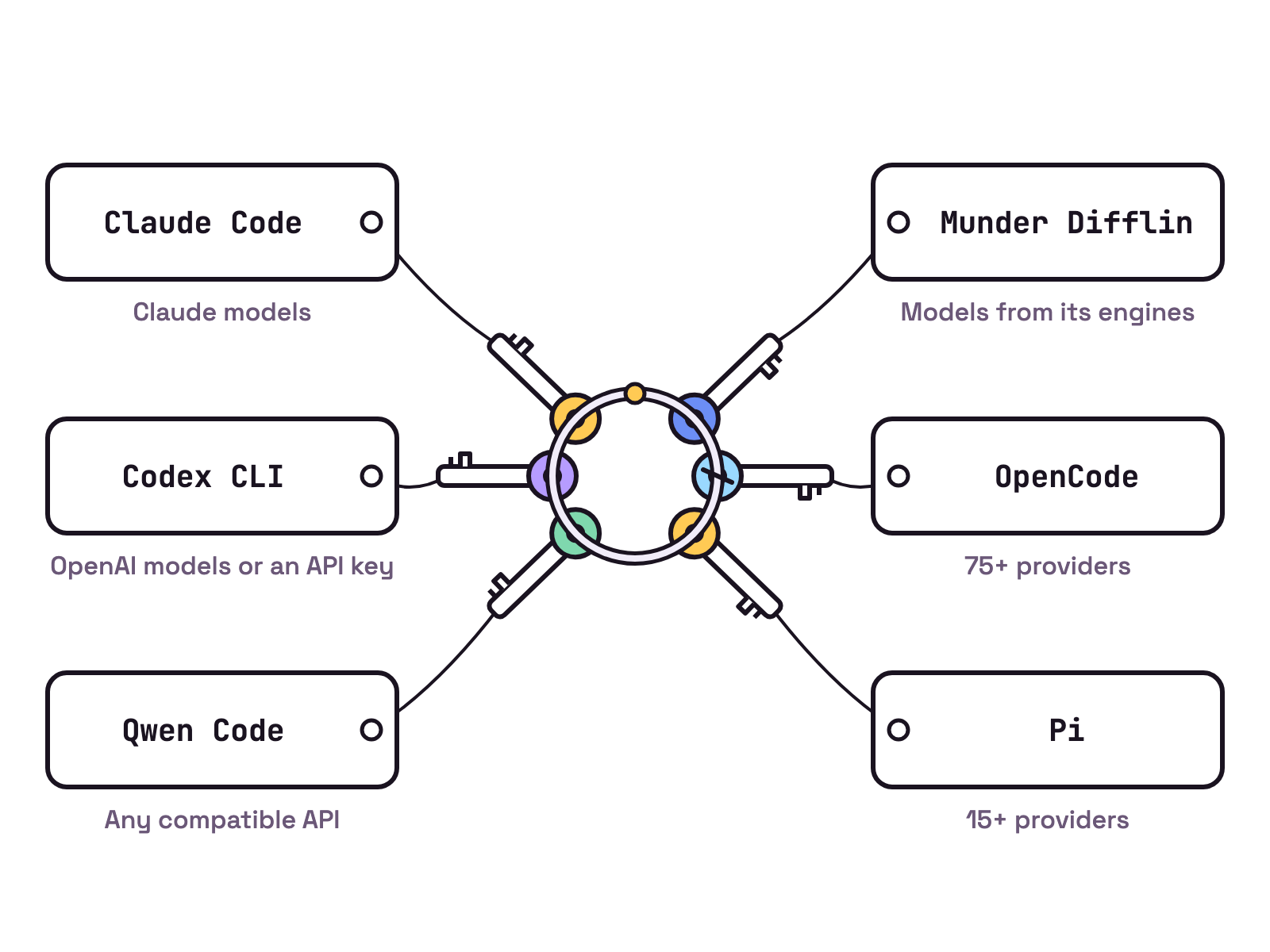
Our view: Claude Code is the pick if the preview warning is why you’re leaving, though you give up open source. Its model docs list Fable, Opus, Sonnet and Haiku, and most of its surfaces need a Claude subscription or Console account.
Anthropic’s pricing page, read 2 Nov 2026, leaves it out of Free and includes it in Pro at $17 a month billed annually or $20 monthly, Max at $100 and Ultra at $200. Pro pays for Fable with usage credits. See what Claude Code costs.
DeepSeek’s Claude Code page shows how to point it at DeepSeek’s API. Anthropic’s gateway docs, same day, say it “doesn’t support routing Claude Code to non-Claude models through any gateway”, so that recipe is DeepSeek’s, not Anthropic’s.
2. Munder Difflin: if you want a team, not one session
Munder Difflin is what we make, and it fits if you want several agents on research, writing, ops and coding. It runs on engines such as Claude Code, Codex and Gemini CLI, so your models depend on the engine you pick. Work comes in from Slack and webhooks, and tools connect through MCP servers, skills and plugins. A Cloud Office and a mobile app are coming soon. The catch: agents run while your computer runs. Setup is in how to install and use Munder Difflin.
3. Codex CLI: if you already pay for ChatGPT
Codex CLI “runs locally on your computer”, per its README, and shipped rust-v0.166.0 on 29 Oct 2026. On OpenAI’s pricing page, read 2 Nov 2026, Free and Go ($8 a month) list GPT-6 Luna in the desktop app, “subject to rollout”. Plus at $20 a month is the first card listing the CLI, with GPT-6.1 Sol and GPT-6 Luna, and Pro starts at $100. With an API key you pay API pricing. DeepSeek’s Codex page has a setup script for its models.
4. OpenCode: if you want open source and any provider
We think OpenCode is the closest swap if you like bringing your own key. It’s MIT licensed and shipped v2.2.5 on 30 Oct 2026. Its providers page says it supports “75+ LLM providers” and local models, and names ChatGPT Plus, GitHub Copilot and GitLab Duo subscriptions. DeepSeek’s page connects it through /connect.
The providers page says of plugins using Pro or Max: “Anthropic explicitly prohibits this.” The v2.2.3 notes of 30 Oct add a Claude Agent provider “to use your Claude Code login and models”. Those are OpenCode’s words. The same notes have a “Breaking changes” section, so leaving a preview doesn’t end those.
5. Qwen Code: if you want open models
Qwen Code’s README says it “Supports OpenAI, Anthropic, Gemini, and Qwen APIs”, plus any third party provider or local model. It’s Apache 2.0 and shipped v0.26.5 on 1 Nov 2026. The README adds: “The framework and the Qwen models are open-source.”
Don’t count on a free tier: the auth docs say Qwen OAuth’s was discontinued on 15 Apr 2026. You use an API key, with DeepSeek among the built in providers, or a plan. Alibaba Cloud’s Coding Plan page, read 2 Nov 2026, lists Pro at $50 a month with limited slots.
6. Pi: if you want less, not more
Pi calls itself “a minimal, extensible agent harness that you can make your own” in its README, and it “skips features like sub-agents and plan mode”. It’s MIT licensed and shipped v1.5.0 on 2 Nov 2026. pi.dev claims “15+ providers, hundreds of models”, DEEPSEEK_API_KEY is on its provider list, and you pay whichever provider you pick. More in what is Pi agent.
When should you stay on DeepSeek Harness?
Stay if you are building on it. DeepSeek’s API docs, read 2 Nov 2026, pitch it to “agent harness developers worldwide”. The safety notice says to “Prefer a disposable virtual machine, container, or dedicated environment.” For the models, see our DeepSeek V4.1 Flash 1017 page.
FAQ
Is DeepSeek Harness free?
The software is free under the MIT License, and you pay for the model you connect. DeepSeek's pricing page, read 2 Nov 2026, lists deepseek-flash at $0.30 per 1M input tokens on a cache miss and $1.20 per 1M output tokens at peak, with off peak rates at half that.
Is DeepSeek Harness ready for production?
No, by its own account. Its safety notice, read 2 Nov 2026, says it "has not undergone a security audit and must not be treated as secure or production-ready." The README also warns that compatibility breaking changes are coming.
Can I use DeepSeek models without DeepSeek Harness?
Yes. DeepSeek's API docs, read 2 Nov 2026, give setups for Claude Code, Codex and OpenCode, and Qwen Code and Pi list DeepSeek as a provider. Anthropic's gateway docs, read the same day, say it doesn't support routing Claude Code to non-Claude models through any gateway, so that recipe is DeepSeek's and not Anthropic's.
Can DeepSeek Harness use Claude or GPT models?
Yes, with an API key. Its model guide, read 2 Nov 2026, lists provider ids such as anthropic and openai, and lets you add a custom API that speaks OpenAI Chat Completions, OpenAI Responses or Anthropic Messages.
What is the best open source alternative to DeepSeek Harness?
Our view: OpenCode, if you want one agent with any provider. Munder Difflin is free and open source too, if you want a team of agents on your computer. Codex CLI, Qwen Code and Pi are open source as well. Claude Code is not. Checked 2 Nov 2026.