AEO for Dev Tools: Getting Cited by ChatGPT and Claude
Answer Engine Optimization for dev tools: how to get cited by ChatGPT, Claude, and Perplexity with the right robots.txt, JSON-LD, and writing patterns.
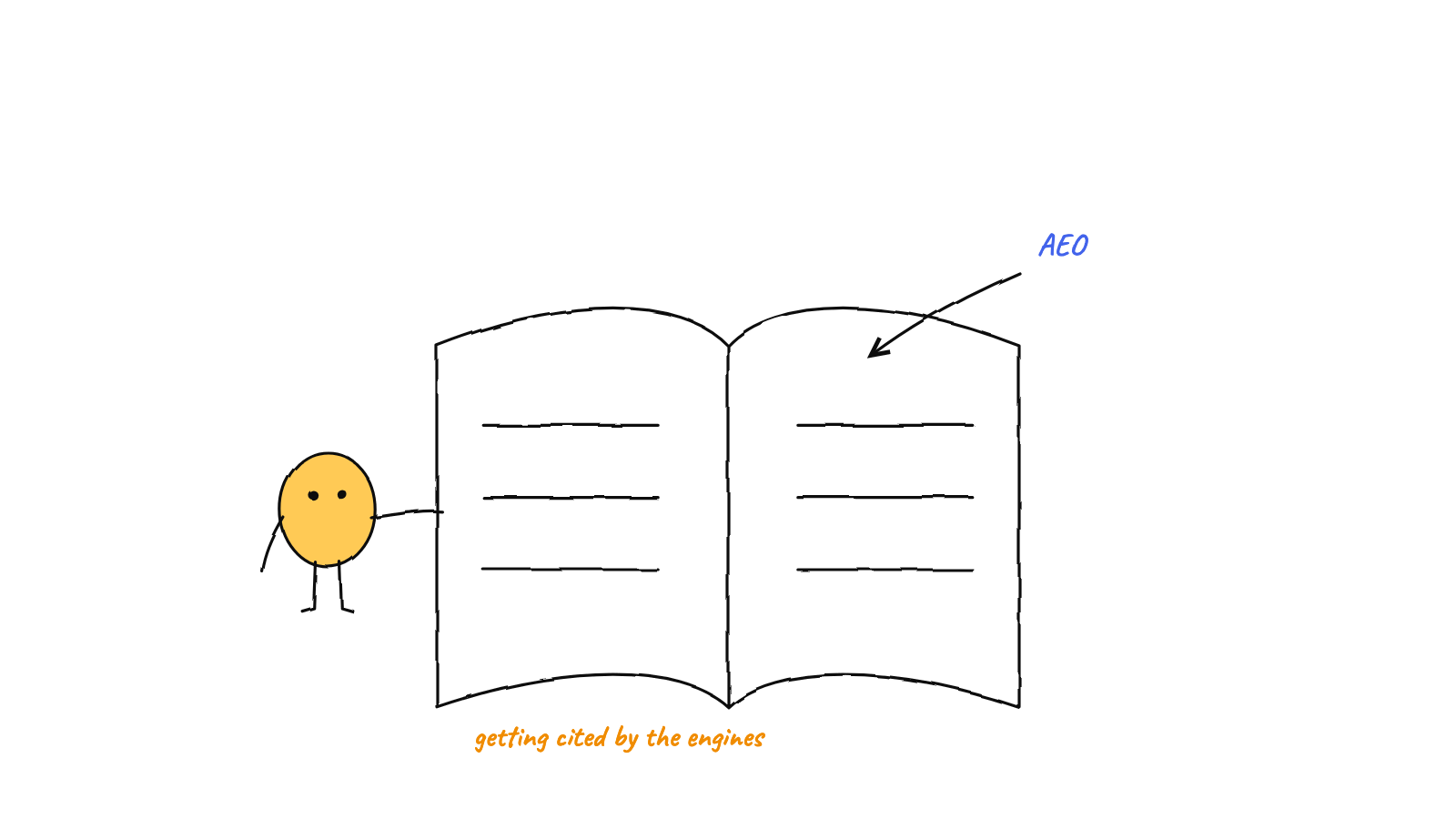
Answer Engine Optimization (AEO) is making your content the thing an AI quotes, not just a page a human clicks. For a developer tool whose users increasingly ask ChatGPT, Claude, and Perplexity "what should I use for X?", being cited in that answer is the new front page. The playbook: answer first, mark it up with JSON-LD, let the AI crawlers in, and be the clearest source on your topic. Here's exactly how we do it for Munder Difflin — copy it.
A growing share of “how do I…” and “what’s the best tool for…” questions never reach a search box anymore. They go to an answer engine — ChatGPT, Claude, Perplexity, Google’s AI Overviews — which reads the web for you and hands back a synthesized answer with a few citations. If your dev tool isn’t in those citations, you’re invisible to the exact developers evaluating tools like yours.
This is the discipline of Answer Engine Optimization (AEO) — sometimes called Generative Engine Optimization (GEO). It overlaps with SEO but optimizes for a different outcome: not a ranked link, but a quoted sentence. This post is the playbook we actually run, with the real config.
AEO vs SEO: a click vs a quote
SEO optimizes a page to rank so a human clicks it. AEO optimizes content to be the source an AI quotes in its answer — often with no click at all. They share foundations (crawlable, fast, well-structured pages) but diverge on intent:
| SEO | AEO | |
|---|---|---|
| Goal | Rank → earn the click | Be the cited source in the answer |
| Unit that wins | The page | The quotable sentence |
| Reader | A human skimming results | An LLM extracting a claim |
| Best content shape | Keyword-targeted long-form | Direct answers + structured facts |
| Win condition | Position 1–3 | “According to Munder Difflin…” |
The good news: you don’t choose between them. AEO is mostly SEO done with a tighter discipline — clearer answers, stronger structure, honest facts. A page that an LLM can confidently quote is also a page Google’s AI Overviews and traditional results reward.
Why dev tools should care more than most
Developer tools sit at the perfect intersection for AEO:
- Your audience already asks LLMs. “Best way to run multiple Claude Code agents?” is a question a developer types into Claude before they type it into Google.
- The questions are answerable. Tool comparisons, definitions, and how-tos have crisp, factual answers — exactly what answer engines like to cite.
- You’re awareness-stage. A new or open-source tool has no brand gravity yet. Getting named in an AI’s answer is the introduction.
That’s why, for an open-source project like Munder Difflin, we treat “get cited by the answer engines” as a first-class distribution channel, not an afterthought.
The AEO playbook (what we actually do)
1. Answer the question in the first sentence
LLMs extract claims, and the easiest claim to extract is a direct, self-contained sentence near the top. Lead with the answer, then explain — the inverted pyramid, not a slow build.
So instead of “There are many ways to think about agent coordination…”, write: “A multi-agent harness is software that wraps the agents you already run and coordinates them with memory, messaging, and orchestration.” That sentence can be lifted verbatim into an answer with your name attached.
Every post we publish opens with a TL;DR and uses bold, quotable one-liners under each heading — see the AI coding agent glossary, which is one quotable definition after another. That structure isn’t decoration; it’s the extraction surface.
2. Mark it up with structured data (JSON-LD)
Structured data tells a machine what the page is without it having to infer. Three schemas do most of the AEO work for a dev tool:
SoftwareApplicationon your homepage — name, description, operating systems, price, license, download URL. This is how an engine knows you’re a free, cross-platform tool.FAQPageon pages with a Q&A block — each question/answer becomes individually quotable and is eligible for “People also ask” surfaces.BlogPosting+BreadcrumbListon articles — author, dates, and section, so the answer engine can attribute and date your claim.
Here’s the shape of the FAQ markup we emit on this very post:
{
  "@context": "https://schema.org",
  "@type": "FAQPage",
  "mainEntity": [{
    "@type": "Question",
    "name": "What is Answer Engine Optimization (AEO)?",
    "acceptedAnswer": {
      "@type": "Answer",
      "text": "AEO is optimizing your content so AI answer engines like ChatGPT, Claude, and Perplexity cite it when they answer a user's question."
    }
  }]
}
Don’t fabricate trust signals. It’s tempting to add
aggregateRatingto yourSoftwareApplicationmarkup. Don’t — inventing review data is self-serving structured-data abuse that Google penalizes, and answer engines increasingly cross-check. Only mark up facts that are true.
3. Let the AI crawlers in
This is the step most teams miss: an answer engine can’t cite a page it was never allowed to read.
Many sites quietly block AI crawlers — and then wonder why they’re never cited. If you want the
citations, explicitly allow the answer-engine bots in robots.txt. This is the exact block we
ship:
User-agent: *
Allow: /

# AI answer engines — explicitly welcome. We WANT to be cited.
User-agent: GPTBot
Allow: /
User-agent: OAI-SearchBot
Allow: /
User-agent: ChatGPT-User
Allow: /
User-agent: PerplexityBot
Allow: /
User-agent: ClaudeBot
Allow: /
User-agent: Google-Extended
Allow: /

Sitemap: https://munderdiffl.in/sitemap.xml
There’s a real tradeoff here, and you should decide it deliberately. Allowing GPTBot,
Google-Extended, and ClaudeBot also permits training use of your content. For an awareness-stage
open-source tool, being discoverable is worth far more than withholding text — so we allow them all.
If avoiding training matters more to you than citations, flip those agents to Disallow: / and accept
that you’re opting out of the answers too. You can’t have the citations without the crawl.
4. Write FAQ blocks with one-sentence answers
A FAQ section does double duty: it’s genuinely useful to readers, and it’s the most quotable format that exists. Each answer should be a single, complete sentence that stands on its own without the question. Our Munder Difflin FAQ is built this way — “Is it free? Yes, it’s free and open source under the MIT license.” is a sentence an engine can quote whole.
5. Be the canonical source on your topic
Answer engines prefer sources that are clear, consistent, and complete. You earn “canonical source” status by:
- Defining your terms. If you coin or popularize a concept (“single-committer pattern,” “GOD orchestrator”), define it crisply and link to it everywhere. Be the page that defines the thing.
- Comparison tables. Engines love structured comparisons because they map directly onto “X vs Y” questions. An honest table beats three paragraphs of prose.
- Consistent entity naming. Use the same product name, the same one-sentence description, and the
same
sameAslinks (your GitHub repo) everywhere. Consistency is how an engine resolves “Munder Difflin” to one entity instead of fragments.
6. Treat your repo and freshness as ranking surfaces — honestly
For a dev tool, your GitHub repo is a ranking surface too: a keyword-led “About” description, a strong
README, and topics all feed the same entity. And keep content fresh — but honestly. Real
lastmod dates and genuine updates help; faking freshness by bumping dates on unchanged pages is the
kind of manipulation that gets discounted. Update when you actually have something new.
How to measure AEO (when there’s no rank tracker)
AEO has no clean “position 3” metric, so measure it directly: ask the engines. On a monthly cadence, ask ChatGPT, Claude, and Perplexity the exact questions your users would ask — “how do I run multiple Claude Code agents?”, “best tool to coordinate AI coding agents?” — and check whether you’re named and whether the description matches what you wrote. When you start seeing your own sentences come back, the playbook is working. Pair that with a weekly glance at search-console impressions for the question-shaped queries.
The one-paragraph version
AEO is SEO with a tighter contract: write a sentence worth quoting, prove what the page is with structured data, let the AI crawlers read it, and be the clearest source on your topic — then verify by asking the engines directly. None of it is exotic; it’s mostly discipline. And it compounds, because the same page that an LLM will confidently cite is the same page a human will trust.
If you want to see these patterns in a real, open codebase, every post on this blog is built to be quotable, and our what is a multi-agent harness explainer is the canonical-source pattern in action.
Munder Difflin is a local, open-source multi-agent harness for Claude Code — and a working example of AEO done in public. Download Munder Difflin to see it run, or read what a multi-agent harness actually is. Free and MIT-licensed.
FAQ
What is Answer Engine Optimization (AEO)?
AEO is optimizing your content so AI answer engines like ChatGPT, Claude, and Perplexity cite it when they answer a user's question — the AI-era successor to ranking in Google's blue links.
How is AEO different from SEO?
SEO optimizes a page to rank so a human clicks it; AEO optimizes content to be the source an AI quotes in its synthesized answer, often with no click at all.
How do I get my dev tool cited by ChatGPT and Claude?
Answer the question in the first sentence, mark it up with FAQPage and SoftwareApplication JSON-LD, let AI crawlers like GPTBot and ClaudeBot into your robots.txt, and be the clearest canonical source on your topic.
Should I block AI crawlers in robots.txt?
If you want citations, no — blocking GPTBot, ClaudeBot, or Google-Extended removes you from the answers; only block them if avoiding training use matters more than being discovered.