The AI Coding Agent Glossary: Harness, Orchestrator, Hive, Subagent
Plain-English definitions of the AI coding agent terms everyone trips over — harness, orchestrator, hive, subagent, agent memory — each in one line.
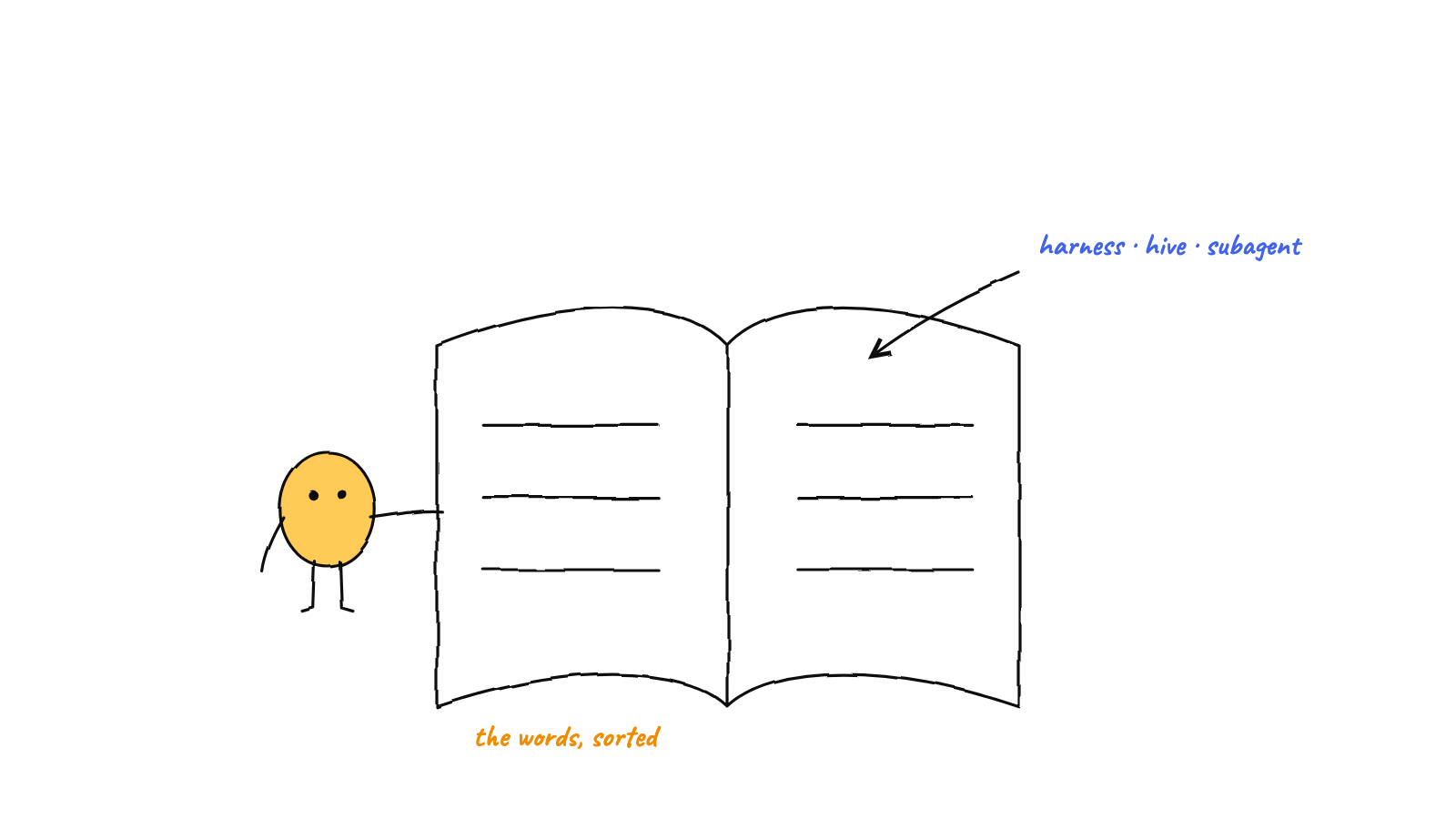
The agent world is thick with jargon — harness, orchestrator, hive, subagent, agent memory. Here's each term in one quotable line, so you can read (and write) about multi-agent AI without tripping. Bookmark it.
Every fast-moving field grows its own vocabulary, and AI coding agents have grown a lot of it fast. This is a snackable reference: each term defined in a sentence you could quote, with a link out when there’s more to say.
Core building blocks
Agent
An agent is a running AI session with a goal and tools — it reads, acts, and repeats in a loop until the task is done. In practice, each Claude Code session is an agent.
Subagent
A subagent is a short-lived helper an agent spawns inside its own run to fan out a piece of work. Great for parallelism within one task; it doesn’t persist or share memory across your whole workflow.
Tool
A tool is a capability an agent can call — read a file, run a command, search the web. Tools are what let an agent do things instead of just talk.
The coordination layer
Harness
A harness is the software that wraps the agents you already run and coordinates them — roles, messaging, memory, orchestration, and visibility. It’s the layer that turns several sessions into a team. More: what is a multi-agent harness.
Framework
A framework is a library you build an agent application with, from scratch (LangGraph, CrewAI, AutoGen). A harness wraps agents you have; a framework is how you’d build one.
Orchestrator
An orchestrator is the coordinator that decomposes your intent and routes work to the right agents, escalating only the critical decisions. In Munder Difflin it’s the GOD agent you talk to in plain language.
Hive
A hive is a coordinated group of agents that share memory and message each other, acting as one team. It’s the running “office” a harness manages.
Memory & messaging
Agent (long-term) memory
Long-term memory is durable storage an agent reads on startup and writes to as it learns, so knowledge survives between sessions. Without it, agents start cold every run — see how to give Claude Code long-term memory.
Semantic memory
Semantic memory lets an agent recall notes by meaning rather than filename — embed the notes, fetch the few most relevant. It’s what keeps recall instant as the knowledge base grows.
Mailbox / inter-agent messaging
A mailbox lets one agent hand a message or result to another directly, instead of routing through you. It’s how a hive coordinates without a human courier.
Workflow patterns
Git worktree
A git worktree is a separate working copy of one repo, so parallel agents edit isolated checkouts and don’t clobber each other. A common foundation for running agents in parallel.
Human-in-the-loop
Human-in-the-loop means the system pauses for your approval on the decisions that matter — spend, destructive actions, scope — and runs autonomously otherwise.
Local-first
Local-first means the harness, agents, and memory run on your own machine, for privacy, predictable cost, and offline capability — why that matters.
Putting it together
In one sentence using all of it: a harness runs a hive of agents (each its own loop with tools), gives them shared semantic memory and mailboxes, and lets an orchestrator route work — local-first, with a human in the loop for the critical calls.
If any term sparked a “wait, which tool does that?”, the roundup of multi-agent Claude Code tools maps the vocabulary onto real software.
Munder Difflin is a harness, a hive, an orchestrator, and shared memory in one local app. Download Munder Difflin to see the glossary come to life — free and open source.
FAQ
What's the difference between an agent harness and an agent framework?
A framework (LangGraph, CrewAI) is a library you build an agent application with from scratch. A harness wraps agents you already run — like Claude Code sessions — and adds coordination on top, without rebuilding the agent.
What's the difference between an orchestrator and a harness?
A harness is the whole coordination layer — memory, messaging, visibility, and routing. An orchestrator is one part of it: the coordinator that decomposes intent and routes work to the right agents.
What is a hive of agents?
A hive is a coordinated group of agents that share memory and message each other, behaving as one team rather than isolated sessions. It's the running 'team' a harness manages.