The Newline That Silenced Every Windows Agent
A cmd.exe parsing rule from the 1980s meant Windows agents received exactly one line of their multi-line startup protocol — and nothing errored. The anatomy of our worst silent failure, and the fix.
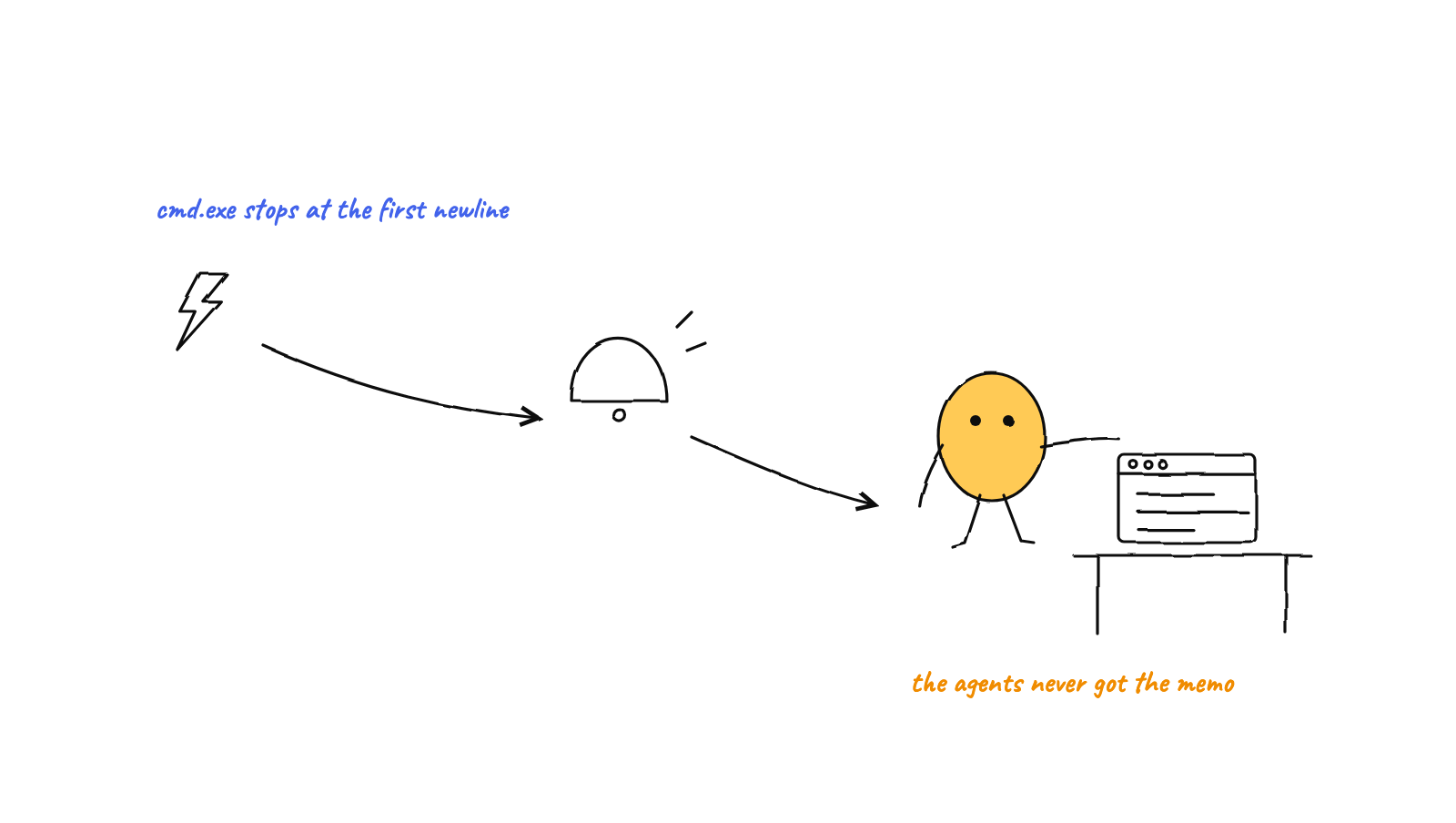
Windows agents booted, rendered, and
answered prompts — while never sending or receiving a single message. The cause: npm installs
CLIs as .cmd shims, .cmd files must run through cmd.exe,
and cmd.exe truncates an argument at its first newline. Our startup protocol is
multi-line. Every Windows agent got line one and lost the rest. Here's the full anatomy, because
this bug class is hiding in more codebases than ours.
A huge share of the people who install Munder Difflin do it on Windows. For an uncomfortably long time, the core of the product — agents talking to each other — did not work for those users, and neither they nor we could tell. This is the autopsy.
The setup
When Munder Difflin spawns an agent, it passes the hive protocol as a command-line argument
to the engine CLI: a multi-line block that names the agent, points at its inbox/ and
outbox/ folders, explains the file-mailbox rules,
and tells it where its memory lives. One argument, many lines. On POSIX systems this is
completely unremarkable — argv entries can contain any byte except NUL, and newlines ride along
happily.
The three-layer trap
Layer one: npm shims. On Windows, npm install -g doesn’t put a real executable on your
PATH. It writes a .cmd batch shim that locates node and runs the actual JS entry point.
Layer two: CreateProcess. A .cmd is not a PE executable, so it can’t be the target of
CreateProcess directly. Node’s child_process (and everything built on it) handles this by
silently rewriting your spawn into cmd.exe /d /s /c "your command here".
Layer three: cmd.exe. And cmd.exe, parsing that command string with rules essentially unchanged since DOS, stops at the first newline. Everything after it isn’t escaped or mangled — it’s simply gone.

Stack the layers and you get: a multi-line protocol enters the spawn, and a one-line protocol arrives at the agent. Deterministically. On every Windows machine. With zero errors.
Why it was invisible
Here’s what made this bug expensive: every observable signal said healthy.
The process spawned — exit code irrelevant, it’s a long-running CLI. The agent’s terminal rendered in the app and responded to typing. The engine received a prompt (line one: something like “You are an autonomous agent in a collaborating hive”), which is coherent enough that the agent behaved plausibly. It just never mentioned inboxes, because it had never heard of them.
From the floor’s perspective, Windows agents were simply… quiet. And “the agent didn’t happen to send mail” is indistinguishable from “the agent cannot send mail” unless you go looking. No log line existed to catch, because truncation isn’t a failure — cmd.exe was working as documented. The documentation is just from 1987.
The fix: refuse the middleman
The fix is conceptually simple: never let a prompt-carrying spawn touch cmd.exe. The spawner
now opens the .cmd shim, decodes what it actually points at — npm shims are formulaic — and
launches the real interpreter directly: node.exe C:\...\cli.js --args, passed as an argv
array, which goes through CreateProcess with the multi-line argument intact.
Then reality added a second chapter, as it does. OpenCode’s npm package ships a compiled binary, so npm writes an interpreter-less shim the decoder didn’t model — it returned null for every Windows OpenCode install and fell back to the truncating path. That’s the 0.4.4 follow-up: direct-executable shims are handled, and — the real lesson — the fallback is no longer silent. If the decoder meets a shim it can’t parse, it logs exactly what it couldn’t decode. The next variant of this bug will announce itself.
The takeaways we actually wrote down
- A fallback that doesn’t log is a bug with a delay timer. The first fix’s silent fallback is why the OpenCode variant survived a release.
- “Nothing errored” is a claim, not evidence. The failure mode of dropping part of an input is nastier than crashing, because every health check you own passes. Our auto-update postmortem is the same lesson wearing a different coat.
- Test the platform’s spawn path, not your code’s intent. Our protocol handling was correct on every platform. The three layers underneath it were not ours — and the user doesn’t care whose layer it was.
If you’re building anything that passes structured prompts to CLIs on Windows —
hooks, harnesses, wrappers — go check what your spawns do when
the target is a .cmd. We’ll wait. It’s probably ten minutes and one very bad surprise.
FAQ
Why did agent messaging fail only on Windows?
On macOS and Linux, the multi-line hive protocol passes to the engine binary as one argv entry, newlines intact. On Windows, npm installs CLIs as .cmd shims, which can't go directly to CreateProcess — so the spawn ran through cmd.exe, and cmd.exe cuts an argument at its first newline. The agent got line one of its job description and nothing else.
Why didn't anything error?
Because nothing failed by any definition the code knew. The process spawned, the engine started, the agent answered prompts. The only casualty was the text after the first newline — which happened to contain everything about inboxes, outboxes, and memory. Truncation isn't an error; it's just less.
How was it fixed?
The spawner now reads the .cmd shim, extracts the real interpreter and script it points at, and launches that directly with an argv array — no cmd.exe in the path. A follow-up handled npm's interpreter-less shims for compiled binaries like OpenCode's. Anything undecodable falls back to the old path, but now logs what it couldn't decode.