The Clone Army Is a Trap: Why a Mixed Swarm Beats Ten Identical Agents
Spinning up tens of identical top-tier CLI agents feels powerful and burns tokens on work a cheaper agent could do. A mixed-capability swarm with shared memory wins on cost — and often on quality.
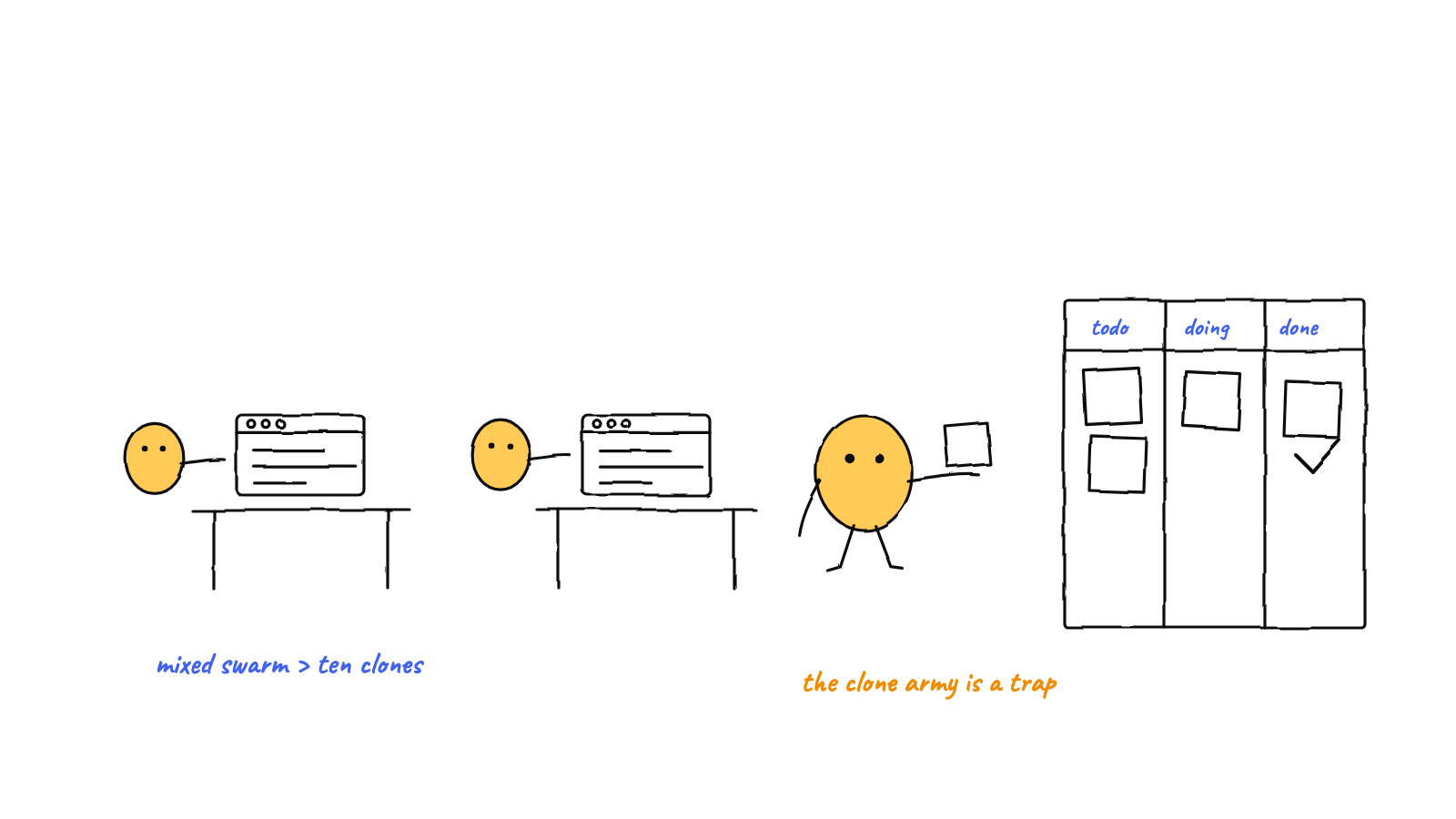
Throwing tens of identical top-tier CLI agents at a problem feels like brute-forcing your way to a great answer. It's mostly brute-forcing your way to a big bill. Real tasks are a mix of cheap and hard subtasks, and a clone army pays frontier prices for the cheap majority — while quietly re-deriving the same context N times and colliding with itself because no one owns the plan. A mixed-capability swarm — an orchestrator routing each subtask to the right tier, shared memory so nobody re-derives context, scoped contracts, and real parallelism — gets comparable or better results at a fraction of the tokens. The lever is specialization, delegation, and shared state — not horsepower applied uniformly.
There’s a seductive move when a problem looks big: spin up more of the best agent. Ten identical top-tier CLI agents, all on the frontier model, all pointed at the same repo. It looks like a force multiplier. It feels safe — every agent is maximally capable, so surely the swarm is too.
It’s a trap. Not because the agents are bad, but because the shape of the work doesn’t reward sameness. We’ve argued before that a hive shouldn’t all run the biggest model and laid out the five levers that cut a fleet’s bill. This post is the head-to-head those posts imply: the clone army versus the mixed swarm — why uniform top-tier agents burn tokens on work a cheaper agent could do, and why a swarm of mixed-capability agents is both leaner and, surprisingly often, better.
Most tasks are not uniform — they’re lumpy
Pick any real job an agent team gets handed. “Add this feature.” “Audit this codebase.” “Triage these issues.” Now look inside it. You’ll find a handful of genuinely hard subtasks — the architecture call, the subtle bug, the ambiguous spec that needs judgment — surrounded by a much larger pile of routine ones: reading files, reformatting, renaming, classifying, summarizing logs, writing boilerplate tests, checking a convention.
That lumpiness is the whole game. The hard subtasks genuinely reward a frontier model. The routine ones don’t — a small, fast model does them just as well. So when you run every agent on the top tier, you’re not buying ten units of capability. You’re buying one unit of capability you needed and nine units you’re paying frontier prices for routine work you’d have gotten for a tenth the cost. The capability you bought on the easy subtasks was never the bottleneck.
The clone army’s three hidden taxes
The per-token waste is the obvious cost. The structural ones are worse.
Tax 1 — Re-derivation. Ten identical agents with no shared state each rebuild the same understanding from scratch. Each one reads the same files, re-infers the same architecture, re-discovers the same constraint that “auth lives in the middleware layer.” That context-building is real tokens, paid N times, to arrive at knowledge one agent already had. Without shared memory, the swarm is N strangers who refuse to talk.
Tax 2 — Collision. Identical agents with no owner have no division of labor. Two of them pick the same subtask; a third refactors a file a fourth is mid-edit on; their outputs contradict and someone (you) has to reconcile them. A leaderless clone army doesn’t parallelize a problem — it parallelizes confusion, and then you pay again to merge it. This is exactly the coordinate-without-colliding problem, made worse by sameness: when every agent is interchangeable, nothing tells them who does what.
Tax 3 — No escalation ceiling, no floor. Because every agent is already maxed out, there’s nowhere to escalate a truly nasty subtask (everyone’s already on the best model) and nowhere to de-escalate the easy follow-ups (everyone stays expensive). You’ve flattened the one dimension that lets a team be efficient: the ability to spend big where it matters and small where it doesn’t.
So the clone army’s bill isn’t “10× one agent.” It’s 10× plus re-derivation plus collision-cleanup — for a result that a smaller, better-organized team would have produced with less drama.

What a mixed swarm does differently
A mixed-capability swarm isn’t “the same idea, but cheaper agents.” It’s a different structure, and the structure is where the wins come from.
- An orchestrator that routes by tier. Instead of ten peers, you have one lead that sees the whole job, decomposes it, and sends each subtask to the right capability tier: routine work to fast cheap workers, the hard reasoning to a frontier worker, and itself reserved for planning and integration. The expensive model still does the expensive thinking — it just stops doing the cheap thinking.
- Shared memory so nobody re-derives. The context one agent establishes — the architecture, the decision, the gotcha — is written once to a shared board and read by everyone. Re-derivation tax: gone. This is why a hive leans on compact, markdown-first memory and semantic recall instead of stuffing the whole world into ten separate context windows.
- Scoped contracts. Each worker gets a narrow assignment with a clear input and expected output — not the whole problem. Narrow scope means a small model can handle it, the context window stays tiny (so the per-turn cost you pay N times stays small), and there’s no ambiguity about who owns what. Collision tax: gone.
- Real parallelism, not redundant parallelism. The independent subtasks run at once because the orchestrator knows they’re independent — a genuine fan-out, not ten agents racing to do the same thing.
Specialization, delegation, shared state. That’s the lever. Each one removes a tax the clone army pays.
“But is it as capable?”
Here’s the part that surprises people: the mixed swarm often produces better output, not just cheaper.
Two reasons. First, a clean division of labor beats raw horsepower applied uniformly — the same reason a real team doesn’t put its most senior engineer on every ticket. A frontier agent that’s only doing hard reasoning, with the routine noise handled elsewhere, is a frontier agent that isn’t drowning the hard problem in busywork. You concentrate capability where it changes the outcome.
Second, the structure adds a quality dimension the clone army lacks: you can route risky output through a maker-checker pass — a cheap worker produces, a stronger agent verifies — which catches more than ten parallel agents independently being confident. Capability isn’t just the model; it’s the organization around the model.
The honest caveat — and we keep this one honest — is that quality drops the moment you route a genuinely hard subtask to a model that can’t handle it. But that’s a routing mistake, not a swarm one. Default lean, escalate the hard minority on signal, and the capability gap to an all-premium fleet closes to roughly nothing — at a fraction of the tokens.

What “fraction of the tokens” actually means
We won’t fabricate a benchmark number, but the direction is not subtle, and it comes from three multiplying sources. The price gap between a small and a frontier model is large per token. The routine subtasks vastly outnumber the hard ones in most workloads. And shared memory plus scoped contracts erase the re-derivation and collision the clone army pays on top. Multiply those together and the mixed swarm isn’t a little cheaper — it’s categorically cheaper, for output that holds up. The real denominator is cost per completed task, and a leaderless clone army that needs a human to merge its contradictions isn’t cheap on that measure at all.
How Munder Difflin is built around this
This isn’t just a thesis — it’s the architecture of the product. Munder Difflin runs a virtual office where a god orchestrator decomposes your intent and delegates to Office-themed worker agents of varying capability. The cheap workers handle the routine; the orchestrator and any escalated workers handle the hard reasoning — per-agent model selection is a real setting, not advice. A shared board, inboxes, and memory mean no agent re-derives what another already established. And a token budget with a steward model keeps the whole swarm inside a spend ceiling you set — so the structure that makes it efficient is also the structure that makes the cost predictable. It supports Claude Code, Codex, and Antigravity CLIs, runs local-first, and you can watch every agent work.
The bottom line
The clone army feels powerful because every soldier is elite. But a problem isn’t won by ten identical elites re-deriving the same context and stepping on each other — it’s won by the right capability on each subtask, a shared brain so nobody repeats anyone, and a lead who owns the plan. A mixed-capability swarm is leaner because it stops paying frontier prices for routine work, and it’s often better because specialization and delegation beat undifferentiated horsepower. Don’t buy more of the best agent. Build a team out of the right ones.
Want to run a swarm that routes by capability instead of brute-forcing with clones? Download Munder Difflin — a local, 24/7 virtual office of AI agents. It’s free and open source.
FAQ
Why not just run tens of identical top-tier agents on a problem?
Because most tasks are a mix of cheap and hard subtasks, and identical premium agents pay frontier prices for the cheap majority too. You also pay a hidden tax: identical agents with no shared state each re-derive the same context, and without an owner they duplicate work and collide. You get a big bill for redundant effort, not more capability.
Is a mixed-capability swarm actually as capable as an all-premium fleet?
On most real workloads, yes — and sometimes more, because specialization and a clean division of labor beat raw horsepower applied uniformly. The frontier model still does the hard reasoning; it just isn't wasted on formatting and lookups. Quality only drops if you route a genuinely hard task to a model that can't handle it, which is a routing mistake, not a swarm one.
What makes a swarm token-efficient rather than just cheaper per agent?
Three structural things: an orchestrator that routes each subtask to the right capability tier, shared memory so no agent re-derives context that another already established, and scoped contracts so each agent carries only what its task needs. Specialization plus delegation plus shared state is the lever — not the per-token price of any one model.
Doesn't an orchestrator add overhead that eats the savings?
It adds a little — one premium agent reasoning about the whole job — but it removes far more: the redundant re-derivation, the colliding work, and the frontier-priced busywork that a leaderless clone army generates. The orchestrator's cost is a fixed overhead; the savings scale with every routine subtask it routes away from the expensive tier.